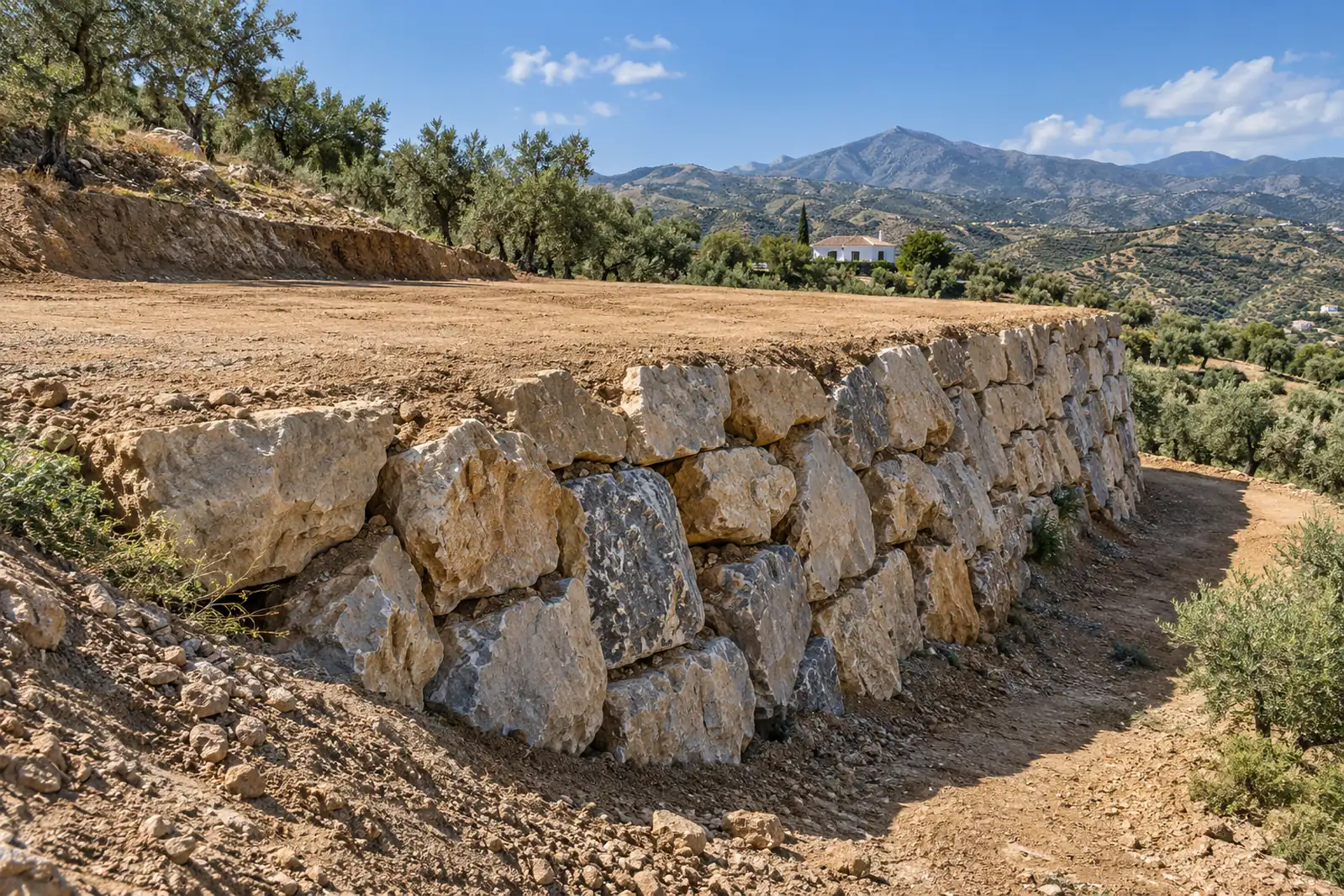
Escollera Rock Walls in Málaga, the Axarquía and the Granada coast
We build natural stone escollera retaining walls to hold back banks, gain usable land and protect farms, plots and tracks. Our own crew and machinery, from Málaga city to Nerja and from the Guadalhorce to La Cala de Mijas. From €100/m² + VAT, with a fixed quote after our technician's visit.
- 5,0 ★ on Google
- Since 2006 building escollera walls
- Our own machinery and quarry used by our own crew
- Fixed quote and in writing
Quick answer: MURES builds escollera rock retaining walls in Málaga and the Axarquía, with our own machinery and crew, based in Vélez-Málaga. We hold back slopes, create flat land and protect plots, from €100 per square metre plus VAT. Building escollera walls since 2006.
What is an escollera wall and what is it used for?
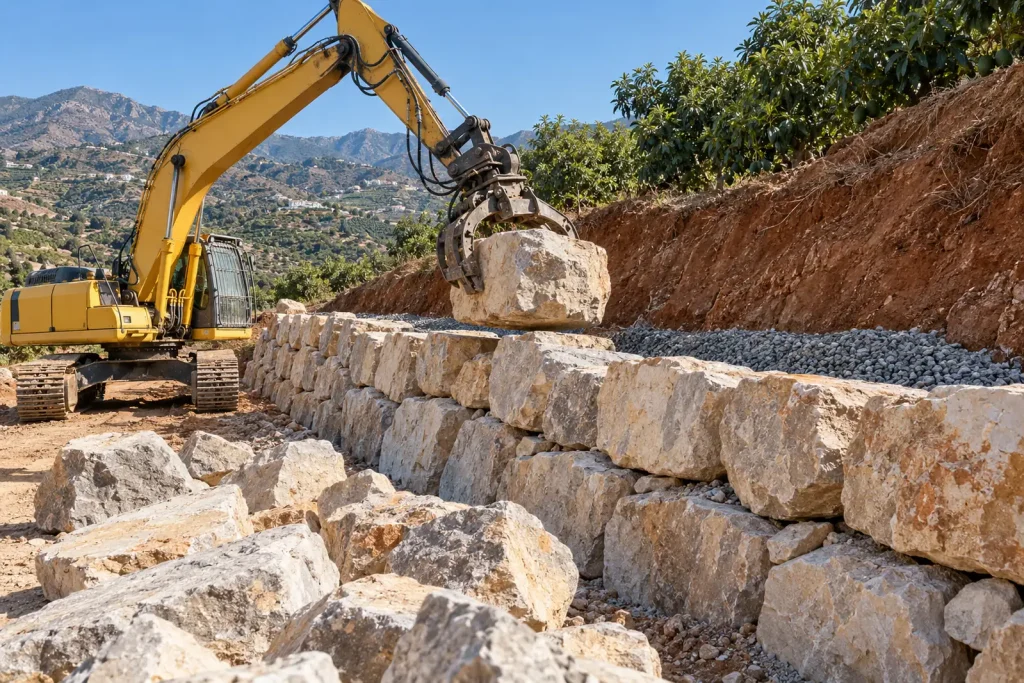
An escollera wall is a retaining wall built from large blocks of natural rock, from 100 kg to over a tonne, placed one by one by machine so they lock together. It holds the soil back by its own weight and lets water through, which is why it lasts for decades on slopes, farms and tracks.
It's the most widely used solution in Málaga for retaining soil on sloping ground, preventing hillside landslips, creating terraces and flat platforms, and protecting tracks and stream banks from erosion. Unlike a concrete wall, it needs no formwork, adapts to irregular ground and blends into the landscape.
At MURES we've been building escollera walls across the province since 2006, handling the excavation, earthworks and stone haulage with our own teams.
What is it used for?
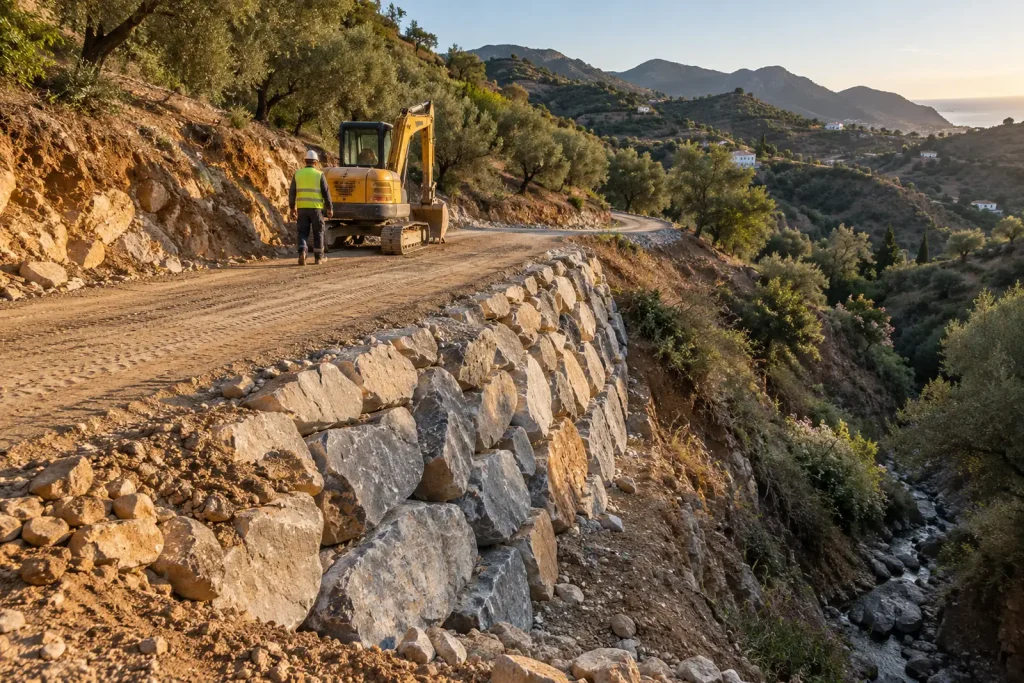
Advantages of escollera walls over other systems
Escollera isn't always the answer, but on farms, slopes and tracks in Málaga it's usually the strongest and the one that ages best. This is how it compares:
| Escollera | Reinforced concrete | Stone masonry | Gabions | |
|---|---|---|---|---|
| Lets water through | Yes, it's free-draining | Needs weep holes and drainage | Depends on the mortar | Yes |
| Adapts to the ground | Very well | Not much | Well | Well |
| Appearance | Natural, rustic | Grey, smooth | Exposed stone, very neat | Wire mesh cages |
| Speed of construction | High | Medium (formwork and curing) | Low (by hand) | High |
| Typical height | Up to 4–6 m in tiers | Whatever the calculation allows | Up to 2–3 m | Up to 4–5 m |
| At MURES | Yes | Yes | Yes | We don't build them |
Need a different solution? See our concrete walls, plus the stone masonry and dry stone walls or our guide to retaining walls. We don't build gabion walls.
Types of escollera walls we build
The type of escollera depends on the height, the ground, the access and the budget. These are the ones we build most in Málaga:
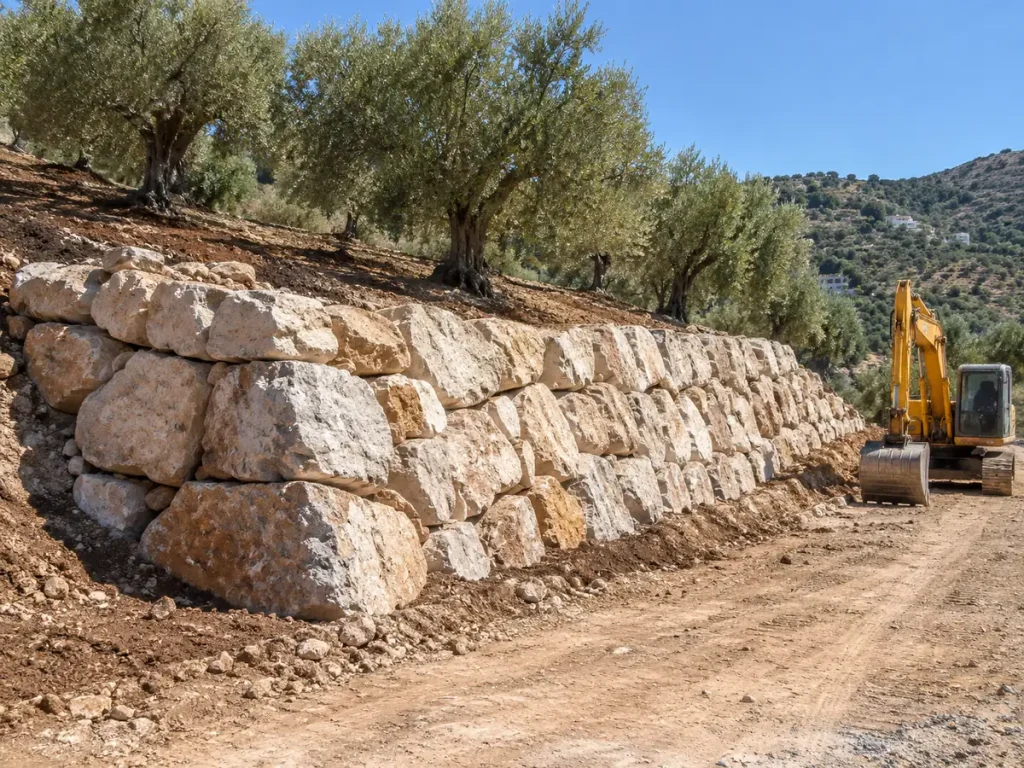
Dry-laid escollera
Rock blocks placed with a grab, without mortar, locked together. It's free-draining and flexible: if the ground moves slightly, the wall moves with it. The most common option on farms and slopes.
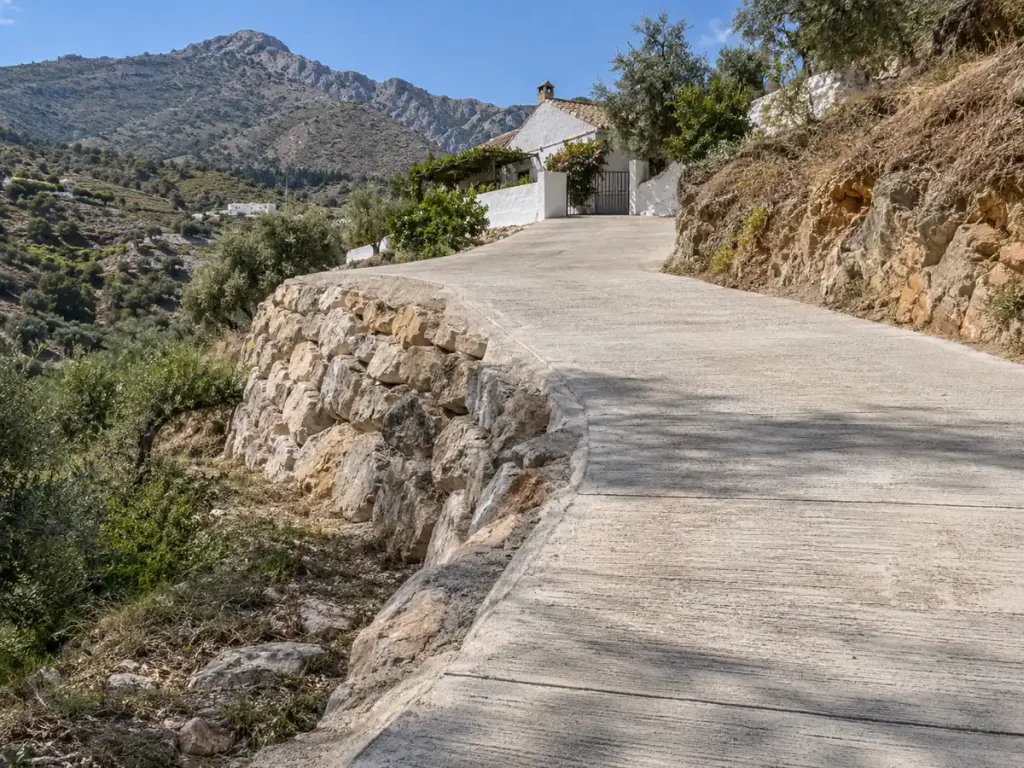
Concrete-bedded escollera
The gaps between blocks are filled with concrete to lock the stone. Used for taller walls, next to roads or when there's little space for the base. Always with drainage behind.
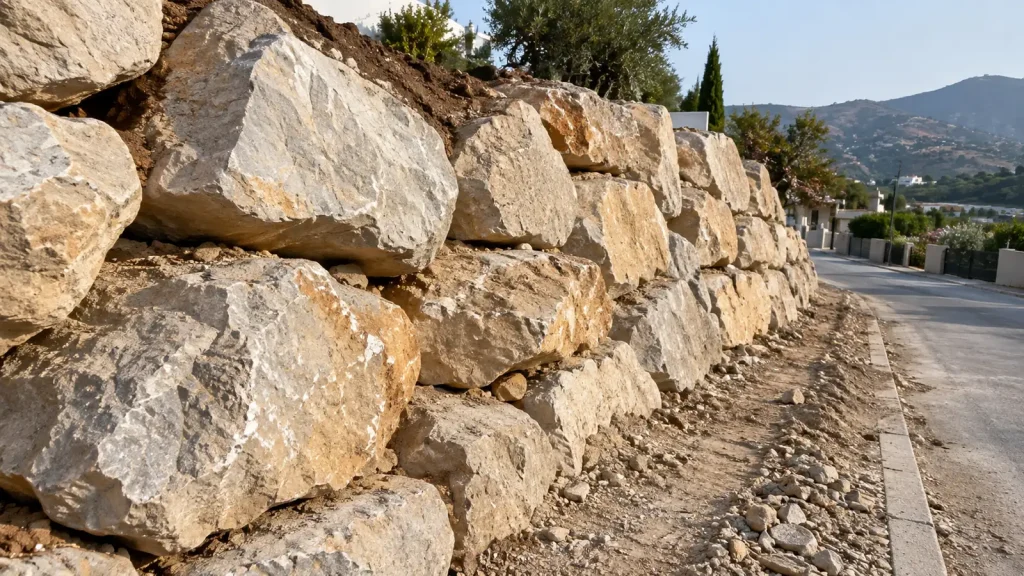
Quarried block escollera
Quarry blocks with flatter faces that give a neater wall. It's better value on the western Costa del Sol, near the quarries; in the Axarquía, haulage makes it more expensive.
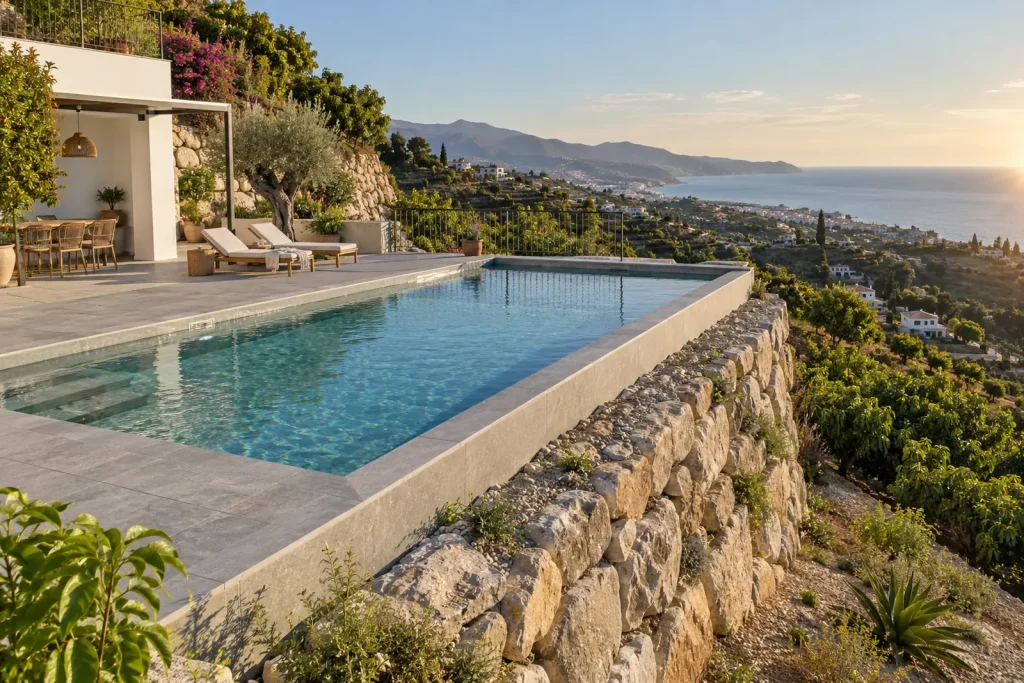
Steps, ramps and finishing touches
Stone steps between terraces, access ramps, planters in the wall and capping. Built at the same time as the wall so everything blends in.
Escollera stone: sizes, weights and origin
Escollera stone is classified by weight. The higher the wall and the more the soil pushes, the heavier the blocks need to be, especially at the base. On each job we decide the stone size according to the wall: a 1-metre wall is not the same as a 6-metre one, and the base always takes the biggest stones. As a guide:
| Block weight | What for | Guide height |
|---|---|---|
| 50 – 100 kg | Low garden walls and stone edging | Up to 0.8 m |
| 100 – 300 kg | Low terraces, planters, track edges | Up to 1.5 m |
| 300 – 600 kg | Plot slopes, platforms for a house or pool | 1.5 – 3 m |
| 600 – 1,000 kg | High farm walls, access roads and tracks | 2.5 – 4 m |
| Over 1,000 kg | Large walls, base of high walls, watercourses | Over 4 m, in tiers |
For guidance only: the maximum height is set by the ground survey, not the table.
Quarried block or local stone
Quarried block stone comes from quarries on the western Costa del Sol and gives a more regular wall. Between Málaga and La Cala de Mijas it's well priced; in the Axarquía, bringing it so far pushes the cost up a lot. That's why there we usually use rustic stone from nearby quarries, which also matches the old walls in the area.
Is it bought by m³ or by the tonne?
The stone is bought by the tonne. One cubic metre of placed escollera contains, depending on block size, about 1.6 to 1.9 tonnes of stone.
Comparing companies? Read how to choose an escollera retaining wall company in Málaga: 8 things to check.
Escollera wall prices: how much does it cost per square metre?
The price of an escollera wall is calculated per square metre of exposed face (length × height). We give you the real guide figure, but the fixed price is always given by our technician after seeing the land (work out your case on our escollera wall price per m²):
Escollera wall in Málaga
from €100/m² + VAT
That's the starting price for jobs with good access, stone nearby and little earthmoving. The final price depends on the factors on the right and is given by the technician after seeing the land.
Work out the starting price of your wall
Minimum guide price, at €100/m². Doesn't include difficult access, large stone or earthworks. The fixed quote is always given after the technician's visit.
Request a technician's visitWhat changes the price
ACCESSWhether the machine and lorry can reach the wall, or a track has to be opened, small machinery used or the stone moved several times.
HEIGHTThe higher the wall, the bigger the blocks, the wider the base and the deeper the foundation.
STONEQuarried block or rustic, block size and distance from the quarry to your site.
EARTHHow much needs excavating, filling or removing in front of and behind the wall.
DRAINAGEGeotextile, gravel and drainage pipe behind the wall, depending on groundwater.
FINISHINGStone steps, ramps, planters, railings or capping.
Why does a technician always visit? Because two walls of the same size can cost twice as much as each other: access, soil type, water and available stone can only be seen on site. That way, the quote you sign is what you pay, with no surprises halfway through.
For very tall walls or special thicknesses, the price can be calculated per cubic metre (m³). Want an approximate price without waiting? Send us photos and measurements and we'll give you an idea.
Need an escollera wall?
Slopes, terraces, access roads and platforms across Málaga. Building escollera walls in the Axarquía, Málaga and the Costa del Sol since 2006, with our own machinery and crew.
- ✓ Free site visit
- ✓ Fixed-price quote
- ✓ Our own machinery
Send us on WhatsApp
- Photos of the slope or land.
- Roughly the length and height.
- The town or village.
Still deciding whether to buy a plot? A feasibility visit costs €100 + VAT, and if you buy and hire us for the work, we deduct it from the bill.
How we build an escollera wall
A well-built escollera wall isn't visible from the outside: it's in the foundation, the drainage and how the blocks lock together. This is our sequence of work:
1. VISIT: The technician looks at the land, the height, the water and the access.
2. QUOTE: Fixed and in writing, with stone, measurements and timescale.
3. EXCAVATION: We dig the foundation trench down to firm ground.
4. BASE: First course with the largest blocks, buried.
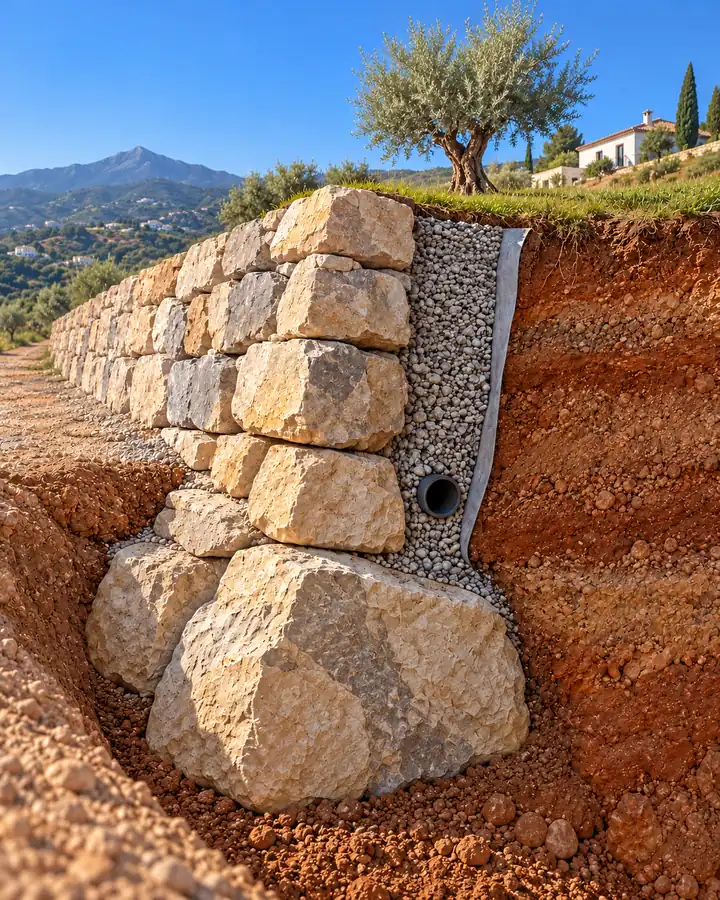
5. DRAINAGE: Geotextile, gravel and drainage pipe behind the wall.
6. PLACEMENT: Block by block with a grab, interlocked and battered.
7. BACKFILL AND FINISHING: Compacted backfill behind, capping and clean-up.
START HERESend us photos of the slope and approximate measurements on WhatsApp.
Details that make the difference: the wall is built leaning into the slope (not vertical), the largest blocks go at the bottom and water always has a way out. Most escollera walls that fail do so because of a lack of drainage or a base that's too small.
Regulations, licences and safety for escollera walls
An escollera wall is a retaining structure: if it fails, it brings down the soil and whatever is on top. That's why we design it following the Guide for the design and construction of escollera walls from the Spanish Ministry of Transport, and the foundation requirements of the Spanish Building Code (DB SE-C).
Does it need a licence?
In Andalusia, walls and earthworks normally require a licence or responsible declaration from the town hall, under the LISTA Law. If the wall is tall, or next to a road, a watercourse or a house, a project signed by a qualified engineer may be needed. On the visit we tell you what paperwork your case needs.
Site safety
We work with our own machinery and trained operators, we cordon off the area and we never leave an excavated slope unprotected.
How do you know if your land needs an escollera wall?
These are the clearest signs that your land needs retaining, and how to choose the right wall.
Warning signs
- Soil slips or washes away when it rains.
- You have a slope you can't use and want to gain flat land.
- An old stone or block wall is opening up or leaning.
- A track or access road is being eaten away at the edge.
- You're going to build a house, pool or parking area on a sloping plot.
If the slope is small, a well-shaped, planted bank is sometimes enough. We explain it in ideas for retaining soil without major works.
Escollera, concrete or masonry?
Escollera
Farms, slopes, tracks and where there's water. The strongest option and the one that blends in best with the landscape.
Reinforced concrete
Basement walls, next to houses or where space is tight. See concrete walls.
Stone masonry
Low walls with a very neat finish, or traditional dry stone. See stone masonry walls.
On the visit we tell you which suits you. If it's another type, we build that too.
What our clients say
★★★★★
MURES rating on Google. See all reviews on Google →★★★★★
“Very happy with the work. They built me an escollera rock wall and did some earthworks, and I was very satisfied. Very professional.”Teresa García Mesa · Google review
★★★★★
“They proposed a wall over three metres high that fitted in with the existing features. […] They showed great professionalism, honesty and commitment, listening to the client and adapting to every requirement.”Nacho · Google review
Typical escollera wall projects in Málaga
Typical examples of how we approach this kind of work, not specific clients.
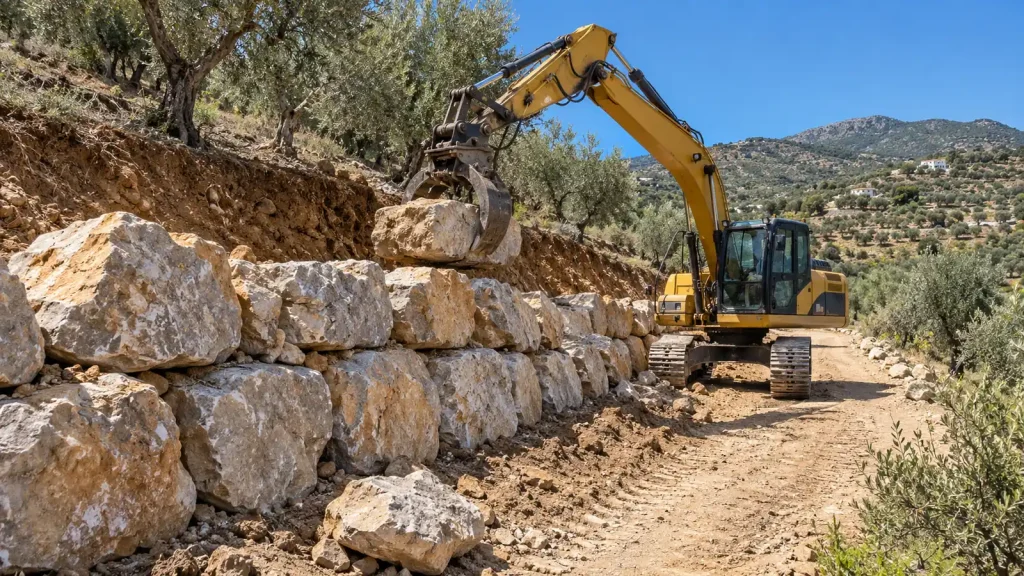
Terraces on a farm in Almogía
Very steep hillside with a narrow track. Two 1.8 m escollera walls in local rustic stone, a stone staircase between terraces and drainage for run-off.
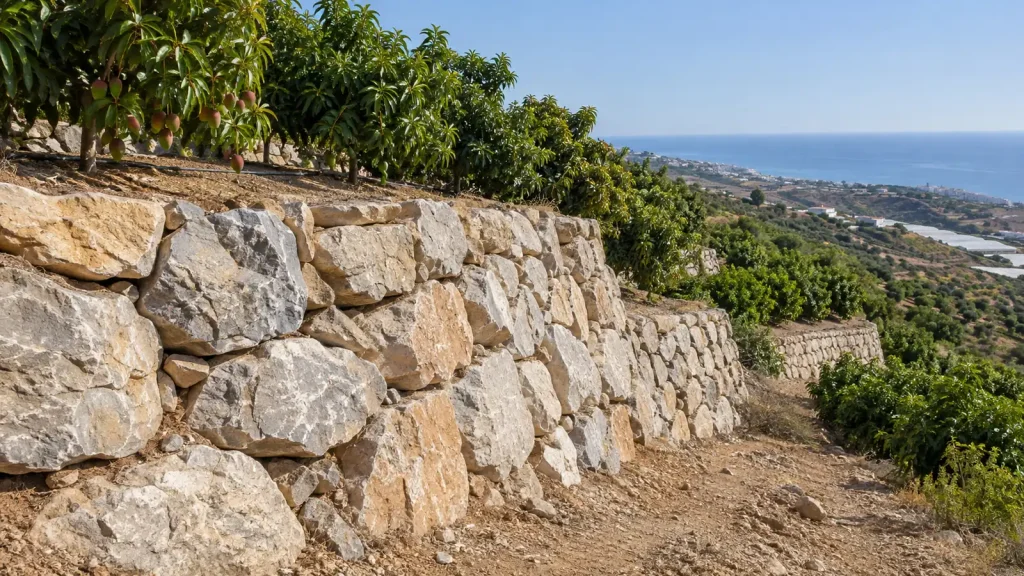
Platform for a house and pool near Nerja
Hillside plot with sea views. A 3.5 m tiered escollera wall with blocks of over a tonne at the base, compacted backfill and a platform for the pool.
Access to a house in La Cala de Mijas
Entrance ramp with a bank to one side. Quarried block escollera because the quarry is close by, finished with a planter and an outlet for rainwater.
Escollera walls across the province of Málaga
We're based in Vélez-Málaga. Our core area runs from Málaga city and the Montes to Vélez-Málaga and Nerja, and we also work in the Guadalhorce, the Costa del Sol as far as La Cala de Mijas and the Costa Tropical as far as Almuñécar. Choose your area:
Axarquía14 areas
- Escollera walls in Vélez-Málaga
- Escollera walls in Torre del Mar
- Escollera walls in Rincón de la Victoria
- Escollera walls in Nerja
- Escollera walls in Torrox
- Escollera walls in Algarrobo
- Escollera walls in Frigiliana
- Escollera walls in Cómpeta
- Escollera walls in Canillas de Aceituno
- Escollera walls in Periana
- La Viñuela
- Benamocarra
- Sayalonga
- Comares
Málaga city and the Montes6 areas
Guadalhorce Valley7 areas
Costa del Sol5 areas
Costa Tropical2 areas
Your village isn't listed? If it's between La Cala de Mijas and Almuñécar or inland in Málaga, ask us: we can most likely get there.
Send us photos of your land and we'll give you a guide price
Fill in the form with the approximate measurements, a few photos and the location. Our technician reviews it and we call you with a guide price and to arrange the visit. No obligation.