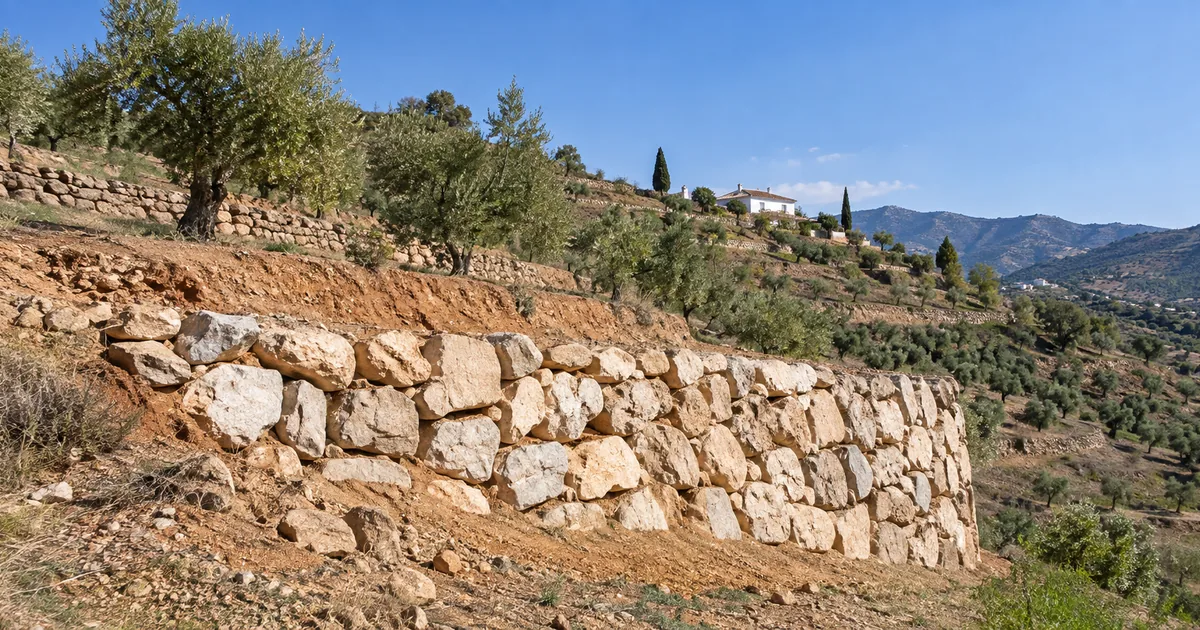
To hold back soil without major building work there are four solutions that work: easing the bank and planting it, building terraces, placing a small escollera wall or putting up a dry stone wall. They all have one thing in common: they let water through. And on sloping ground, water is in charge.
In the Axarquía we see it every autumn: one October storm and the bank that had stayed put for years comes down, carries away the vegetable plot soil and leaves the track covered in mud. The good news is that most of these problems can be fixed without concrete, without cranes and without months of work. Here we explain the options, when each one works and when there’s no alternative to building a proper retaining wall.
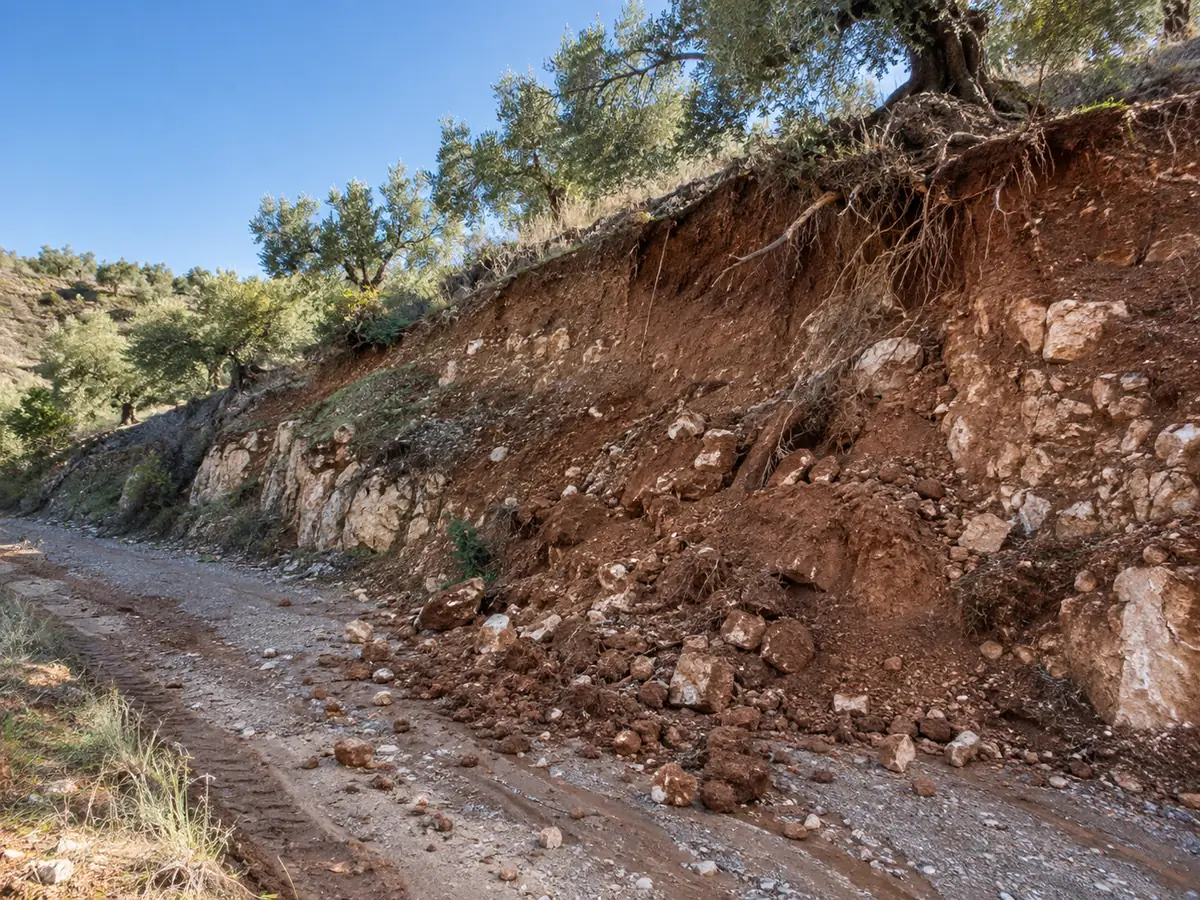
Before choosing: three questions about your land
There’s no single solution that suits all ground. Before spending a euro, it’s worth answering these:
- How much height needs holding? Up to about a metre, almost anything works. Above a metre and a half we’re talking about a wall with a survey, foundations and, normally, a licence.
- What’s on top? Holding up a terrace of olive trees isn’t the same as holding the ground a house, a pool or a track used by cars sits on. If there’s weight on top, the solution has to be more serious.
- Where does the water go? If water runs down the slope when it rains, any solution that doesn’t let it out will end up pushed over and broken. It’s the number one cause of walls collapsing.
With those three answers, the choice is usually quite clear.
1. Easing the bank and planting it
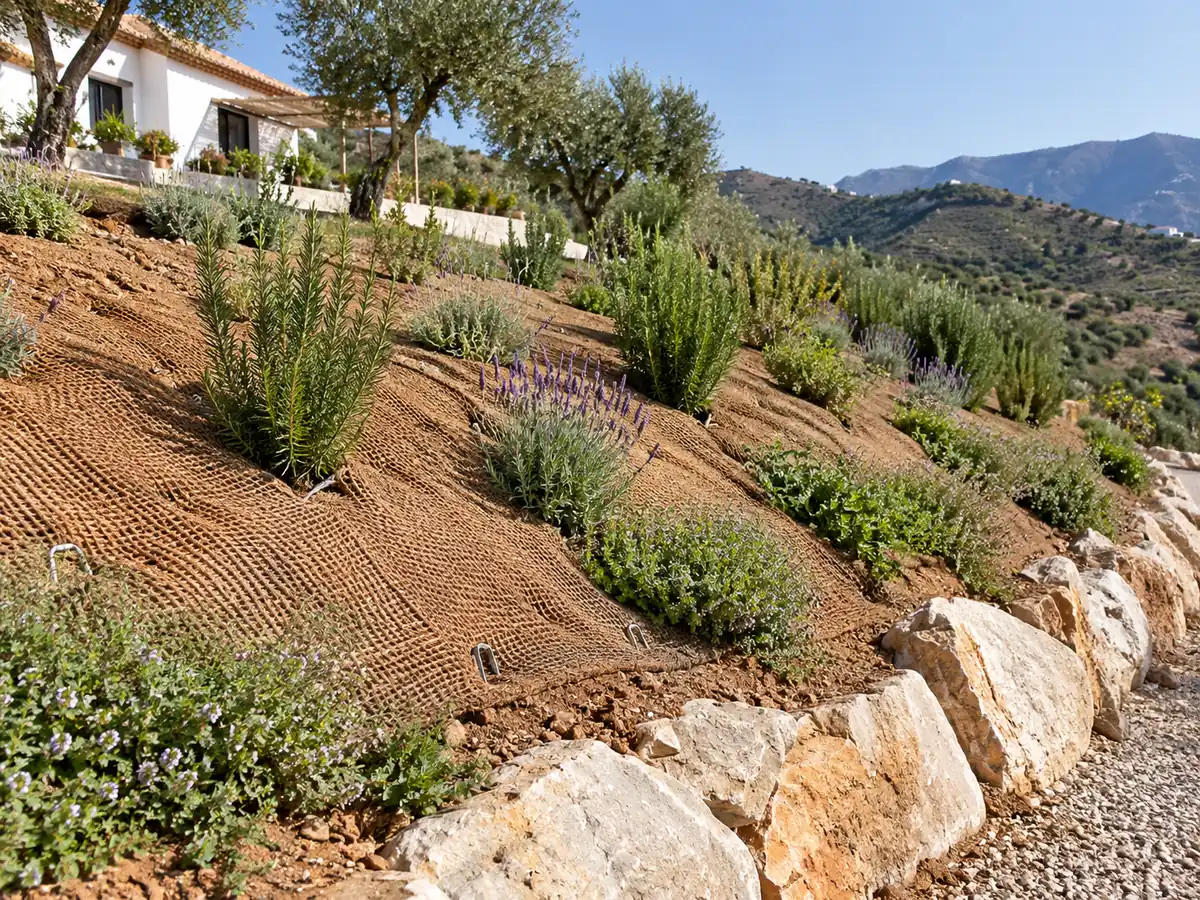
It’s the cheapest and most natural option. The idea is to give the ground a gentler slope so it holds itself up, then fix it with roots. As a guide, a slope that drops one metre for every two metres of distance is already fairly stable if it’s well planted; if it’s steeper, the soil tends to slide.
To hold it while the plants grow, coconut fibre or jute mesh or blankets are used, which hold the surface and break down on their own over the years. On top, deep-rooted, low-water species are planted: rosemary, lavender, gazania, ice plant or local ground-cover plants.
Works well on: farms with space, low banks and areas with no weight on top.
Doesn’t work on: narrow plots where there’s no room to flatten the slope.
2. Terraces
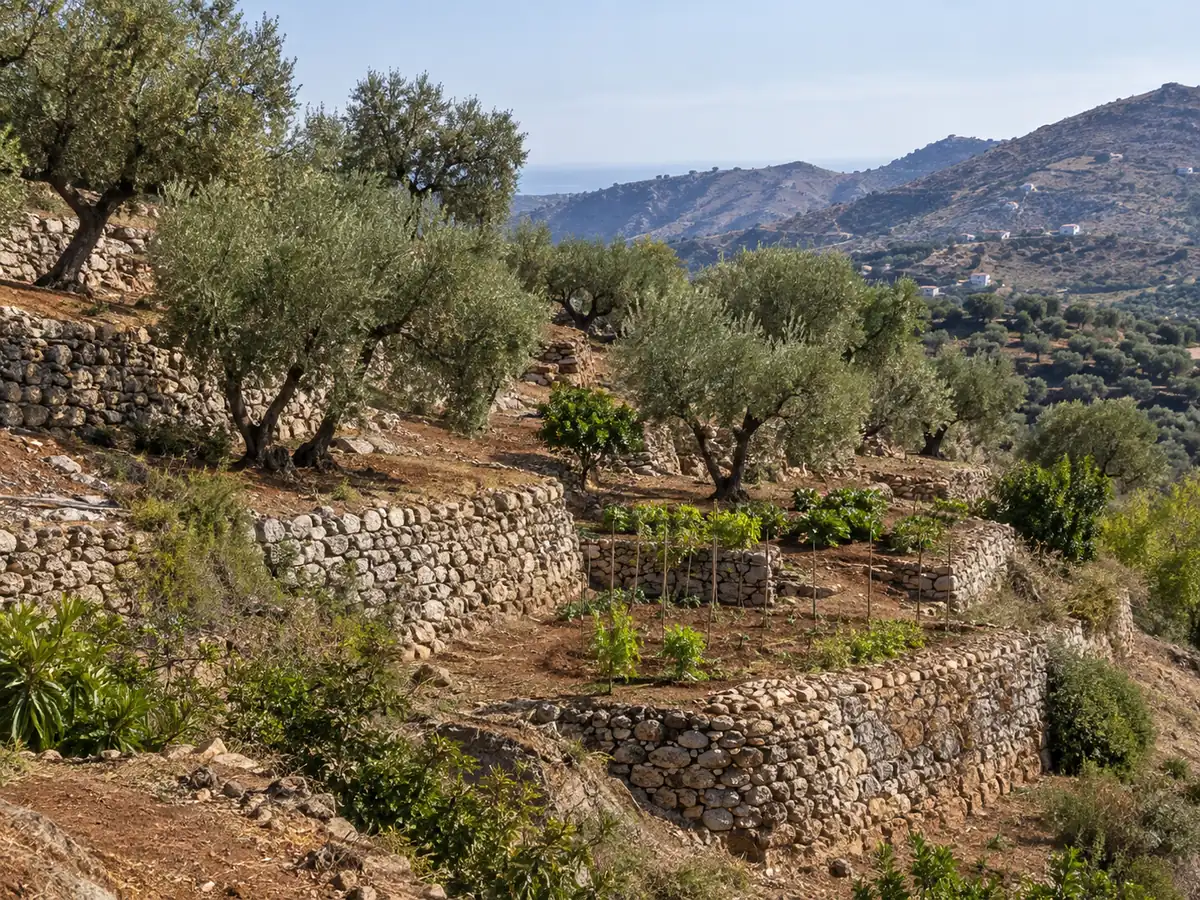
It’s what has always been done in the Montes de Málaga: instead of one long slope, several flat steps. Each step holds back only a little soil, so each wall can be low and simple. You also gain usable space for a vegetable plot, fruit trees or a seating area.
The edges can be built in stone, treated timber sleepers or precast garden blocks. Timber is quick and cheap, but it doesn’t last as long and isn’t suitable for greater heights. Stone ages best.
Works well on: long slopes, farms and sloping gardens.
Watch out for: the drainage of each terrace. If water sits on the step, it ends up pushing the edge out.
3. A small escollera wall: the longest-lasting option
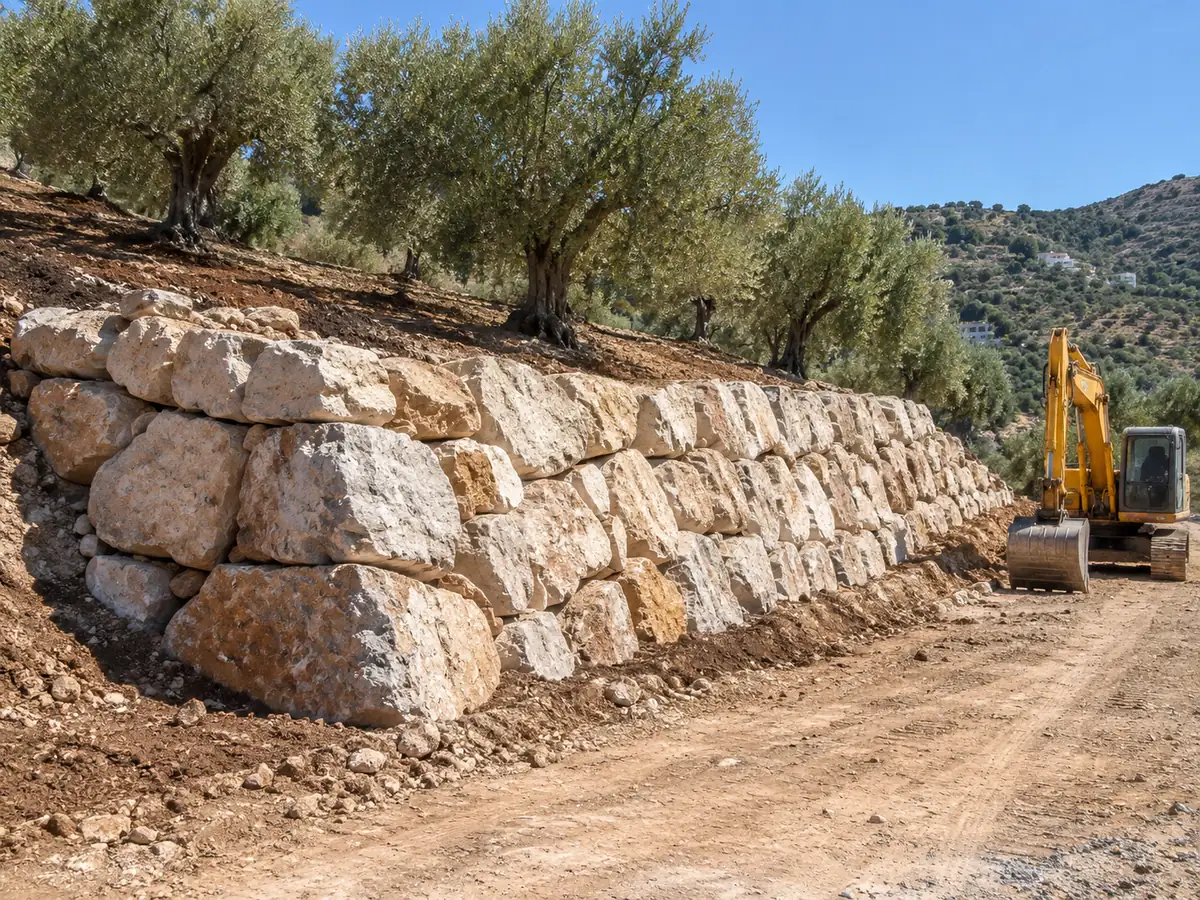
If you want something that lasts for decades with no maintenance, escollera is hard to beat. It’s made of large natural stone blocks placed by machine, interlocked and leaning slightly into the ground. There’s no mortar, so water escapes between the stones and the wall never builds up pressure.
Many people think escollera is only for roads or rivers, but for a one or two-metre bank on a farm it’s a job of just a few days. With a backhoe and the right stone, a long section is finished in very little time, and it blends into the landscape from day one.
Works well on: banks with weight on top, ground where there have already been landslips, boundaries and tracks.
You can see how we build escollera walls in areas such as Vélez-Málaga, Nerja or Rincón de la Victoria.
4. Dry stone or stone masonry wall
It’s the handcrafted version of escollera: smaller stones, laid by hand, with or without mortar. It looks lovely, suits the local cortijos and country houses and is ideal for terraces, planters and low boundary walls.
It takes more labour than escollera and isn’t designed for great heights, but for shaping a sloping garden it’s one of the most charming options. We explain it in detail on our stone masonry walls page.
The detail that decides whether a wall lasts: drainage
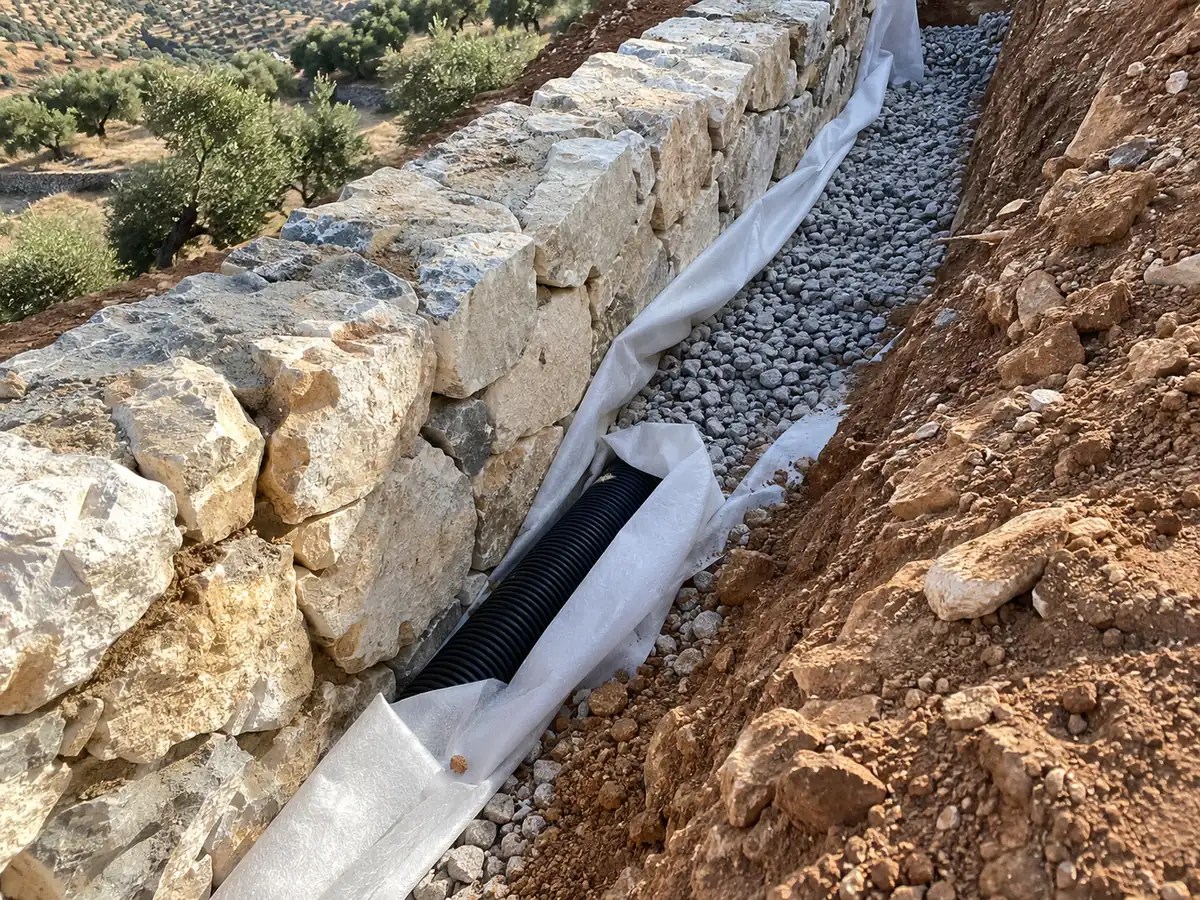
Whatever solution you choose, if the water has no way out, the wet soil weighs much more and pushes until something gives. That’s why any properly built retaining solution includes, at the very least:
- Gravel behind the wall, so water drains down without soaking the soil.
- A drain pipe at the base to take the water to a safe area.
- A ditch or channel at the top when the slope collects rainwater from other plots.
If you want to go further, we have a guide on drainage and water control systems.
Quick comparison
| Solution | Approximate height | Relative cost | Ideal for |
|---|---|---|---|
| Planted bank | Gentle slopes | Low | Farms with space |
| Terraces | Low steps | Low – medium | Vegetable plots and hillside gardens |
| Escollera | Low to high | Medium | Banks with weight, landslips |
| Stone masonry | Low | Medium – high | Charming gardens and boundaries |
When you really do need proper building work
The ideas above solve most cases, but there are situations where it’s not worth improvising:
- The change in level is more than one and a half or two metres.
- Right above there’s a house, a pool, a neighbour’s wall or a track with traffic.
- Cracks have already appeared in the ground, in a wall or in the floor above.
- The ground has moved after heavy rain.
In those cases the ground needs surveying, the base needs preparing properly and, often, earthworks or excavation are needed before building the wall. That’s where a well-founded escollera wall or a properly calculated retaining wall makes the difference.
Not sure which suits your land?
Send us a few photos of the bank, a rough idea of the height and the location, and we’ll tell you which solution makes sense and what it would cost. No obligation and no beating about the bush: if a few plants and a coconut blanket will do, we’ll tell you.
Ask for your quote here or message us on WhatsApp. We work across the whole Axarquía and the province of Málaga.
Frequently asked questions about holding back soil
What’s the cheapest way to hold back soil on a bank?
The cheapest way to hold back soil is to reduce the slope of the bank and plant it with deep-rooted species, using coconut fibre blankets while they grow. It works on low banks with no weight on top. If there isn’t room to flatten the slope, the next most economical option is low terraces.
Do I need a licence to build a retaining wall?
It depends on the town hall and the height of the wall. Low garden walls or terraces are usually processed as minor works, while tall walls or those holding back ground next to houses or tracks usually need a technical project and a licence. Before starting, it’s best to check with your town hall.
Why do retaining walls fall down?
The most common cause is water. When the soil behind the wall gets saturated and the water has no way out, the pressure increases a lot and the wall eventually gives way. That’s why a well-built wall has gravel behind it, a drain pipe at the base and, if needed, a ditch at the top to divert the rain.
How long does it take to build a small escollera wall?
A section of escollera for a one or two-metre bank on a farm is usually built in a few days, depending on the length, machinery access and the stone available. As there’s no concrete, there’s no curing time and the wall works from day one.