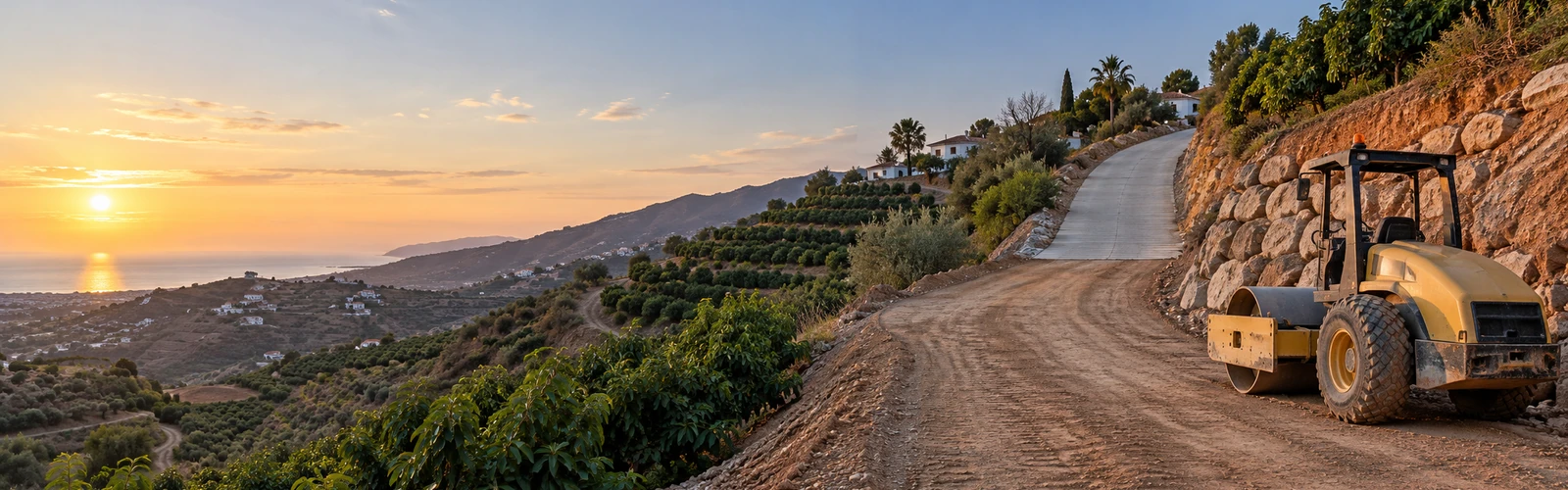
Rural track and road repairs in the Axarquía
We repair tracks, dirt roads and farm access roads from Málaga to Nerja. We do it in two ways: with compacted hardcore, levelled by machine, or concrete surfacing, so you never get potholes again. And first, we deal with what really destroys tracks: water. We send a surveyor with no obligation to look at it and give you a fixed quote.
- Since 2006 building across the Axarquía
- Our own machinery and quarry used by our own crew
- 5,0 ★ on Google
- Free technical visit and a fixed quote
Quick answer: If you need the track to your finca in the Axarquía repaired, call MURES on 686 746 094 or WhatsApp us photos of the track (English spoken). We repair rural tracks and access roads with compacted hardcore or concrete, sorting out the water first, with our own machinery and lorries.
Why a track breaks up and how to repair it properly
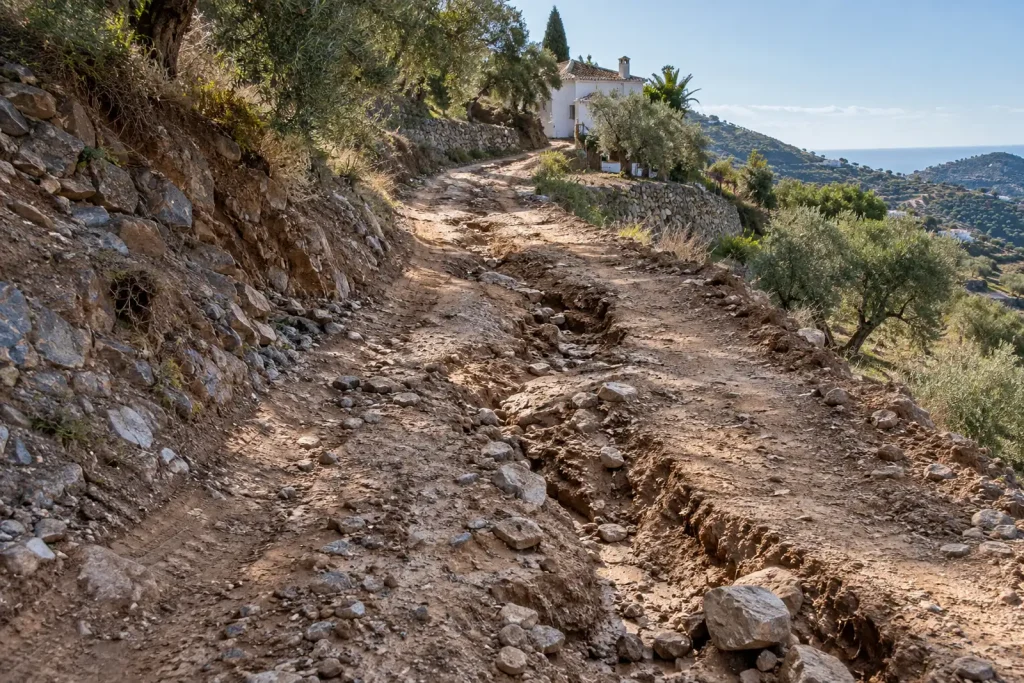
If you live in the countryside, you already know: every winter the water takes away a piece of the track. Ruts, potholes and loose stones appear, and on the slopes the car skids. At MURES we repair tracks across the Axarquía and east Málaga with our own machinery: backhoe, motor grader, compactor roller and aggregate lorries.
A track repair that lasts has three parts, always in this order: getting the water off the track, rebuilding the base and laying the surface each section needs, which can be compacted hardcore or concrete. If you just fill the potholes, they come back with the next storm.
If the bank along the track is collapsing, we hold it up with a escollera rock wall. And if a new track needs opening, we start with the earthworks.
Which tracks do we repair?
How we repair a track or rural road
Every track is different. It depends on the length, the gradient, how much water runs down it and who uses it every day. That's why the surveyor comes first and tells you what suits your case, without selling you the most expensive option.
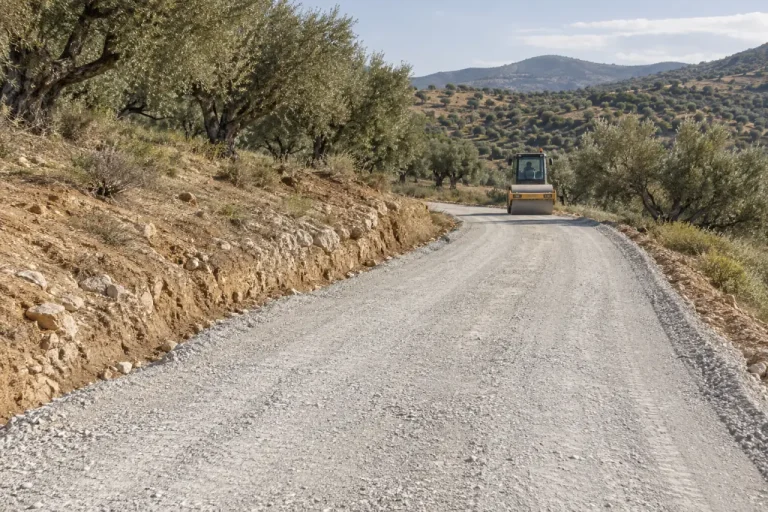
Compacted hardcore track with a roller in the background.
Track repair with compacted hardcore
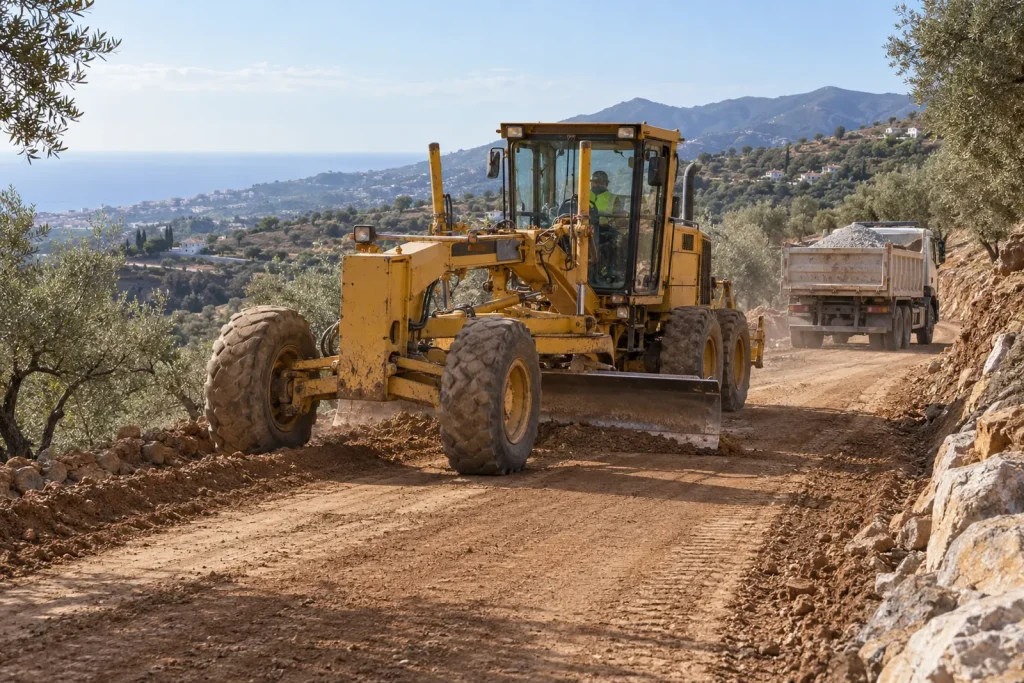
We reshape the track by machine, remove stones, fill ruts and lay hardcore in layers compacted with a roller. We give it a camber, a slight fall to the sides, so water doesn't sit in the middle.
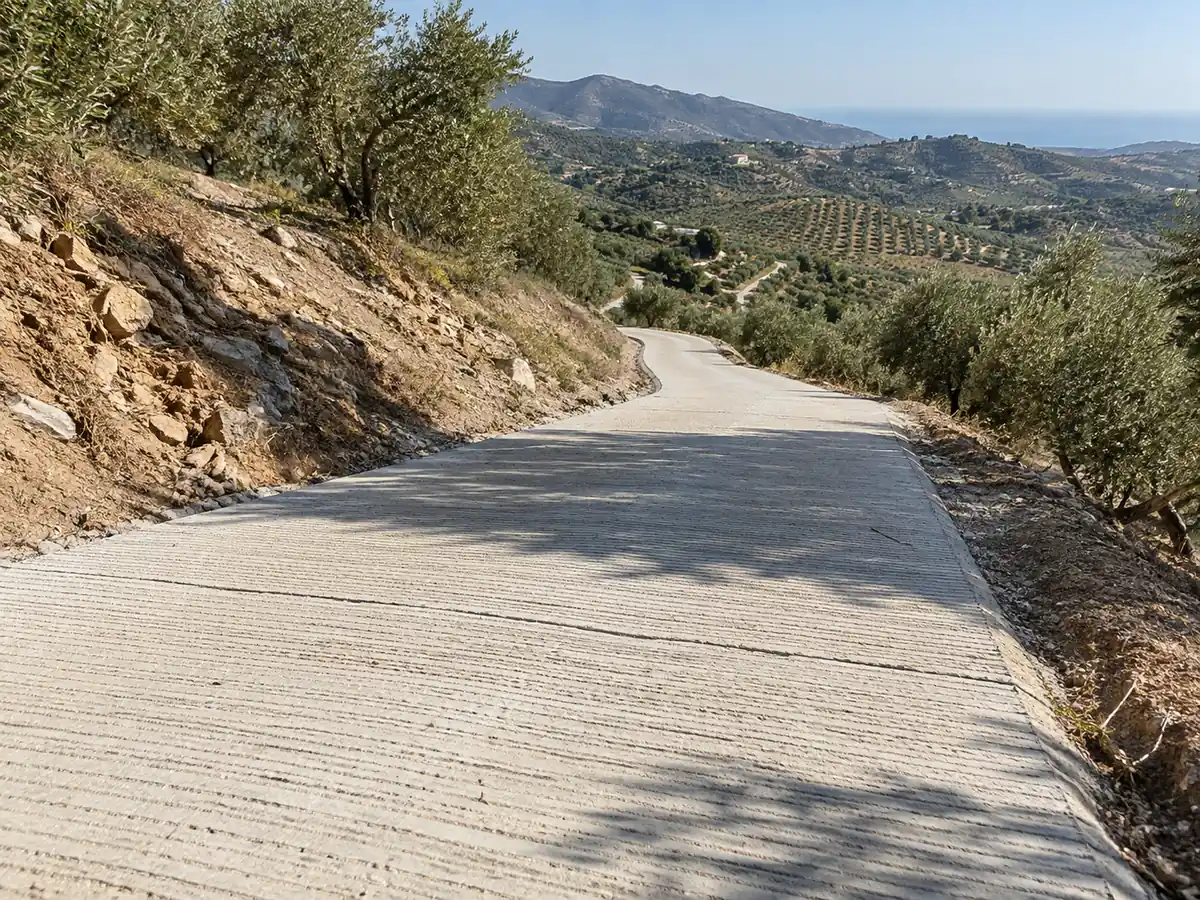
Concrete surfacing for tracks and roads
For slopes, bends and access to houses. A compacted hardcore base, steel mesh and concrete with a brushed non-slip finish. Almost maintenance-free: the rain doesn't wash it away.
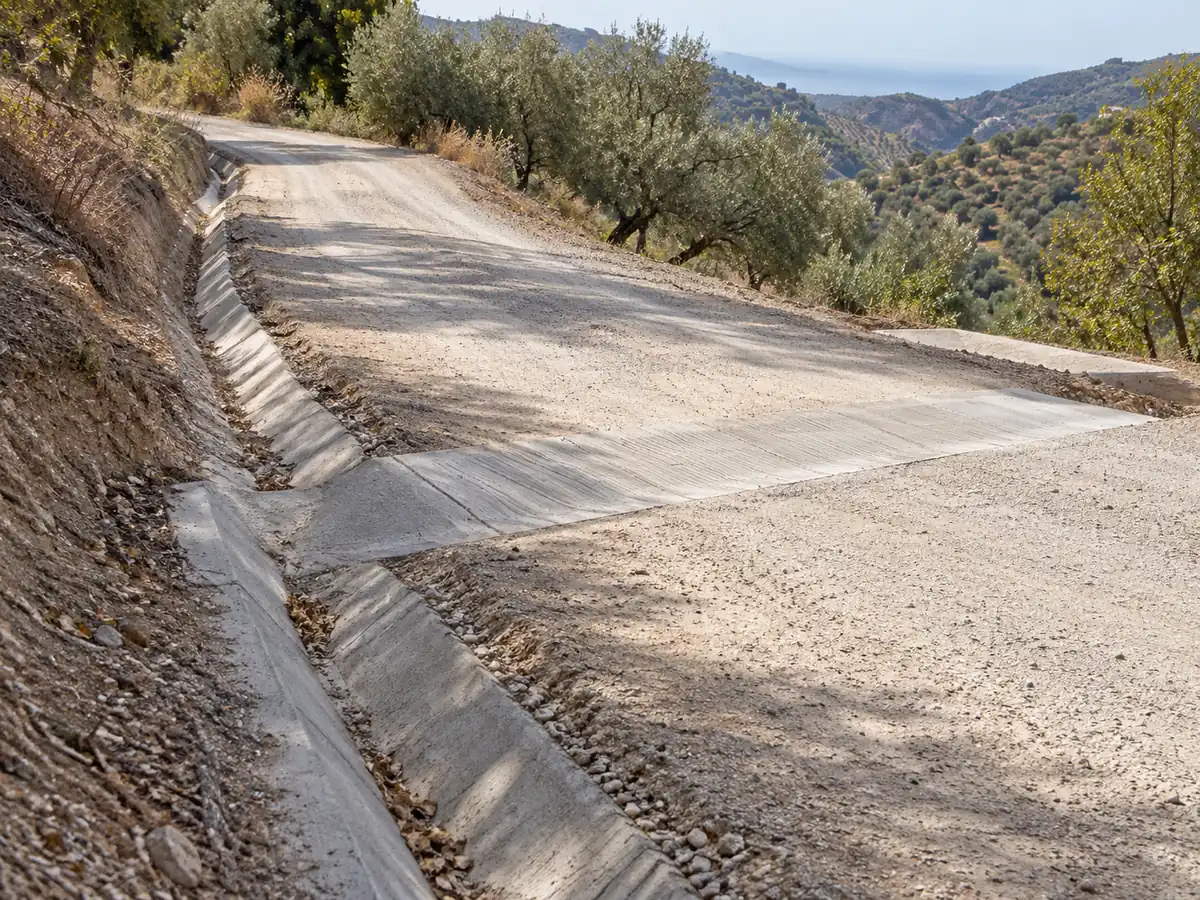
Ditches, water bars and culverts
We open or clear ditches, build water bars across the track to divert the water and lay pipes where it crosses gullies.
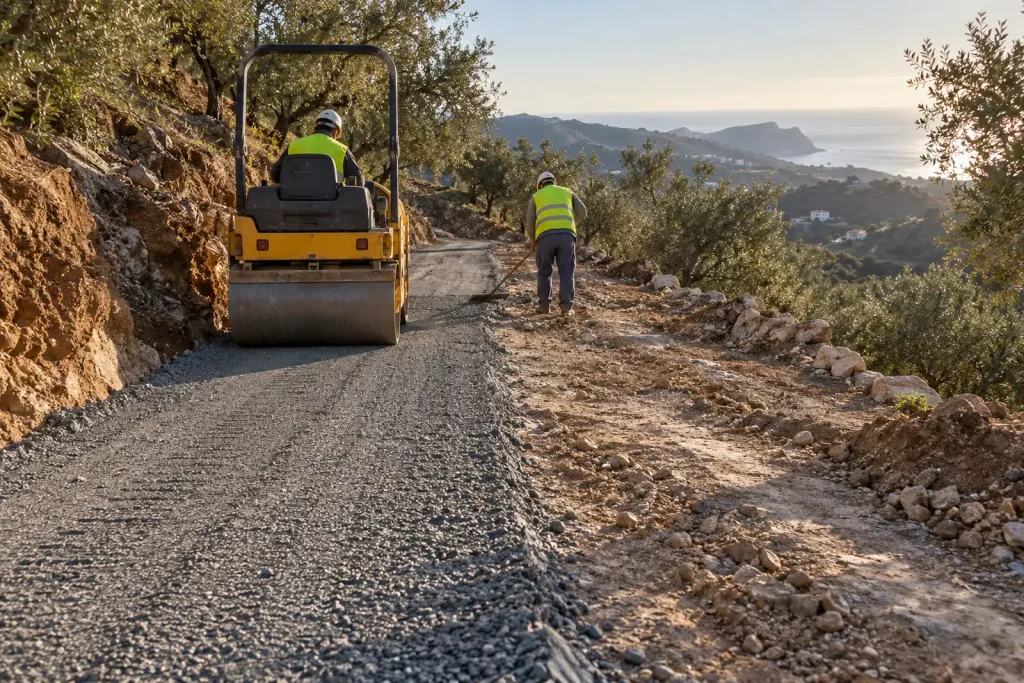
Pothole and section repairs
If only one section or the slope is bad, we repair just that. But we'll tell you honestly if the problem is coming from water higher up.
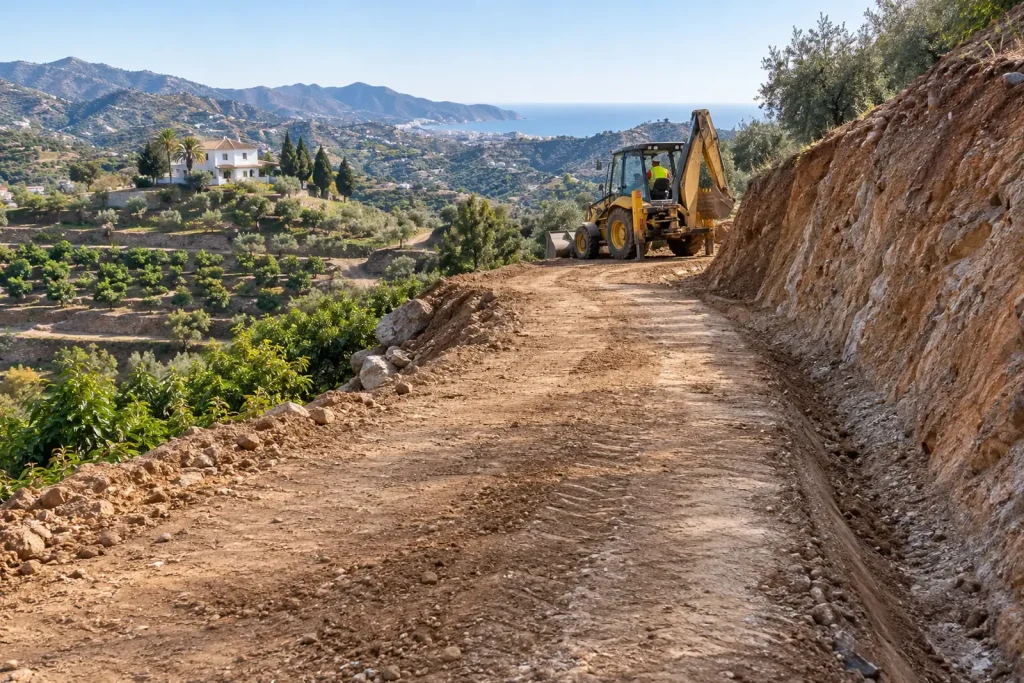
New tracks and plot entrances
We set out the route, do the earthworks, compact and lay the surface, with the right gradient and a ditch. For the garage entrance, see our concrete ramps.
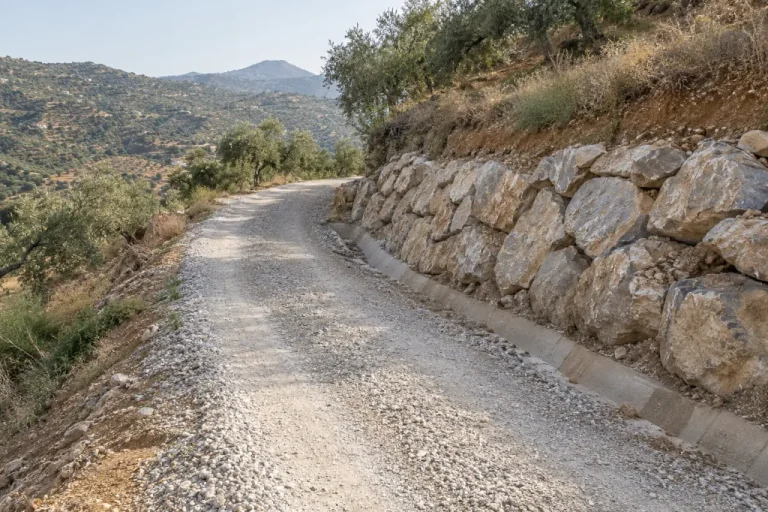
Rural track with a stabilised bank and side ditch — Service.
Track banks and walls
When the edge of the track crumbles or the hillside slips onto it, we hold it up with an escollera rock wall or a concrete wall before repairing the surface. See escollera rock walls.
Hardcore or concrete? A quick comparison
The most common approach is to combine the two: hardcore on the flat sections and concrete only on the slopes and bends. That way the track ends up in good shape and the investment is kept well in check.
| Compacted hardcore | Concrete | |
|---|---|---|
| Investment | More economical | Higher, but for many years |
| Gradient | Flat or gentle slopes | Steep slopes |
| Lifespan | Needs touching up every few years | Decades with little maintenance |
| Rain | Holds up well with good drainage | The water doesn't wash it away |
| Timescale | Can be used as soon as it's finished | You have to wait for it to cure |
| Ideal for | Farms, long tracks, agricultural use | Access to homes, ramps and problem sections |
What is hardcore (zahorra)? It's a mix of gravel and sand of different sizes which, watered and compacted with a roller, becomes as hard as a road base. For tracks we mainly use Crushed hardcore (zahorra artificial, similar to Type 1) (crushed rock), which compacts better and holds up on slopes better than natural hardcore. We bring it ourselves with our aggregate lorries.
Concrete tracks and roads in Málaga
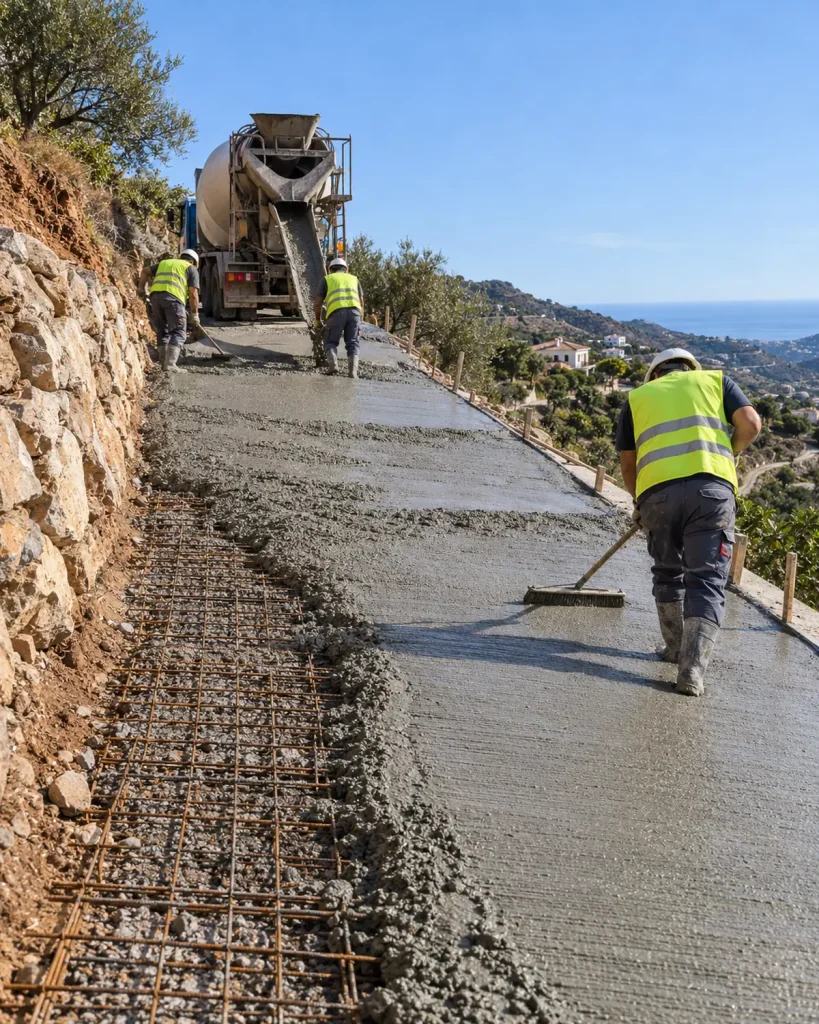
For tracks on a slope, access to houses or sections where potholes always form, concreting the track is the permanent solution. A well-built concrete track lasts for decades, doesn't get muddy or dusty and isn't washed away by the rain. This is how we do it:
HARDCORE BASECompacted with a roller. Without a good base, the concrete ends up cracking.
15 TO 20 CM THICKThe norm for car traffic. More if lorries or heavy tractors use it.
STEEL MESHSteel reinforcement to spread loads and control cracking.
BRUSHED FINISHBrushed or grooved non-slip finish: it grips on slopes and in the rain.
JOINTSCuts every few metres so the concrete can move without cracking.
FALL AND DRAINAGECamber or side fall and water bars so water doesn't run down the middle.
Concrete track on a slope: on Axarquía slopes the brushed finish isn't optional, it's what stops the car skidding. We concrete in sections, from the bottom up, and if it's your only access we organise it so you can still get in. The concrete complies with the Spanish Structural Code.
For a house driveway, see our concrete ramps, and if you want a decorative finish, stamped concrete.
Water: the first thing we fix on a dirt track
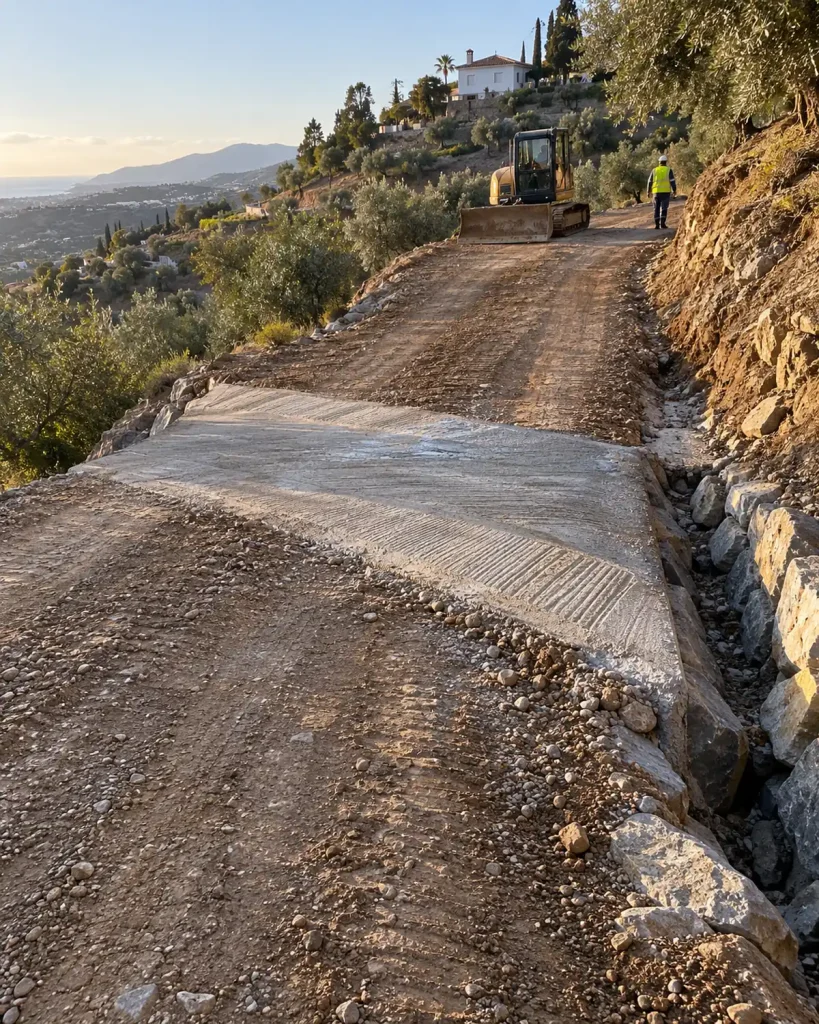
A track almost always breaks up because of water. Ruts, potholes and loose stone are the consequence; the cause is water running down the middle of the track. That's why, before laying any material, we sort out the drainage:
This is how we get the water off the track:
- Ditches: on the uphill side, to catch the water before it reaches the track.
- Water bars: they cross the track diagonally and take the water off to one side every few metres, especially on slopes.
- Pipe culverts: in gullies and dips, so the water passes underneath rather than over the top.
- Camber: the track slightly higher in the middle, so water runs off to the sides and doesn't cut ruts.
- Water outlet: the water has to end up somewhere it does no harm, either to the track or to the neighbour below.
Do you lay tarmac?
No. We don't work with tarmac, and on Axarquía tracks it's hardly ever the best option. Tarmac needs road-building machinery that often won't fit along a narrow track, and on steep slopes in the sun here it deforms and cracks. Concrete copes better with slopes, doesn't need that machinery and lasts longer with less maintenance.
If you were thinking of tarmacking a rural track, ask us for a price for concreting the bad sections and hardcore on the rest: it often works out the same or better, and lasts longer.
Machinery for repairing tracks
Backhoe loader for reshaping, cutting ditches and laying pipes. Motor grader to give the track its shape and camber. Compactor roller for each layer of hardcore. Aggregate lorries of our own for the hardcore. And a mini digger for narrow mountain tracks.
How we work, step by step
From site visit to handover, always in the same order and with our own team:
1. YOU CONTACT US: By WhatsApp or phone, and you tell us where the track is.
2. SURVEYOR VISIT: Free if the land is yours. They measure the length and look at the gradient, the water and where the machine can get in.
3. FIXED QUOTE: In writing, with the solution we recommend and, if needed, an alternative.
4. DRAINAGE: Ditches, water bars and pipe culverts to get the water off.
5. RESHAPING AND BASE: We reshape by machine and rebuild the compacted base.
6. SURFACE: Compacted hardcore, concrete or both, depending on the section.
7. CHECK WITH YOU: We go over it together and explain how to look after it.
START HERESend us photos of the track on WhatsApp, especially of the worst areas.
How much does it cost to repair a track or concrete a road?
We don't put fixed prices on the website because every track is different. A repair with hardcore for tracks is priced per linear or square metre of track and concrete surfacing per square metre, plus whatever drainage is needed. This is what changes the price:
LENGTH AND WIDTHThe length of the track and its width. More metres, better price per metre.
GRADIENT AND BENDSSteep slopes and tight bends usually call for concrete.
ACCESSA narrow mountain track is not the same as a flat one next to the road.
CONDITION AND DRAINAGEHow badly it's broken up and how many ditches, water bars and pipes are needed.
MATERIALHardcore, concrete or a combination of both.
USECars, tractors or lorries: the thickness and reinforcement change.
That's why we'd rather see it. We send a surveyor with no obligation at all and give you a quote tailored to your track, with no surprises.
How to repair a dirt track on a budget
1. Water first: well-built ditches and water bars add years to the life of the track.
2. Concrete only where it's needed: slopes, bends and the house entrance.
3. Compacted hardcore on the rest, never loose soil or rubble.
4. If there are several neighbours, one quote: one single mobilisation of machinery.
Tracks shared between neighbours
Many tracks in the Axarquía serve several houses or farms. If that's your case, we'll give you a single clear quote, broken down by section, so it's easy to split between the neighbours. We can also come on a day that suits you all to show you the solution on the track itself.
Is the track public? If the track belongs to the council, repairing it is the town hall's responsibility. We work for homeowners, farms and communities of neighbours on private or shared tracks. If you're not sure who owns the track, the town hall or the land registry (catastro) can tell you.
We make it easy
A quote broken down by section. A visit with all the neighbours on the track. And the work organised so nobody is left unable to get into their house.
Typical project: repairing a track in the Axarquía
A typical example of a very common job in our area, not a specific customer.
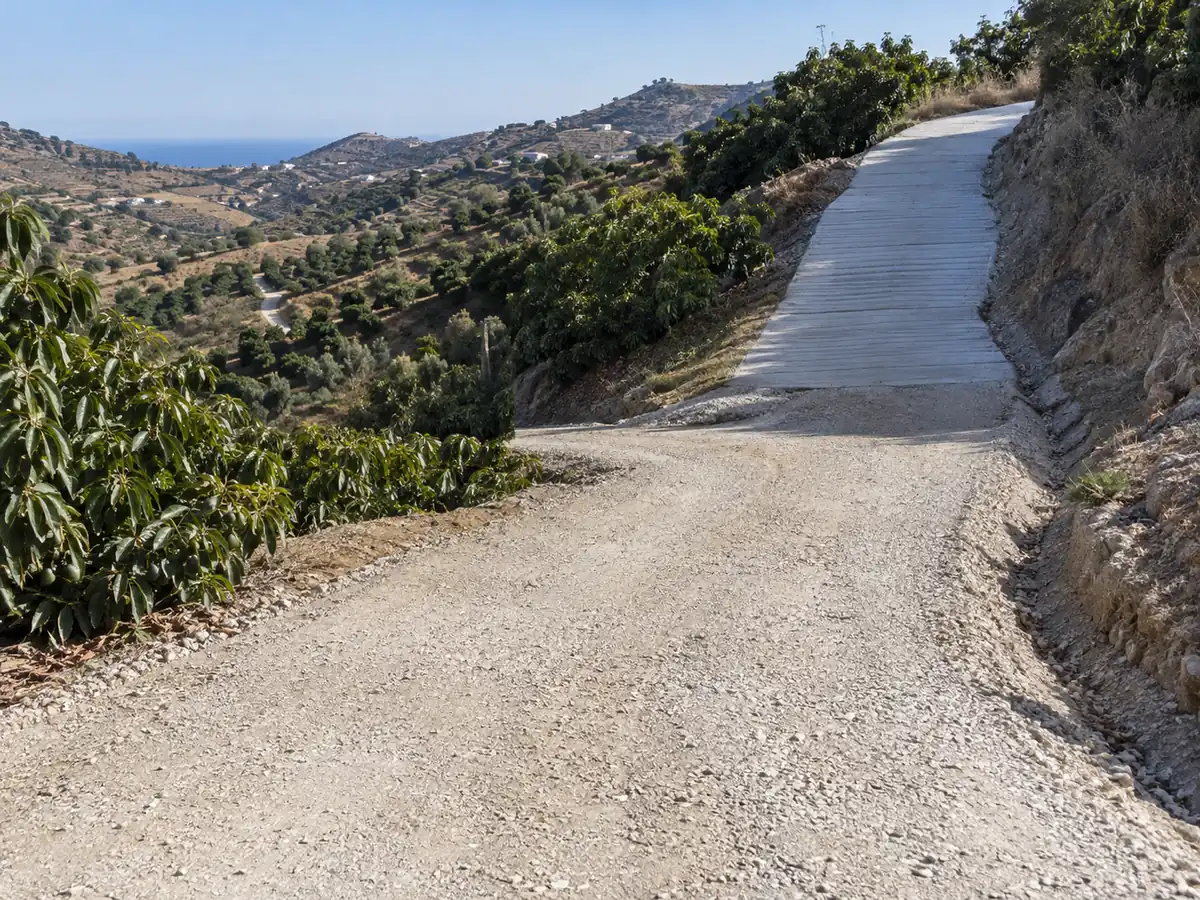
Access track to an avocado farm in the Axarquía
A dirt track a few hundred metres long, with a steep final section up to the house. Every winter it filled with ruts and cars skidded on the slope.
What we did: reshaping by machine, a ditch on the uphill side and water bars to take the water off, compacted hardcore along the whole flat section and concrete with a brushed finish on the slope.
Result: a firm track all year round, with no mud, and a much smaller investment than concreting the whole thing.
Track repairs in your town
We're based in Vélez-Málaga and repair tracks and rural roads across the Axarquía and east Málaga. Choose your town:
- Rincón de la Victoria
- Vélez-Málaga
- Torrox
- Nerja
- Algarrobo
- Frigiliana
- Cómpeta
- Sayalonga
- Periana
- Colmenar
- Canillas de Aceituno
- Benamocarra
- Almáchar
- Moclinejo
- Comares
- Torre del Mar
- Canillas de Albaida
- Alcaucín
- La Viñuela
- Sedella
- Salares
- Árchez
- Arenas
- El Borge
- Cútar
- Benamargosa
- Iznate
- Macharaviaya
- Totalán
- Riogordo
- Alfarnate
- Alfarnatejo
Coast and valley: Vélez-Málaga, Torre del Mar, Algarrobo, Benamocarra, Rincón
Flat tracks on avocado and mango farms. Here the problem is hardly ever the gradient: it's the mud and the wheel ruts when the fruit lorry comes in. Well-shaped compacted hardcore and a ditch to take the water away are usually enough.
Mid-mountain: Almáchar, Moclinejo, Comares, Sayalonga, Frigiliana, Cómpeta
Gradients of 12 to 20%. Hardcore on its own washes away with the first big storm, so the steepest sections are concreted with a brushed finish and the rest left in hardcore. It's the mix that gives the best value for money over time.
High mountain and Montes: Canillas de Aceituno, Periana, Colmenar, Olías, Jarazmín
Sections of more than 20%, loose slate and deep gullies after the rain. It almost always calls for concrete with a transverse brushed finish and water bars to cut the water off before it gathers speed.
We also work in Totalán, Macharaviaya, Iznate, El Borge, Benamargosa, Cútar, Arenas, Viñuela, Alcaucín, Sedella, Salares, Árchez and Canillas de Albaida. If your town isn't listed, ask us.
Does your track need repairing?
We repair tracks and rural roads with compacted hardcore or concrete, and get rid of the water that breaks them up. Working in the Axarquía since 2006, with our own machinery and lorries.
- ✓ Free site visit
- ✓ Fixed-price quote
- ✓ Our own machinery
Send us on WhatsApp
- Photos of the track, especially of the worst areas.
- Roughly how many metres long it is.
- The town or village.
Still deciding whether to buy a plot? A feasibility visit costs €100 + VAT, and if you buy and hire us for the work, we deduct it from the bill.
Track repair FAQs
What we're asked most before repairing a track or rural road.
Which is better for my track, hardcore or concrete?
It depends on the gradient, the water and the use. On flat sections and long tracks, compacted hardcore works very well and is more economical. On steep slopes, bends and access to houses, concrete is the permanent option. Often the best thing is to combine the two, and that's what the surveyor proposes when they see it.
How much does it cost to repair a track?
It depends on the length, the width, the gradient, access for the machinery and whether it's done with hardcore, concrete or a combination. That's why we don't give blind prices: if the farm is yours, we send a surveyor free of charge and with no obligation, and give you a fixed written quote.
Do you tarmac rural tracks?
No, we don't work with tarmac. On Axarquía tracks, with their slopes and narrow access, concrete usually gives a better result: it copes better with gradients, doesn't need road-building machinery and lasts longer with little maintenance.
How do you repair a dirt track that the rain washes away?
The first thing is to get the water off the track: ditches, water bars across it and pipes where it crosses gullies. Then it's reshaped by machine, hardcore is laid in layers and compacted with a roller. If you just fill the potholes without sorting out the water, they come back with the next storm.
How do you improve a very steep track?
On steep slopes hardcore tends to be carried away by water and tyres. The best approach is to concrete that section with a brushed finish, which grips and stops cars skidding, and to add water bars so the water doesn't run down the middle of the track.
How thick should the concrete be on a track?
For tracks used by cars, the norm is a slab of about 15 to 20 cm, with steel mesh, on a compacted hardcore base. If lorries or heavy farm machinery will use it, it's reinforced. The surveyor specifies it according to the use it will have.
Do I need permission from the town hall to repair the track?
It depends on the municipality and the type of land. Often a notification or a minor works licence is enough, but each town hall has its own rules. When we come to see it, we'll guide you on what your town hall usually asks for.
When can I drive on it after concreting?
You can walk on it after a few days, and with a car it's best to wait at least a week for the concrete to gain strength. We'll tell you the exact day and, if it's your only access, we organise the work in sections so you can still get in.
Several neighbours share the same track. How do we go about it?
We give you a single quote broken down by section so it's easy to split. If you like, we'll meet you all on the track and explain the solution there and then.
Can you repair just one section or just the potholes?
Yes. We can repair just the worst section or just the slope. But we'll tell you honestly if the problem is coming from water higher up, because if that isn't sorted, the repair won't last long.
How much does it cost to concrete a track?
It's priced per square metre and depends mainly on the thickness, the reinforcement, access for the concrete lorry and the state of the base. Concreting only the slopes and bends, and leaving the rest in compacted hardcore, makes the repair much cheaper. We give you a fixed price after seeing the track.
How can I repair a dirt track on a budget?
Start with the water: well-built ditches and water bars prevent most potholes. Then compacted hardcore rolled in place of loose soil, and concrete only on the sections that suffer most. Filling potholes with rubble or uncompacted soil is cheap but lasts one winter.
How long does a hardcore track last?
A well-compacted hardcore track with good drainage lasts several years with an occasional touch-up. What shortens its life most is water running down the middle and heavy lorries driving on it when the ground is wet.
What is hardcore (zahorra) and why is it used on tracks?
Zahorra is a mix of gravel and sand of different sizes. Watered and compacted in layers with a roller, it becomes hard and tight, doesn't get muddy and lets water run off. It's the base material for roads and the most widely used for repairing dirt tracks.
Who has to repair a rural or shared track?
If the track is public or council-owned, it's the town hall's responsibility. If it's private or a right of way between farms, it's normally paid for by the owners who use it, sharing the cost. If in doubt, the town hall or the land registry (catastro) can confirm who owns it.
Natural or crushed hardcore for a track?
Natural zahorra is rounded aggregate from a quarry or river: cheaper, but it compacts less well. Crushed zahorra is broken stone with angular edges that lock together: it ends up harder and copes better with water and slopes. For tracks used by cars we recommend well-compacted crushed hardcore.
Do you build new tracks and plot entrances?
Yes. We set out the route by machine, do the earthworks, compact the base and finish with hardcore or concrete, with the right gradient and a ditch. If there's a bank, we hold it up with escollera rock.
Next steps for your project
Swimming pool construction in the Axarquía
Concrete pools, also on sloping plots.
See →Excavation and earthworks in the Axarquía
Levelling, terracing and digging.
See →Demolition in the Axarquía
Houses, outbuildings and slabs.
See →Skip hire
Containers for building work and renovations.
See →Concrete water tanks
For irrigation on farms.
See →