STAMPED CONCRETE
Stamped concrete for driveways, garages and ramps
For a driveway or a garage ramp, stamped concrete is laid 12–15 cm thick, with mesh and a compacted hardcore base, and grooved on steep slopes so tyres don’t spin. Done well, it takes the weight, the turning and the oil stains for decades.
In the Axarquía hardly any house is on flat ground, so ramps are our bread and butter. This is what we take into account.

Thickness depending on what will drive over it
| Use | Concrete thickness | Reinforcement |
|---|---|---|
| Cars and vans | 12–15 cm | Mesh + fibres |
| Caravan, small tractor or occasional lorry | 15–20 cm | Heavy mesh + fibres |
| Regular lorry traffic | Calculated case by case | As calculated |
And always on a 15–20 cm compacted hardcore base. A driveway that sinks is almost never the concrete’s fault: it’s the base.
Ramps: gradient and grip
How steep it can be
Local by-laws usually limit garage ramps to 16 % on straight sections and 12 % on bends, with an almost flat section next to the street. On private finca tracks much steeper ramps are built; there, the finish is the key.
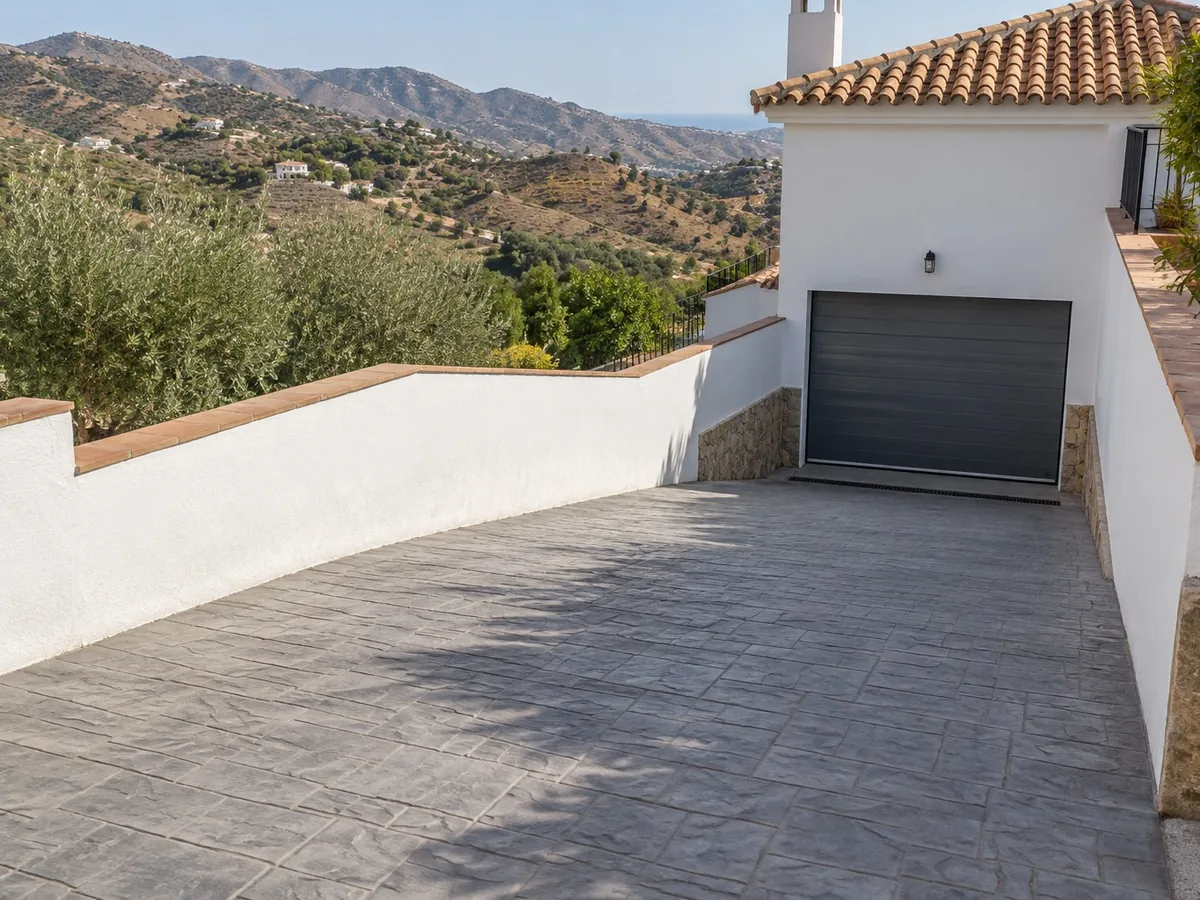
Grooves or herringbone on steep slopes
Above 12–15 %, the pattern alone isn’t enough: we mark transverse grooves or a herringbone design, which gives tyres grip in rain and dust. On the slopes of Cómpeta, Canillas or Frigiliana it’s a must.
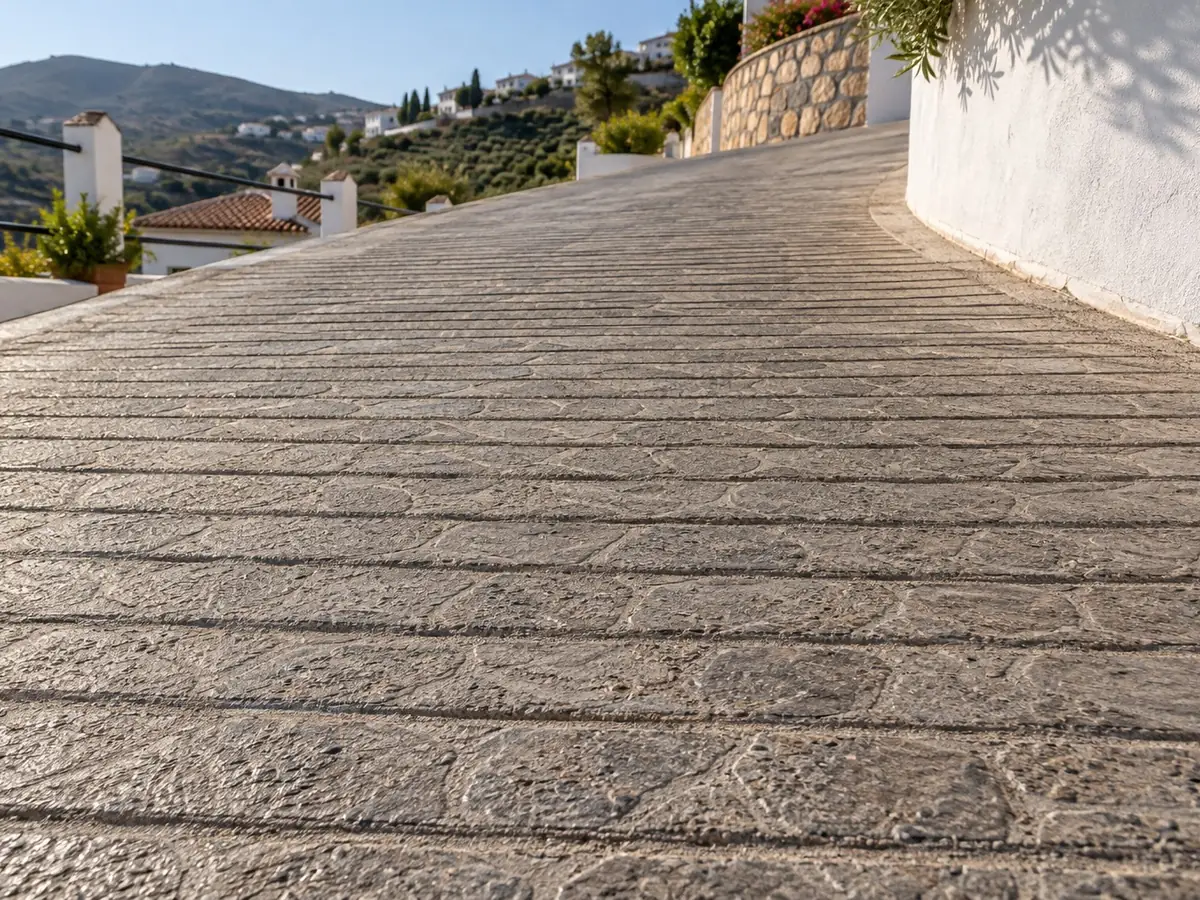
Water: half the job on a ramp
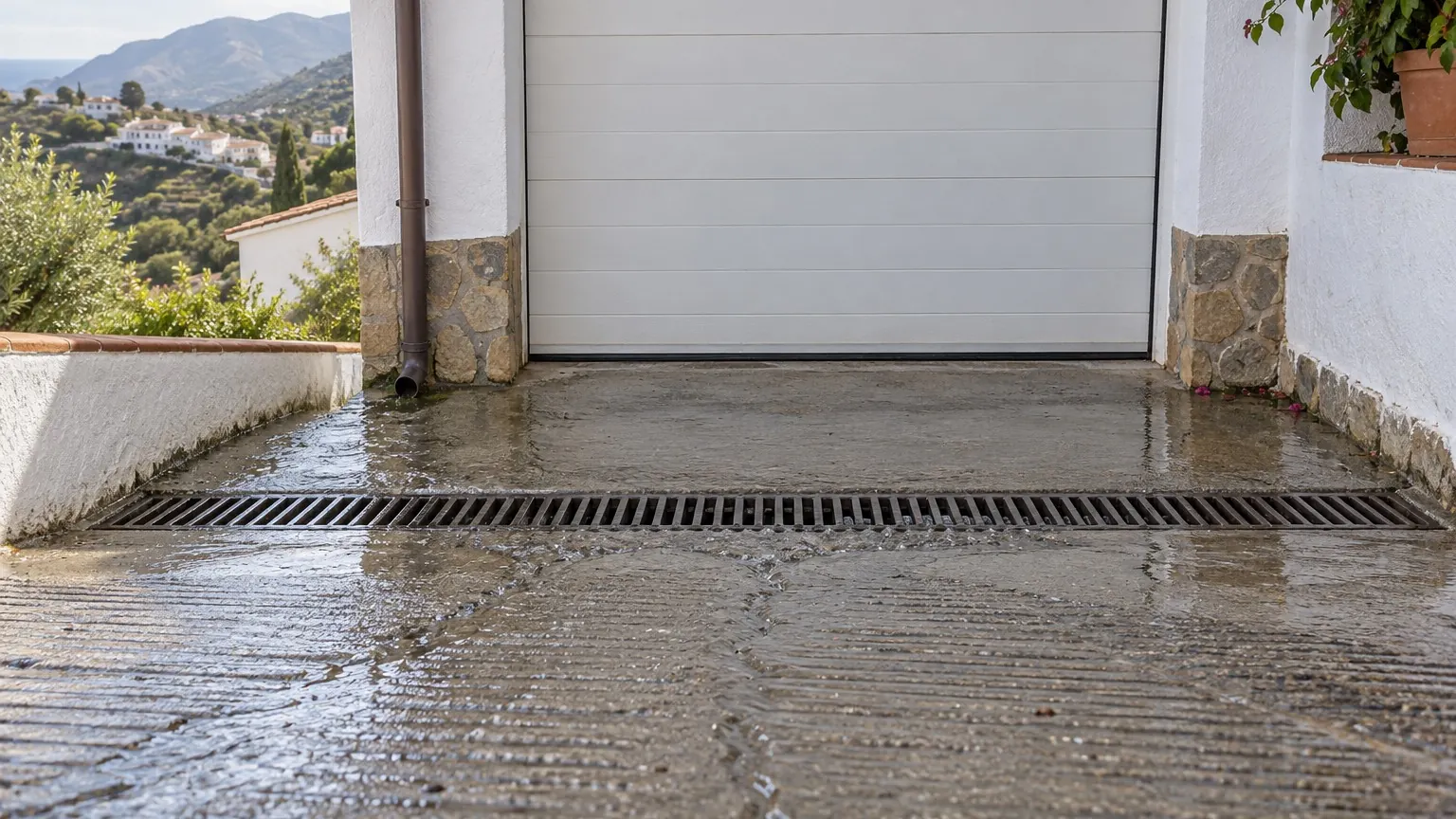
A ramp going down to a garage is a funnel. If you don’t plan where the water goes, one autumn storm will send it inside. That’s why we fit:
- A grated drainage channel at the foot of the ramp, connected to the drains or a soakaway.
- A slight cross-fall so water doesn’t run down the middle.
- Control joints cut and sealed, so water doesn’t get under the paving.
Tyres, oil and turning
What punishes a driveway most is turning the steering wheel while the car is stationary: the tyre scuffs the surface. A good colour hardener and two coats of sealer withstand that for years. Oil stains come off more easily if the sealer is up to date, so on garages we insist on resealing every 2–3 years.
Random stone or paver patterns hide tyre marks better than smooth or wood patterns.
Typical project
Illustrative example. Not a specific client.
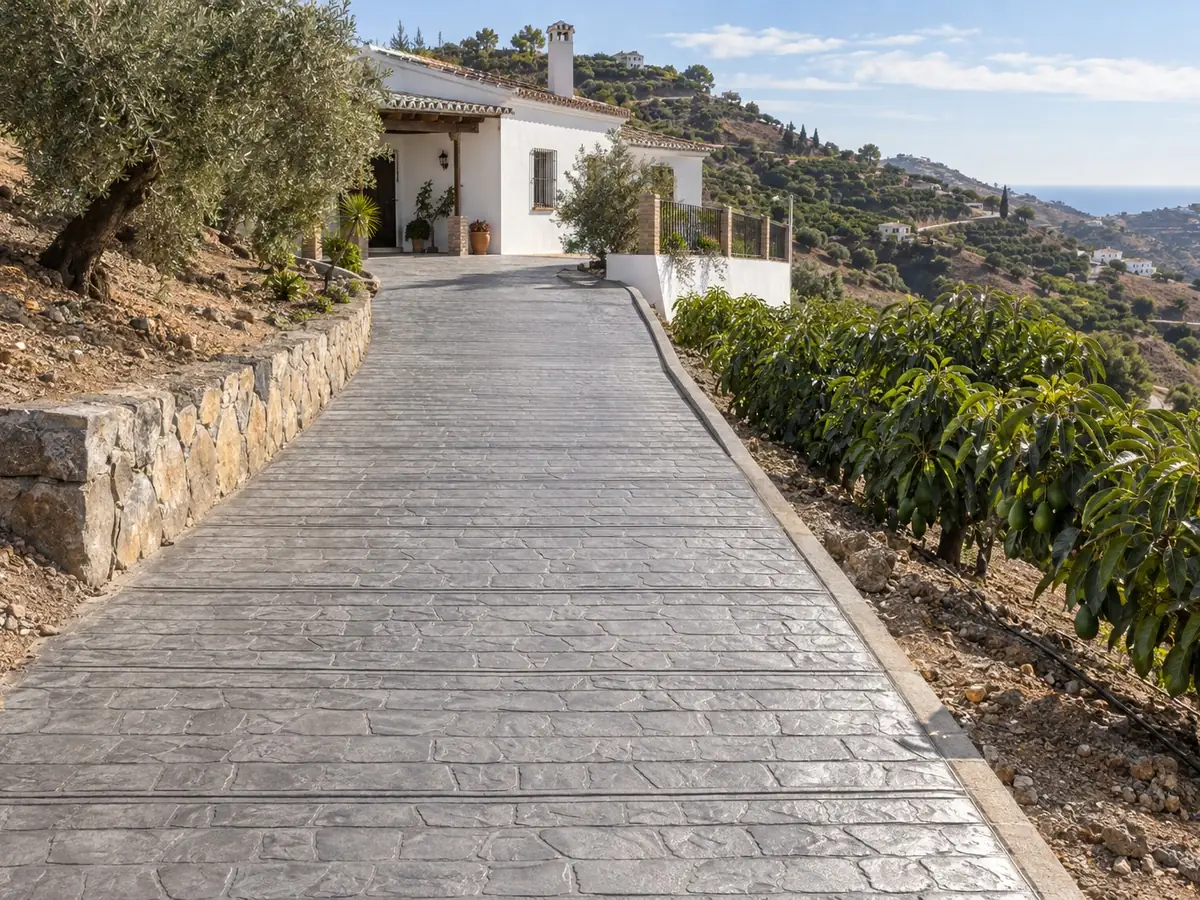
A 45 m² access ramp to a hillside house, at an 18 % gradient
Excavation and a 20 cm hardcore base, 15 cm concrete with mesh, stone-grey colour and transverse grooves every 10 cm along the whole sloping section. Drainage channel at the foot connected to a soakaway. Two days’ work and one week before driving up it.
Is your driveway sinking, cracking or slippery?
If it’s new, we’ll build it with the right base and thickness. If it already exists and is causing problems, we’ll see whether it can be fixed or whether it’s worth relaying. You can also see how we repair stamped concrete.
FAQs: garages and ramps
What people ask us before building a driveway or ramp.
How thick should a stamped concrete driveway be?
A stamped concrete driveway needs to be 12–15 cm thick, with mesh and fibres, on a 15–20 cm compacted hardcore base. If caravans, small tractors or the odd lorry will use it, it goes up to 15–20 cm with heavy mesh.
What is the maximum gradient for a stamped concrete ramp?
Local by-laws usually limit garage ramps to 16 % on straight sections and 12 % on bends. Steeper ramps are built on private tracks, but above 12–15 % the stamped concrete needs transverse grooves or a herringbone pattern so tyres don’t spin in the rain.
Does stamped concrete stand up to turning tyres?
Stamped concrete stands up to turning tyres if it has a good colour hardener and two coats of sealer. What wears it most is turning the wheel while the car is stationary. With the sealer kept up to date, resealing every 2–3 years, the surface keeps its colour for many years.
How do you stop water getting into the garage down the ramp?
To stop water coming down a garage ramp, a grated drainage channel is fitted at the foot, connected to the drains or a soakaway, and the paving is given a slight cross-fall. The joints in the stamped concrete are cut and sealed so water doesn’t get underneath.
When can you drive on a new stamped concrete driveway?
You can drive on a new stamped concrete driveway after 7 days. You can walk on it after 48–72 hours. The concrete reaches full strength at 28 days, so during the first month it’s best to avoid lorries or very heavy loads.