Retaining Walls in Málaga | Professional, Long-Lasting Construction
Retaining walls are essential engineered structures that resist the sideways pressure of the ground and hold different levels of soil in place, preventing landslips, erosion and collapse on steep sites. They keep land stable, protect homes, roads and driveways, and let you make the most of every square metre on sloping plots – something almost every property owner in Málaga and the Costa del Sol will recognise.
At MURES we design, calculate and build retaining walls tailored to each project. With more than 20 years’ experience in civil works, we offer everything from natural stone and escollera rock walls to reinforced concrete and masonry, built to last, built safely and fully compliant with regulations.
What Is a Retaining Wall?
A retaining wall is a vertical or near-vertical structure that holds back the horizontal pressure of soil between two different ground levels. Its main job is to stop soil moving, stabilise banks and create level platforms on uneven land – for a garden, a pool terrace, a driveway or a new home.
These structures are carefully calculated taking into account key geotechnical factors such as soil type, water table, additional loads, seismic activity and climate. Poor design can lead to serious structural failure, so a ground study and qualified professionals are always essential.
Retaining walls are used to stabilise hillsides, hold back soil on urbanisations, create agricultural or garden terraces, protect roads, build on coastal sites and level plots for construction. Every design must include efficient drainage to release water and reduce hydrostatic pressure.
Types of Retaining Walls: The Right Solution for Every Project
1. Stone Walls: Tradition and Natural Strength
Stone walls are the most traditional and attractive way to retain soil. Built with natural rock, they blend into the landscape and combine structural function with natural beauty – ideal for gardens, country fincas, high-end homes and any project where the wall should sit naturally in its surroundings.
They are exceptionally durable, weather-resistant and low-maintenance. Natural stone copes with harsh weather without deteriorating, and it only looks better with age as it weathers and plants take hold.
1.1. Escollera Rock Walls
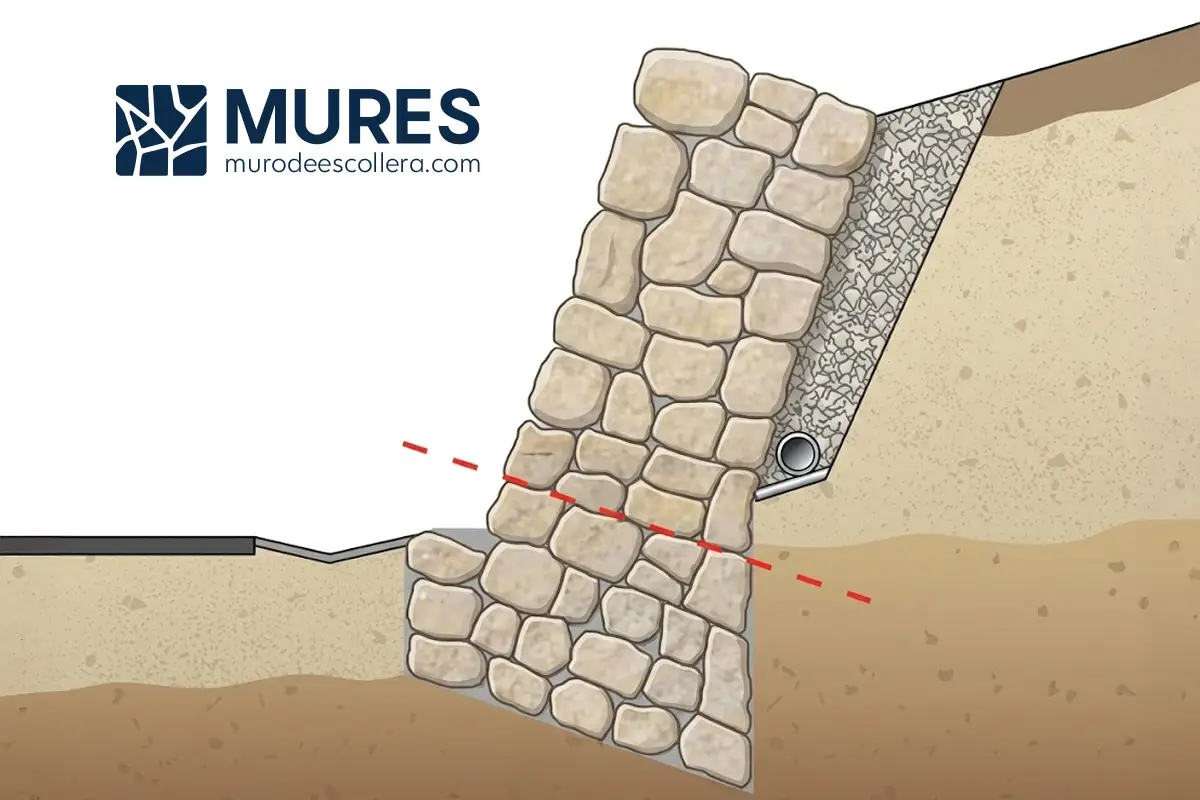
Escollera walls use very large, heavy blocks of natural stone, placed strategically to create strong, stable retaining structures. This time-tested technique resists high pressures and drains naturally through the gaps between the stones.
Especially effective for:
• Stabilising steep embankments and hillsides
• Protecting riverbanks and coastal areas from erosion
• Retaining large volumes of soil on major changes of level
• Projects that need to blend completely into the landscape
• Sites with high groundwater, thanks to excellent drainage
Advantages of escollera walls:
• Extremely durable: a lifespan of over 100 years
• Exceptional resistance to impact and dynamic loads
• Natural drainage without extra systems
• Minimal or no maintenance
• Highly valued rustic, natural look
• Flexible enough to cope with small ground movements

1.2. Stone Masonry Walls
Masonry walls use medium-sized, regular stones bonded with cement mortar, creating solid structures with a more refined finish than escollera. It combines the traditional look of stone with greater structural precision and design flexibility.
Main features:
• Superior finish with visible joints
• Greater dimensional control and a more regular face
• Possibility of complex architectural shapes
• Excellent strength with a slimmer section than escollera
• Blends perfectly into urban and residential settings
Ideal for stepped gardens, landscaped terraces, decorative boundary walls, medium-height retention (up to 3–4 metres) and projects that call for a traditional look with a neat finish. Proper drainage is always included.
2. Concrete Walls: Versatile and Efficient
Concrete walls are the most versatile and cost-effective option for large projects. They offer maximum structural strength, fast construction and adapt to any shape or height. They are the preferred choice for infrastructure, urban developments, industrial projects and any build where value matters without compromising safety.
Concrete allows everything from simple gravity walls to L-shaped, inverted-T or buttressed walls, optimising material for the specific loads and pressures. Reinforced with steel, it is ideal for tall walls and heavy loads.
Types of concrete walls:
• Gravity walls: use their own weight to resist pressure
• Cantilever walls: a more efficient L-shaped structure
• Buttressed walls: for great heights
• Reinforced concrete: maximum structural strength
• Precast concrete: fast installation
Main advantages:
• Excellent value for money
• Fast construction
• Adapts to any shape
• Suitable for great heights (10+ metres)
• Decorative finishes available: textured, exposed stone, paint
• Proven durability of 50–100 years
How We Build a Retaining Wall
Building a retaining wall is a technical process that needs careful planning and professional execution. At MURES we follow a rigorous process to deliver safe, durable, compliant structures:
1. GROUND STUDY: analysis of the land, soil type, water table and bearing capacity.
2. STRUCTURAL DESIGN: calculation of lateral pressure and stability against overturning, sliding and settlement; sizing of foundations and reinforcement where needed.
3. DRAINAGE: geotextiles, perforated drain pipes, gravel backfill and weep holes to release water and reduce hydrostatic pressure.
4. EXCAVATION AND FOUNDATIONS: site preparation, digging the footing and pouring the foundation to the calculated size.
5. BUILDING THE WALL: stone, concrete or masonry, with constant checks on plumb and level.
6. BACKFILL AND COMPACTION: suitable granular backfill, compacted in layers to prevent settlement.
7. FINISHING: surface finish to match the look you want.
Where We Build Retaining Walls
MURES builds retaining walls across:
• MÁLAGA PROVINCE (our main area)
– Málaga city and the metropolitan area
– Costa del Sol: Marbella, Estepona, Mijas, Fuengirola, Benalmádena and Manilva
– Axarquía: Vélez-Málaga, Torre del Mar, Nerja, Torrox, Frigiliana and Cómpeta
– Guadalhorce Valley
– Ronda and the Serranía
Is your project outside these areas? Get in touch and we’ll look at your case – for larger projects we can travel further afield.
Why Hire Professionals for Your Retaining Wall
A retaining wall is not a DIY job. It needs specialist knowledge of geotechnics, structural calculation and building regulations. Choosing MURES gives you:
- STRUCTURAL SAFETY: designs calculated by engineers for long-term stability.
- REGULATORY COMPLIANCE: projects that meet the Spanish building code (CTE), council rules and permits.
- PROVEN DURABILITY: quality materials and tried-and-tested techniques.
- PROFESSIONAL GUARANTEE: an established company with more than 20 years behind it.
- LONG-TERM SAVINGS: no costly repairs or rebuilds caused by poor design.
- PROPER DRAINAGE: preventing damp and excessive water pressure.
- FULL ADVICE: from choosing the type of wall to finishes and landscaping.
Retaining Wall Prices: What Affects the Cost
The price of a retaining wall varies a lot depending on several factors. At MURES we give you a personalised quote after assessing:
• HEIGHT AND LENGTH: bigger walls cost more overall but less per m².
• MATERIAL: natural stone (€80–150/m²), concrete (€60–120/m²), masonry (€90–160/m²).
• ACCESS: hard-to-reach sites increase machinery and logistics costs.
• GROUND CONDITIONS: problem soils need special foundations.
• DRAINAGE: geotextiles, pipes and drainage material.
• FINISHES: decorative, textured or cladding finishes.
* Guide prices only; the final price depends on the type of stone, distance to the site, access, etc.
FREE, NO-OBLIGATION QUOTE: request your free quote within 24–48 hours. We visit your land, look at what you need and give you a detailed quote with no obligation.
NEED A PROFESSIONAL, LONG-LASTING RETAINING WALL?
Retaining Wall FAQs
What is a retaining wall?
A retaining wall is a structure that holds back the pressure of the ground so it doesn’t slip or collapse, letting you have two different levels – for example, a flat terrace on a sloping plot. It can be built with escollera rock, reinforced concrete, stone masonry or gabions, depending on the height and the ground.
How much does a retaining wall cost?
As a guide, a retaining wall costs €60–120/m² in concrete, €80–150/m² in natural stone or escollera and €90–160/m² in masonry, plus VAT. The price mainly depends on the height, machine access and the foundations and drainage required.
What is a gabion wall?
A gabion wall is made of galvanised wire mesh baskets filled with stone and stacked. It is flexible, drains naturally and copes with small ground movements. It is used on banks, watercourses and gardens. In the Axarquía it competes with escollera, which usually lasts longer and fits the landscape better.
What types of retaining walls are there?
The main types are escollera walls (large stone blocks), reinforced concrete walls (footing and stem), masonry walls (stone and mortar), gabion walls (mesh baskets filled with stone) and reinforced concrete block walls. The choice depends on the height, the ground, access and the look you want.
When does a retaining wall need an engineer's design?
A retaining wall needs a technical design and calculation when it reaches a certain height, when it supports a house, a road or another structure, or when the council requires it for the licence. As a practical rule, anything over 1.5–2 m should always be calculated by an engineer or architect, although each municipality sets its own requirements.
What drainage does a retaining wall need?
A well-built retaining wall has gravel backfill behind it, a perforated drain pipe at the base to carry water away and, in concrete walls, weep holes through the wall. In escollera, the gaps between the stones drain naturally, but a gravel backfill is still recommended. Without drainage, water pushes the wall.
What happens if a retaining wall doesn't drain properly?
If a retaining wall doesn’t drain, rainwater builds up behind it and adds pressure the wall was never designed for. With the autumn storms, damp appears, the wall leans or cracks and, in the worst case, collapses. Most of the failed walls we see in the Axarquía fail because of water, not soil.