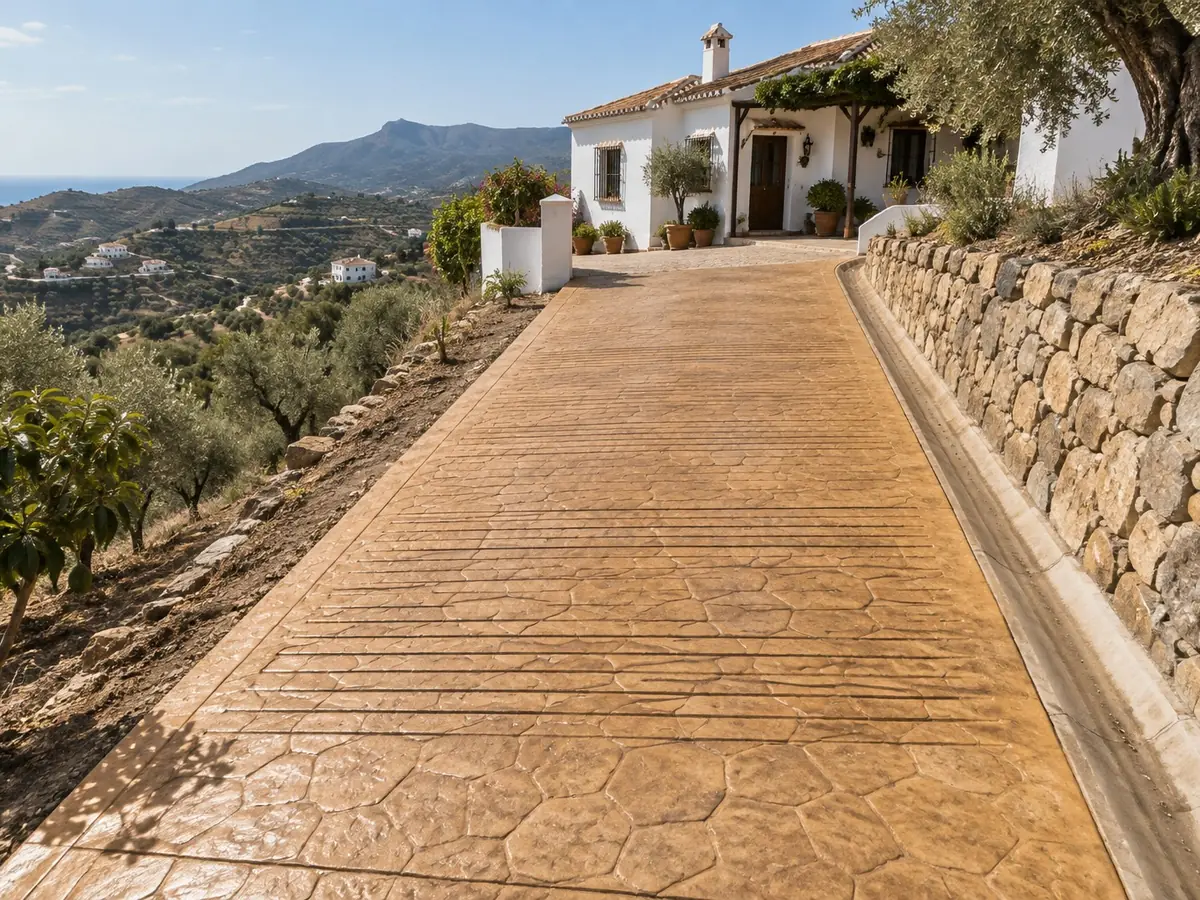
Concrete ramps and driveways in Vélez-Málaga and the Axarquía
Garage ramps, villa driveways and access to hillside properties. We calculate the gradient so your car doesn't scrape, build a base that won't sink and leave a finish that grips in the rain. Our own machinery and a fixed, itemised quote.
- Since 2006 building across the Axarquía
- Our own machinery and quarry used by our own crew
- 5,0 ★ on Google
- Free, no-obligation visit
A well-built ramp goes unnoticed. A badly built one, every single day
The car scraping its underside, the ramp that's slippery in the rain, water getting into the garage or the crack after two winters. It's almost always down to the gradient, the base or the drainage. That's exactly what we take care of.
Calculated gradient
We measure the real height difference and design sections and smooth transitions so the car doesn't touch at the bottom or the top.
A base that won't sink
We excavate the formation, add machine-compacted gravel and reinforce with steel mesh. It's the part you don't see and the part that lasts longest.
Truly non-slip
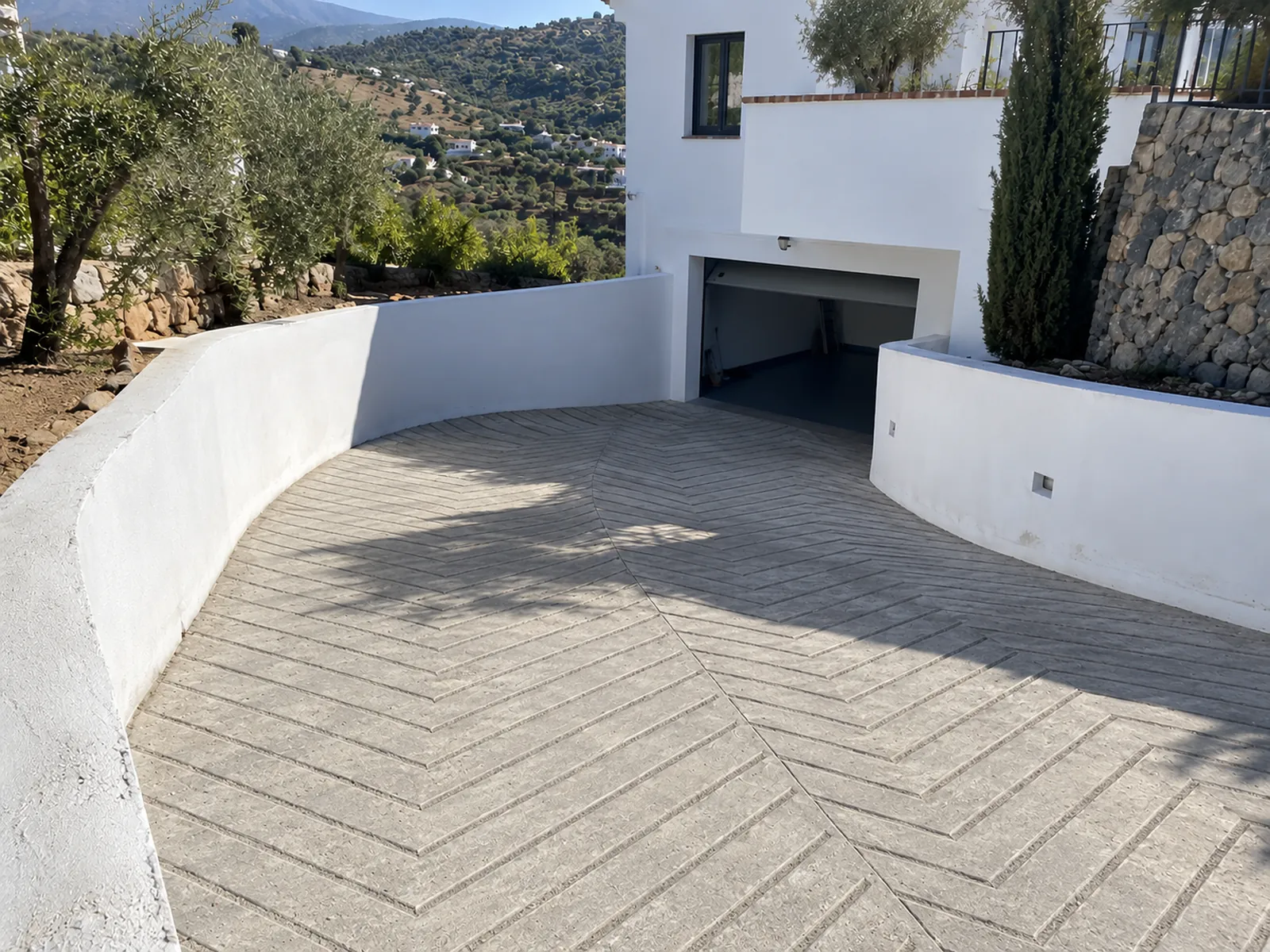
Herringbone, brushed or stamped with non-slip aggregate. Grip in the rain, on leaves and with a loaded car.
Water kept out
Channel drain, cross-fall and water outlet sorted before concreting, so it doesn't end up inside your garage.
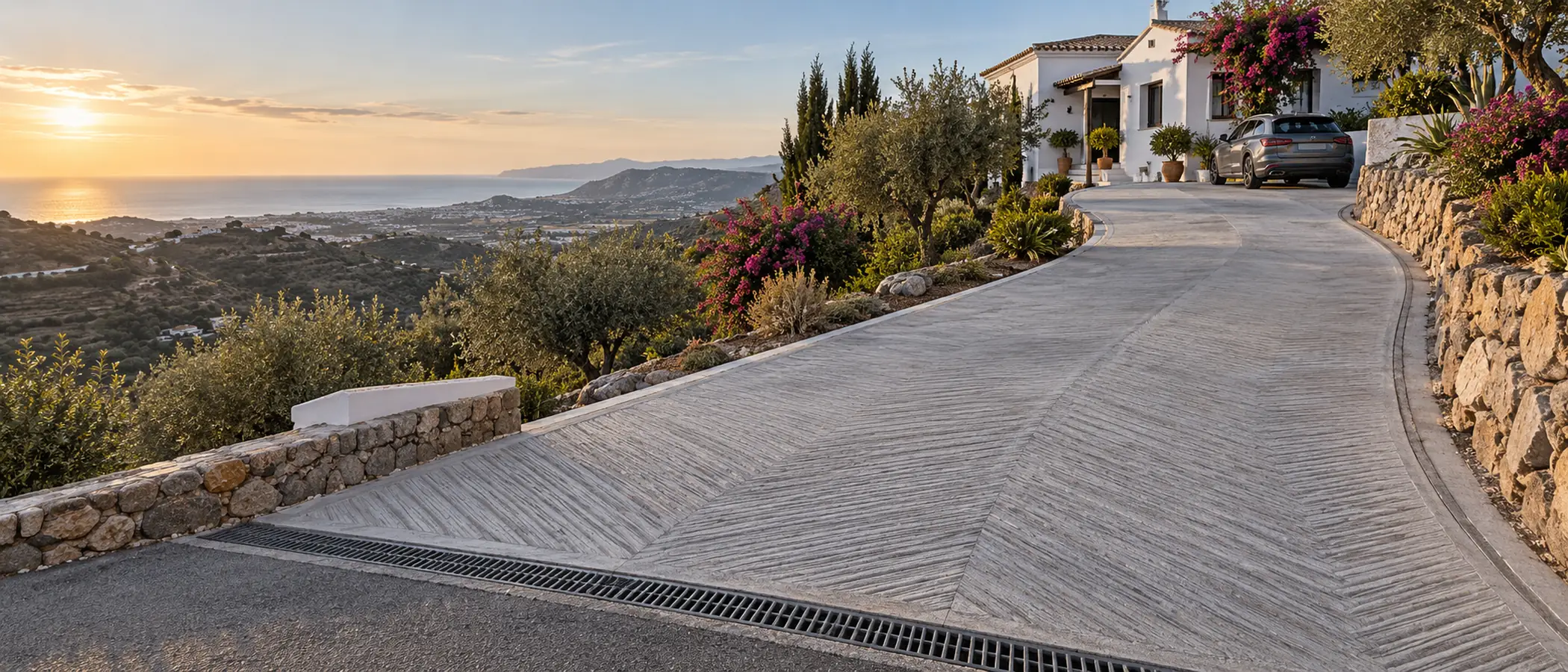
How much does a concrete ramp cost?
Every ramp is different, so we don't give catalogue prices: we see the site and give you a fixed, itemised quote. These are the factors that affect the price most.
Area and thickness
The ramp area and concrete thickness: 15 cm for cars, 18–20 cm if lorries or loaded vans will use it.
The ground and the base
If we need to excavate, remove poor soil or do a lot of filling, the quote changes. A good gravel sub-base is non-negotiable.
Height difference and gradient
A lot of height to gain in a short space calls for bends, landings or a small retaining wall along the side.
The finish
Brushed or herringbone is the most economical; stamped concrete with colour and pattern costs a little more.
Drainage
Grated channel drains, gullies or pipework to the water outlet.
Access for the concrete lorry
If the lorry can't reach, a pump or dumper is needed, especially on rural plots and narrow streets.
Removing the old ramp
If old concrete or block paving has to come up, add demolition and removal.
Licence and dropped kerb
Depends on the town hall and whether the ramp touches the pavement or public road. If you need one, it can be handled by Trámita.
A cheap ramp with a poor base ends up expensive two years later. If it sinks or cracks, the whole thing has to come up. That's why in our quote the excavation, compacted gravel and steel mesh are always itemised, line by line.
Calculate your ramp gradient
Enter the length, width and how much it has to rise. You'll see the gradient, whether it's comfortable for a car and how much concrete it needs. It's a guide: we check the rest on the visit.
These are rough calculations, not a price. Many by-laws limit garage ramps to 16–18% on a straight and 12% on a bend, with an almost-flat section next to the street; we check this for your town hall on the visit.
Ask for a price for this ramp on WhatsAppHow steep can a garage ramp be?
The gradient decides whether the ramp is comfortable or a daily headache.
As a guide, a straight garage ramp works well up to 15–16%, and on a bend it's best not to exceed 12 %. Above 20% many cars scrape, skid in the wet or struggle to pull away in winter.
Just as important as the gradient are the changes in slope: at the top and bottom we build a gentler transition so the car's nose and underside don't touch. And next to the street we leave, where possible, a few almost-flat metres so you can pull out with good visibility.
| Gradient | What it's like |
|---|---|
| Up to 12% | Very comfortable. Fine on a bend too. |
| 12–16 % | Fine for a straight garage ramp. |
| 16–20 % | Steep: very non-slip finish and gentle transitions. |
| Over 20% | Only for short sections on rural plots. Better to lengthen it or add a bend. |
What a proper ramp quote includes
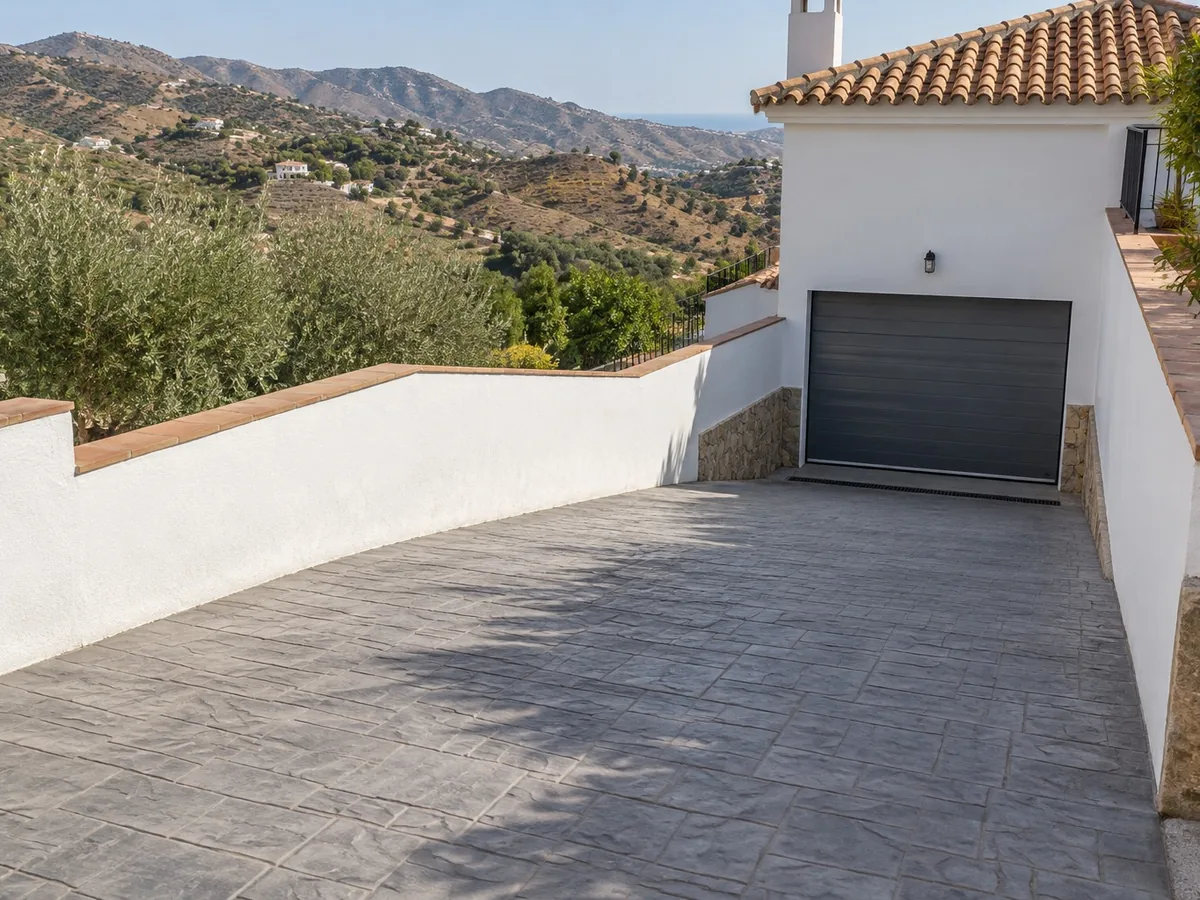
Always ask for the base and thickness to be specified. That's where corners get cut most and what shows most over the years. In ours, every item is listed.
The base
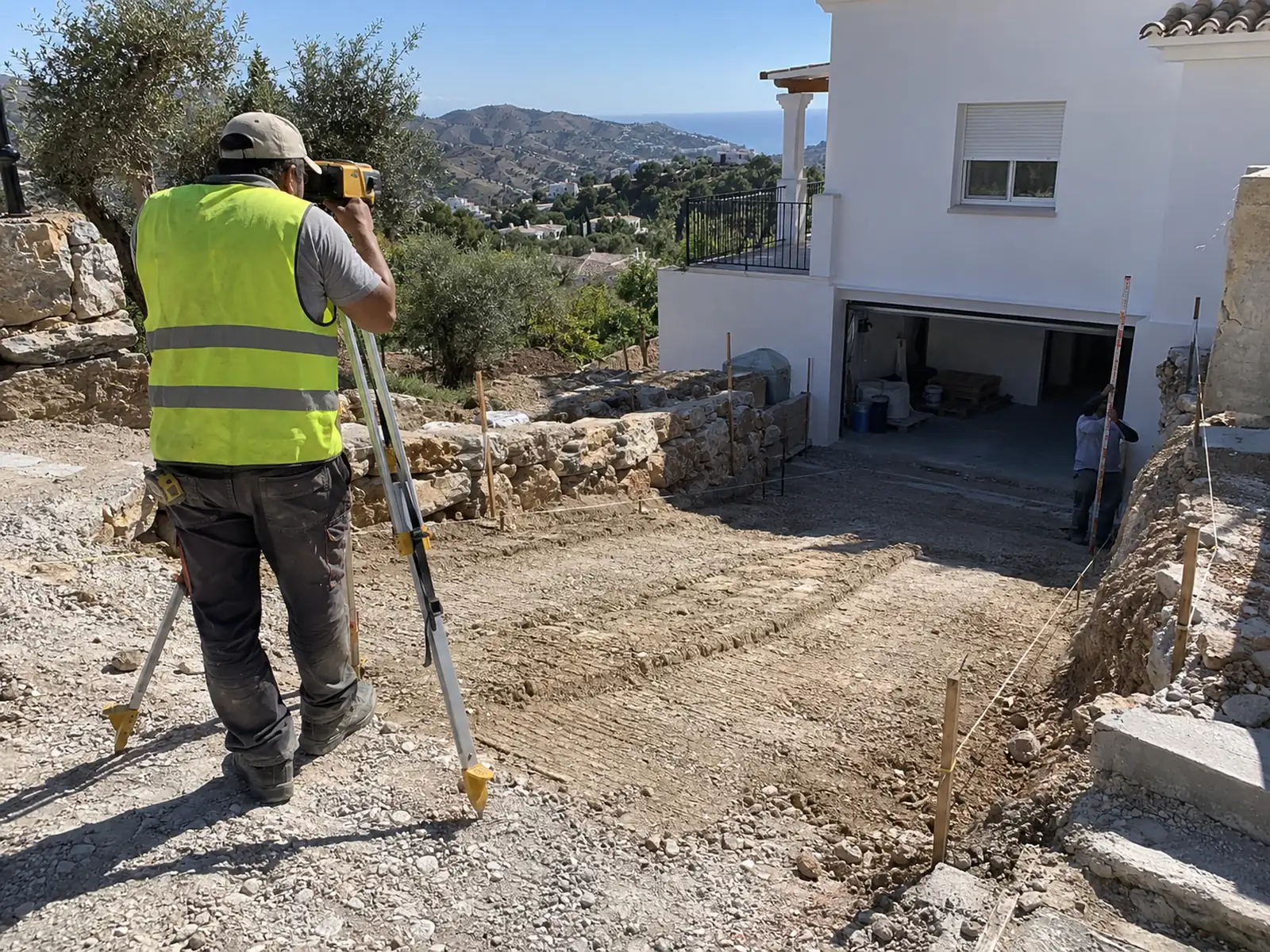
- Visit, measuring the height difference and designing the gradient
- Demolition of the old ramp, if there is one
- Excavating the formation and removing spoil
- Compacted crushed gravel sub-base, laid in layers
- Edge formwork and, if needed, a kerb or low wall
- Steel mesh on spacers
The concrete and the finish
- Ready-mix HA-25 concrete, vibrated and screeded
- Non-slip finish: herringbone, brushed or stamped
- Control joints cut at the right time
- Grated channel drain and water outlet
- Curing and protection for the first few days
- Cleaning and removal of waste
How we build a concrete car ramp
A standard garage ramp takes 3 to 6 days on site. After that, you need to wait a few days for the concrete to gain strength before driving on it.
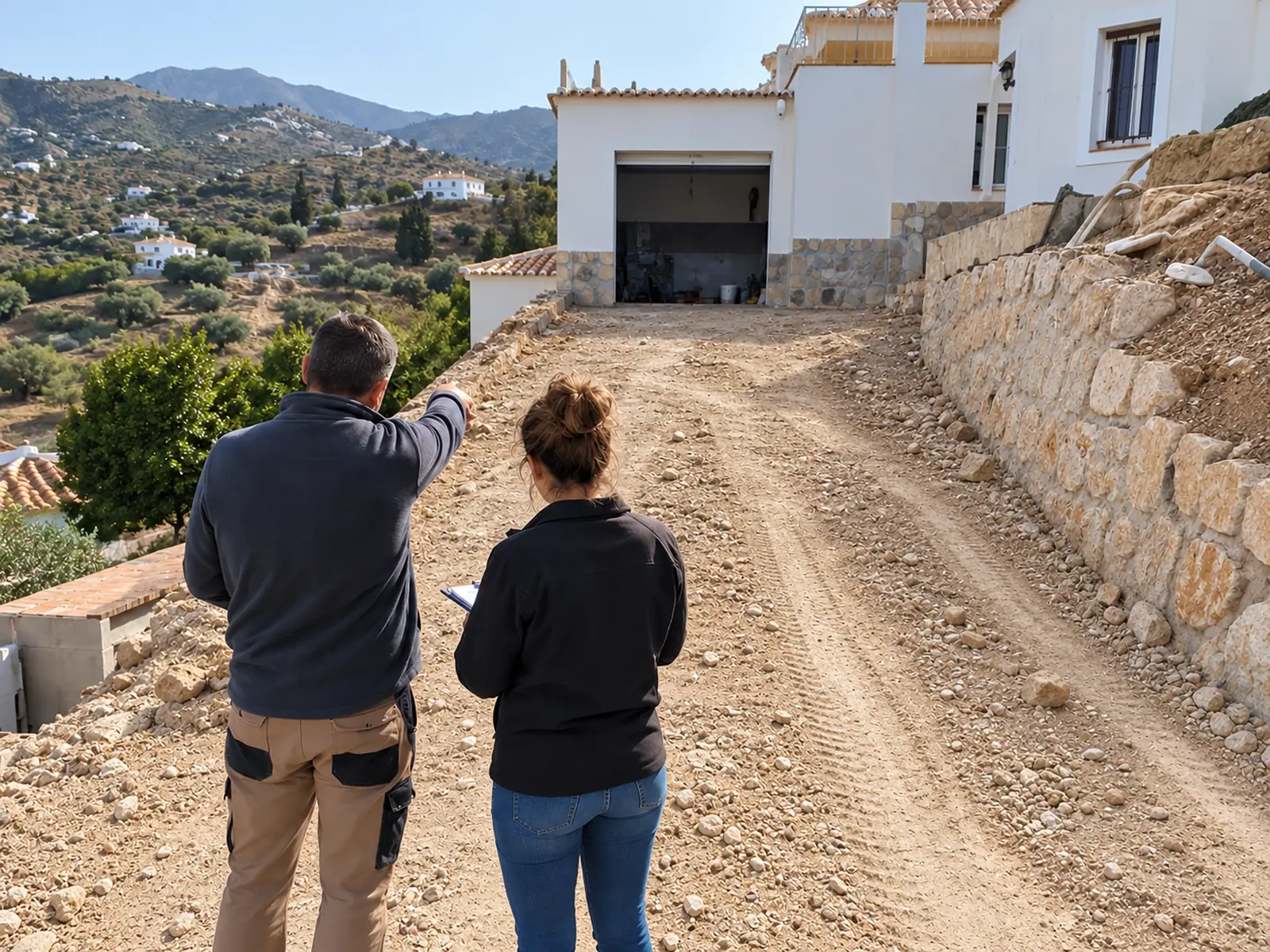
Visit and measurement
We measure the height difference, see where the water runs and give you an itemised price.
Free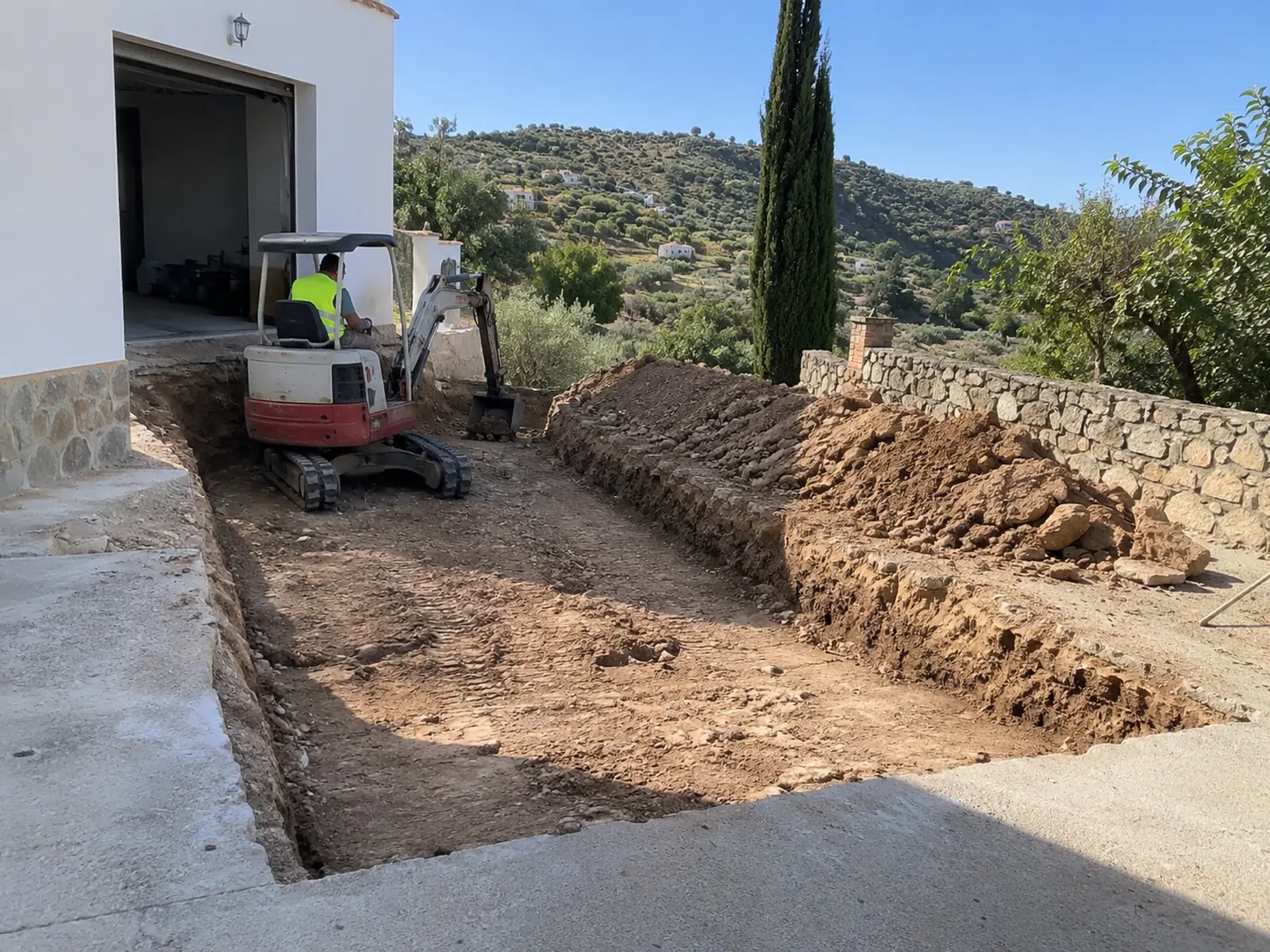
Demolition and formation
We remove the old surface and excavate the formation to the exact level.
1 day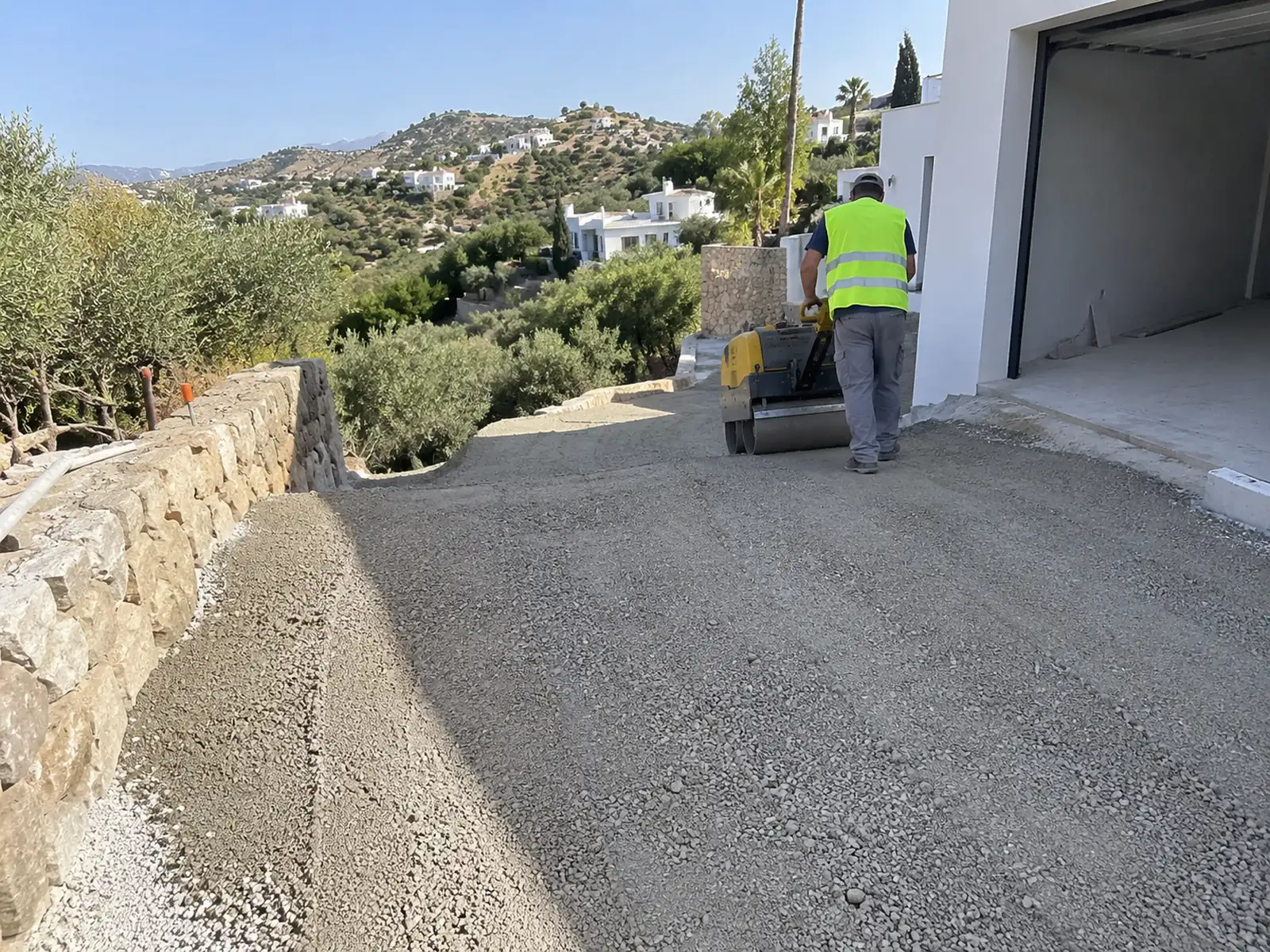
Compacted base
Gravel laid in layers and machine-compacted. That way it won't sink.
1 day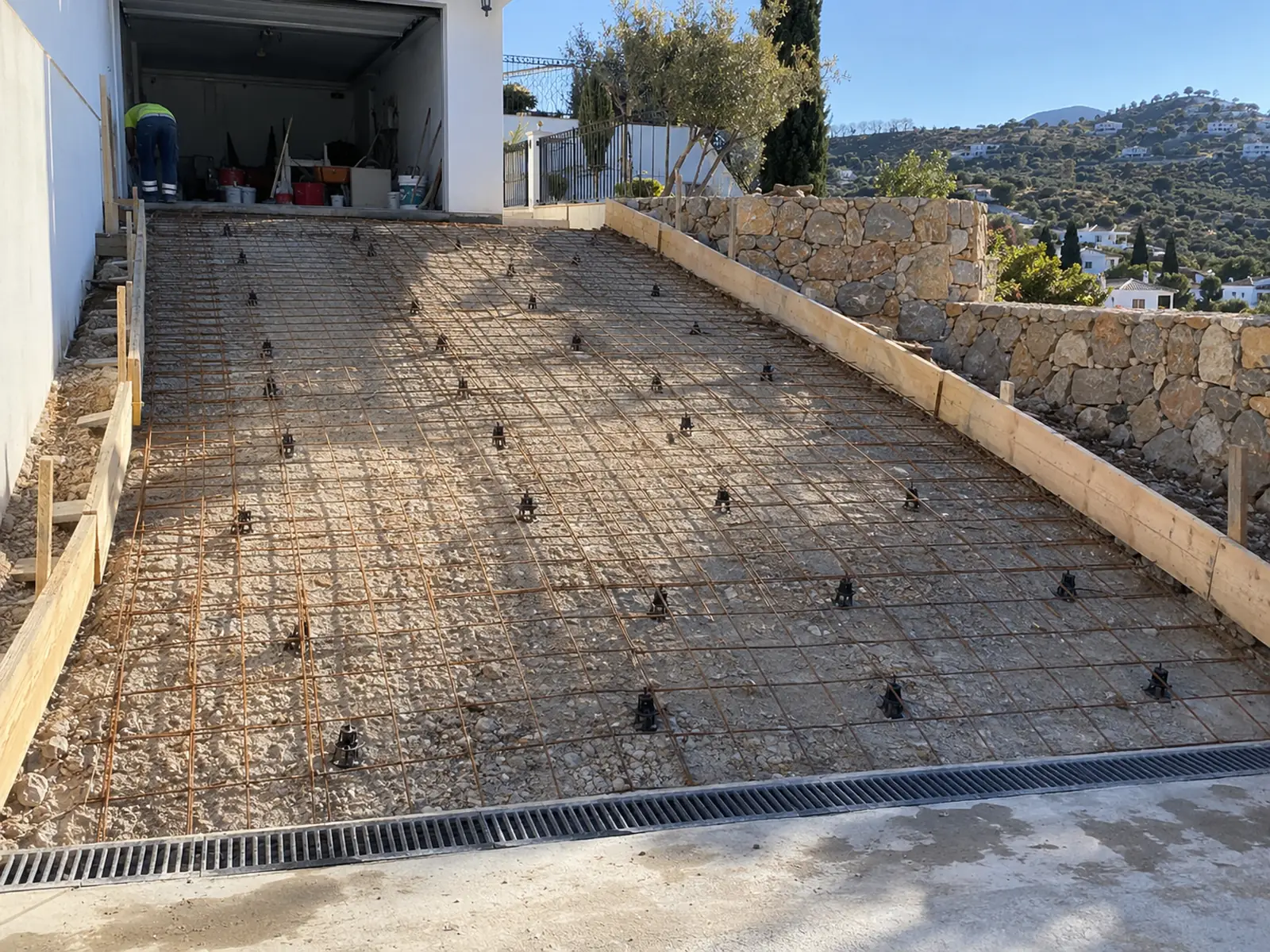
Formwork and steel mesh
Edges formed, channel drain placed and steel mesh on spacers.
1 day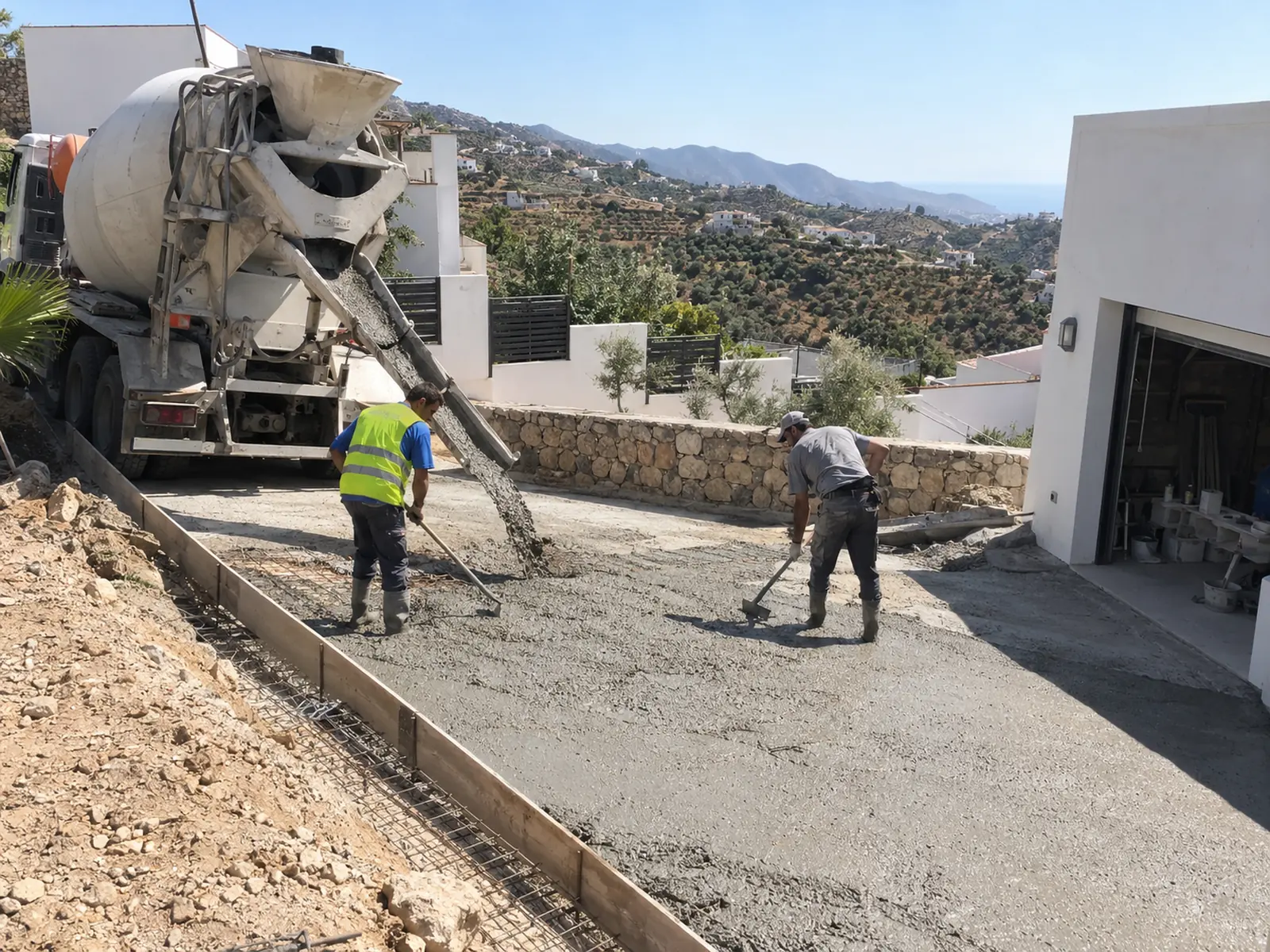
Concreting
Ready-mix concrete, vibrated and screeded following the set gradient.
1 day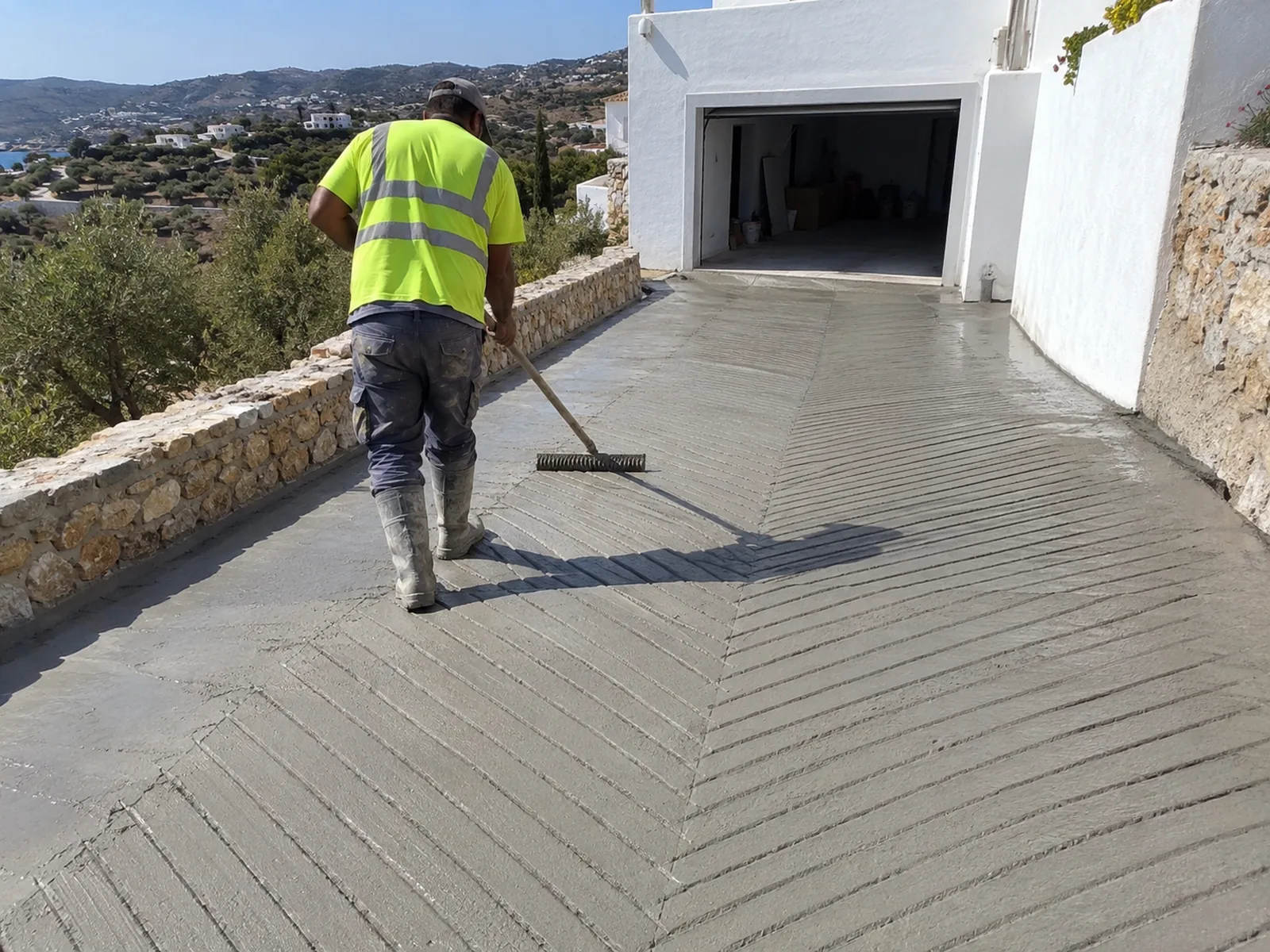
Non-slip finish
Herringbone, brushed or stamped, at just the right moment of setting.
Same day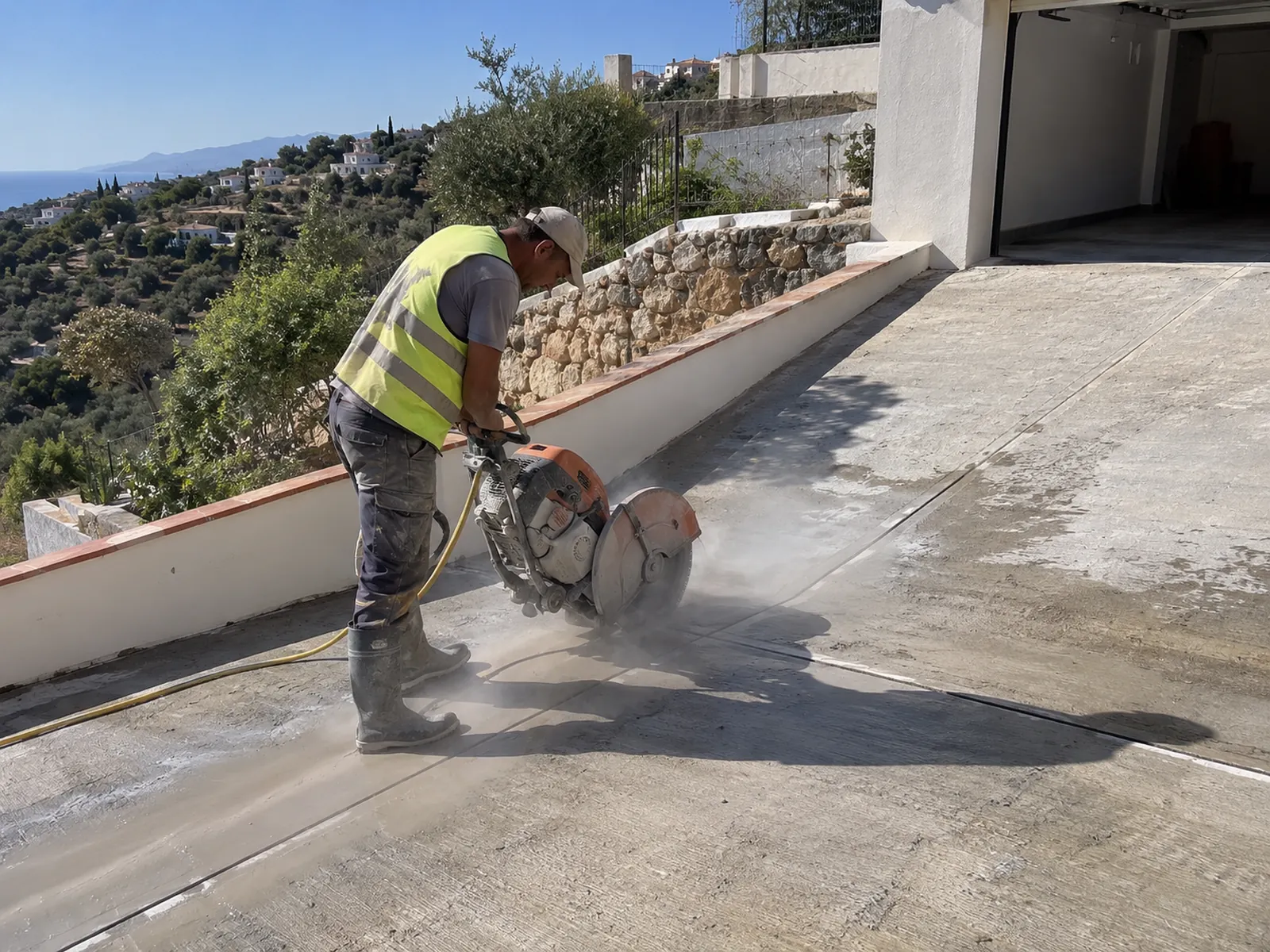
Joints
We cut the joints so the concrete can move without cracking.
24–48 h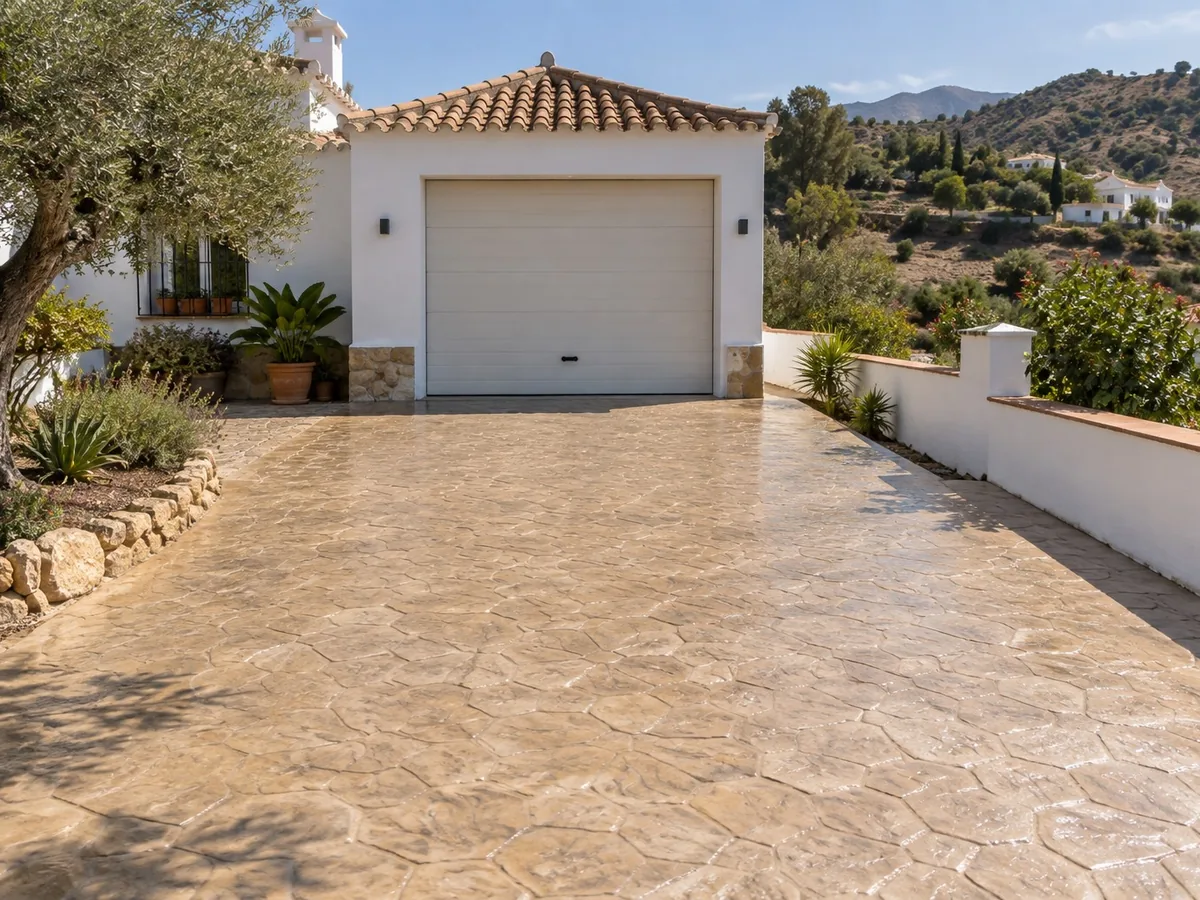
Curing and first use
Light cars from about 7 days. Lorries, better after a month.
7 daysHerringbone, brushed or stamped: which finish to choose
On a ramp, grip comes first; looks come second. This is how each finish performs.
Herringbone
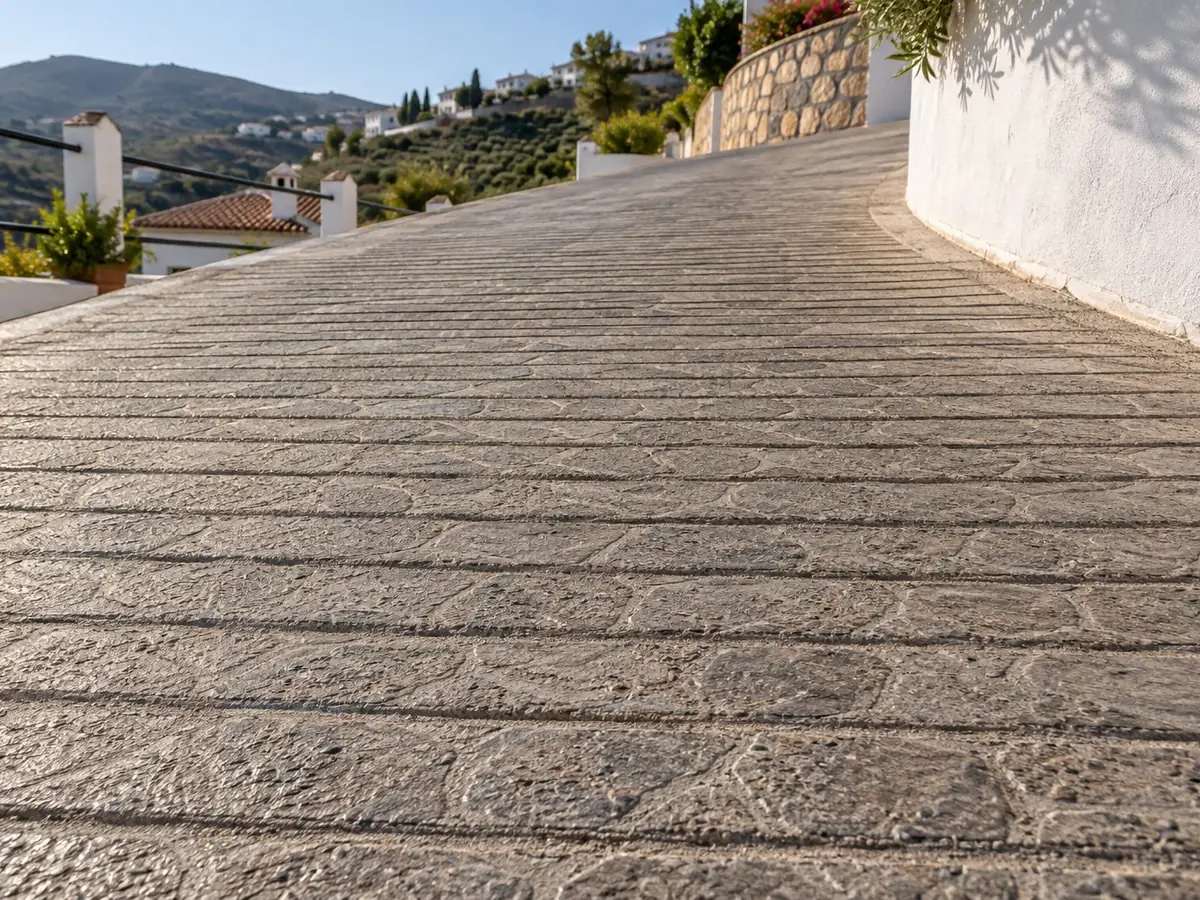
Maximum gripHerringbone or straight grooves marked while fresh. The best grip on steep ramps.
Brushed
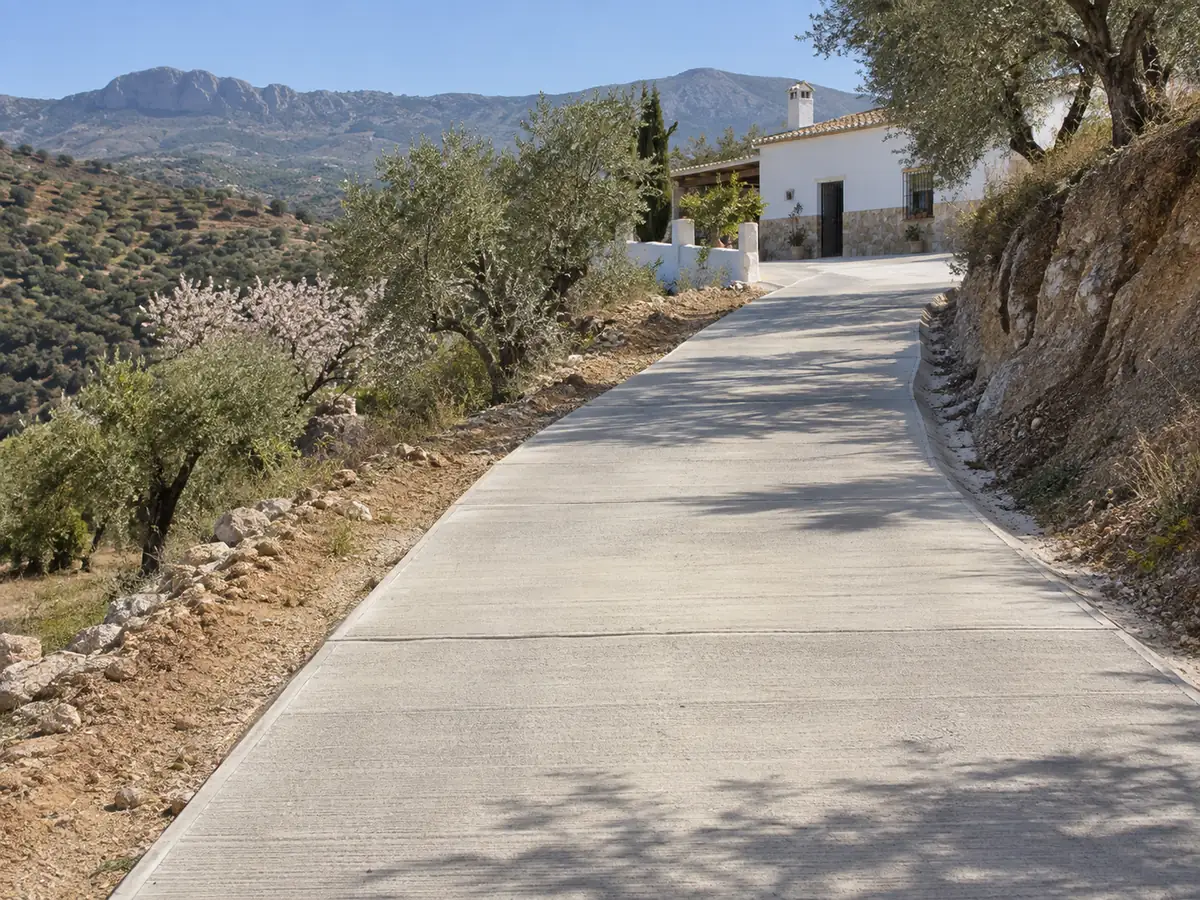
Broom texture, economical and practical. Ideal for long access tracks.
Stamped concrete
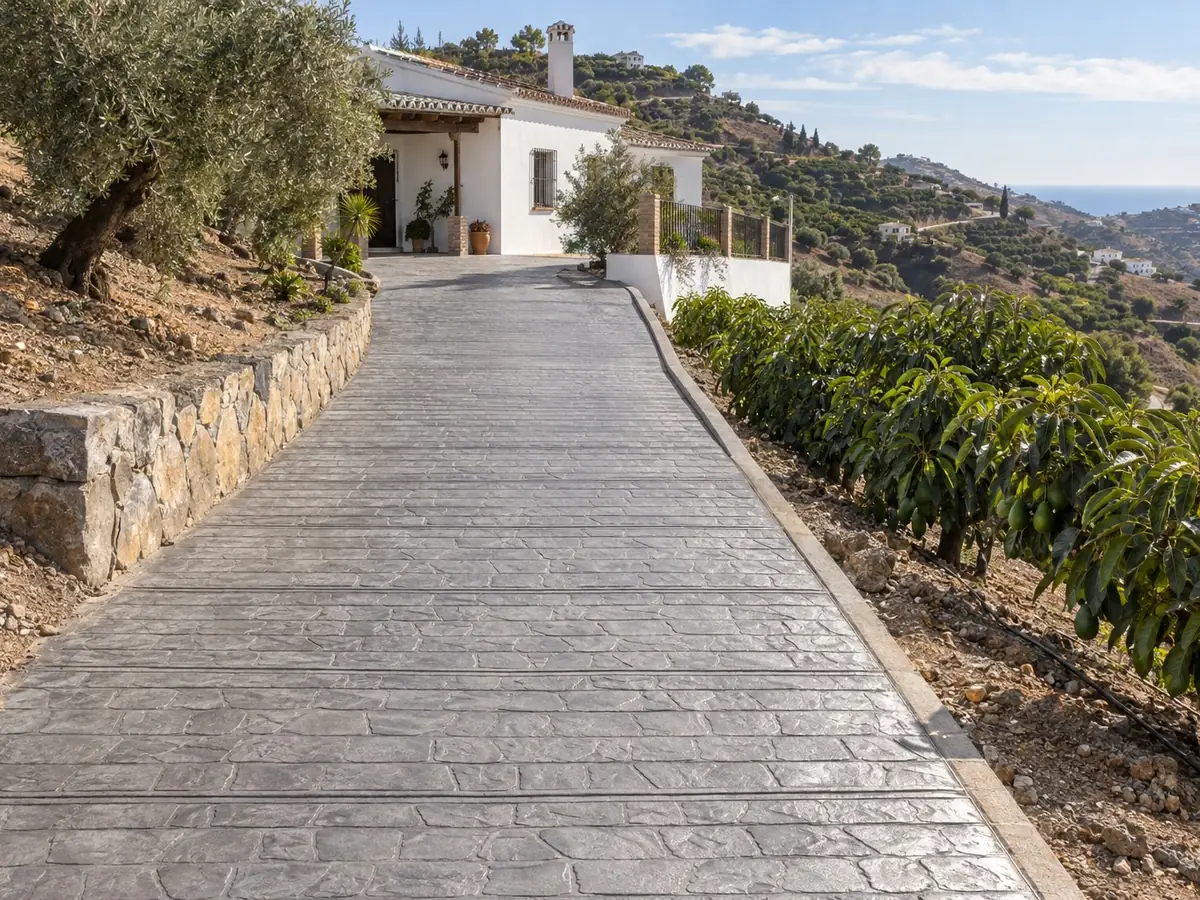
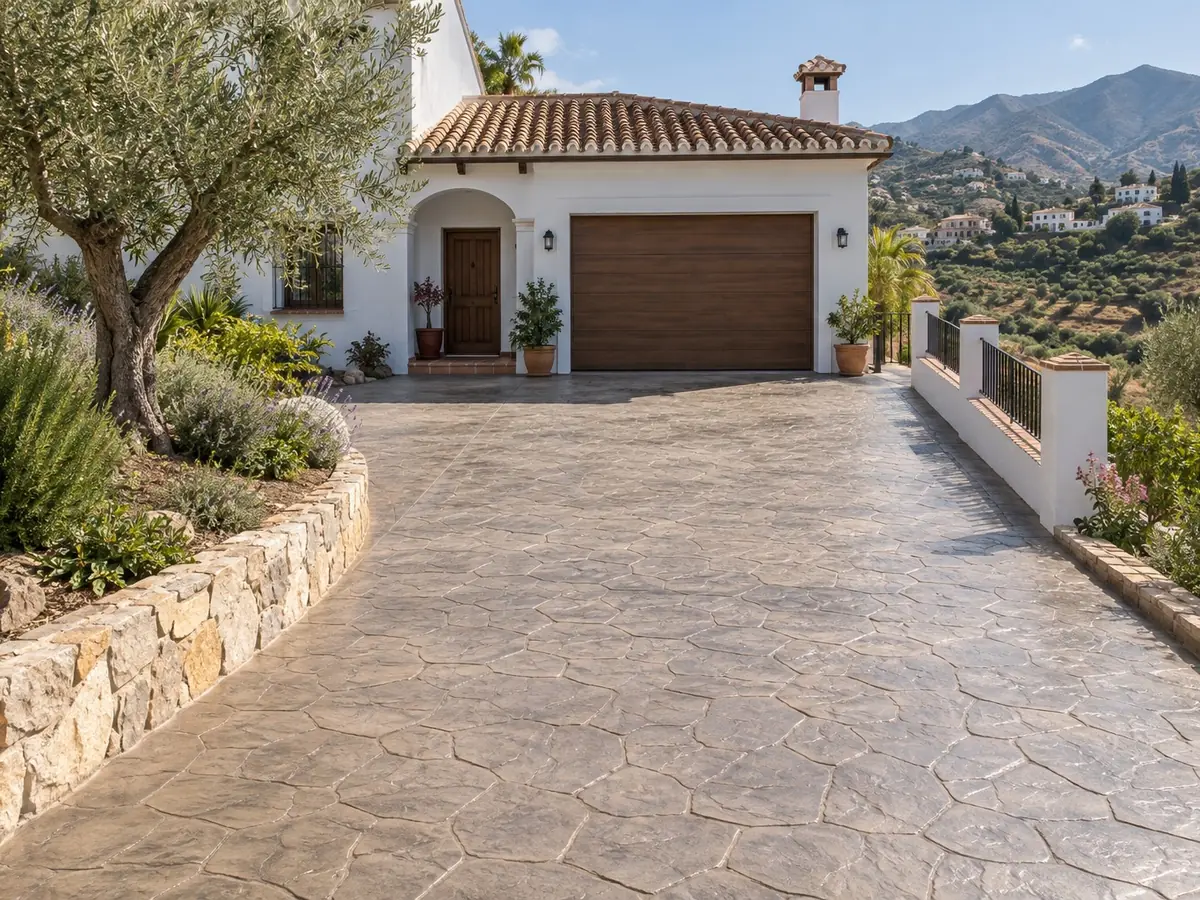
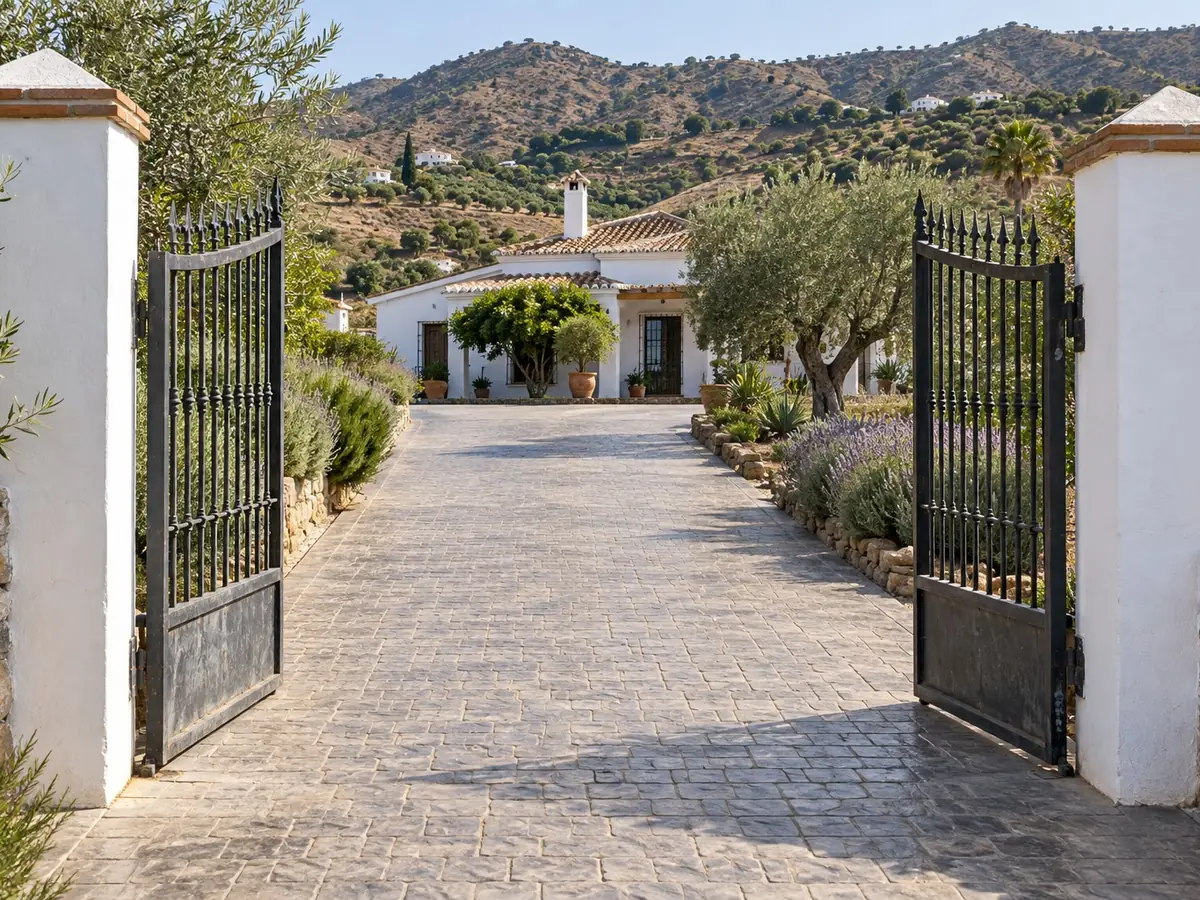
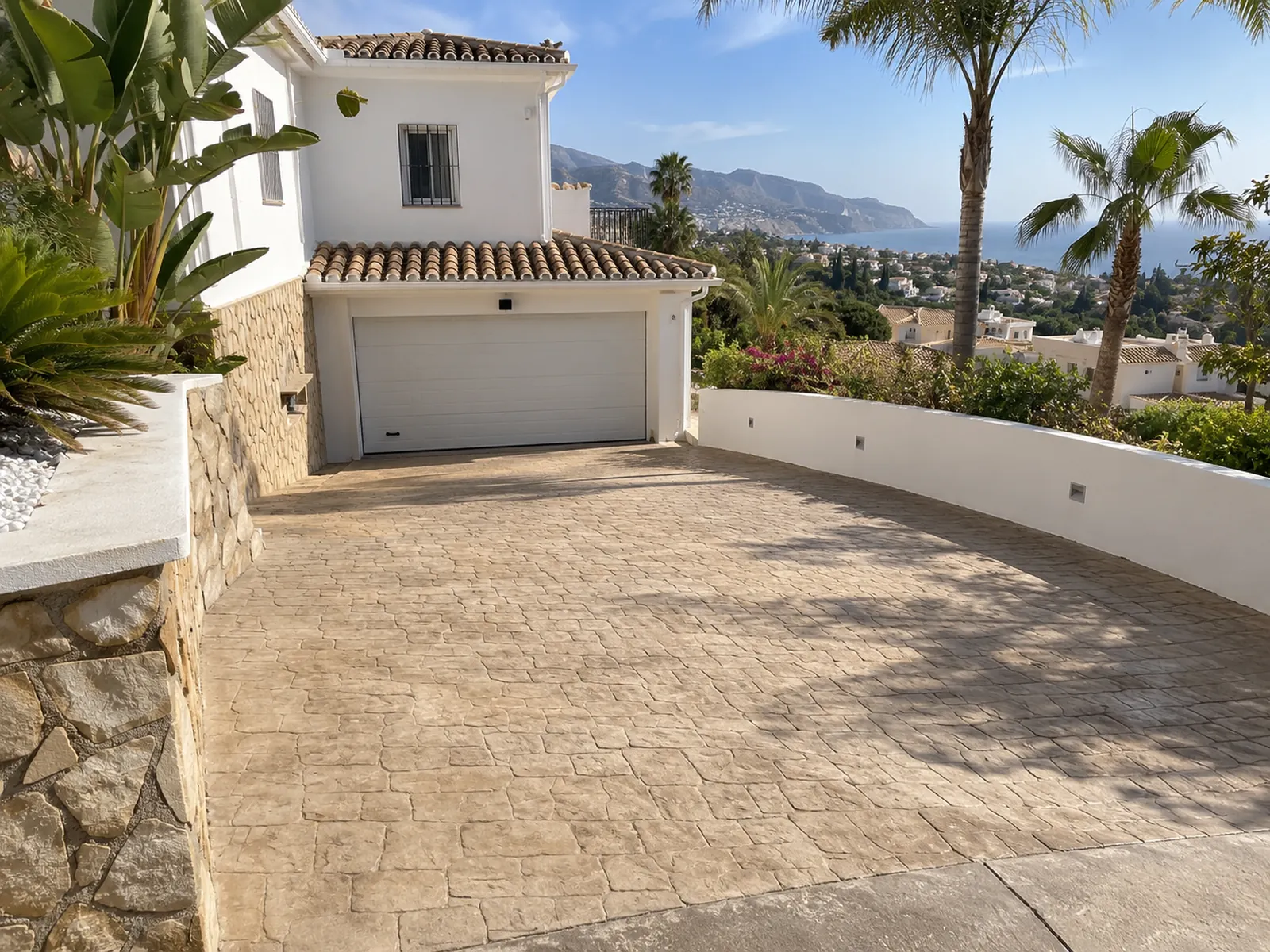
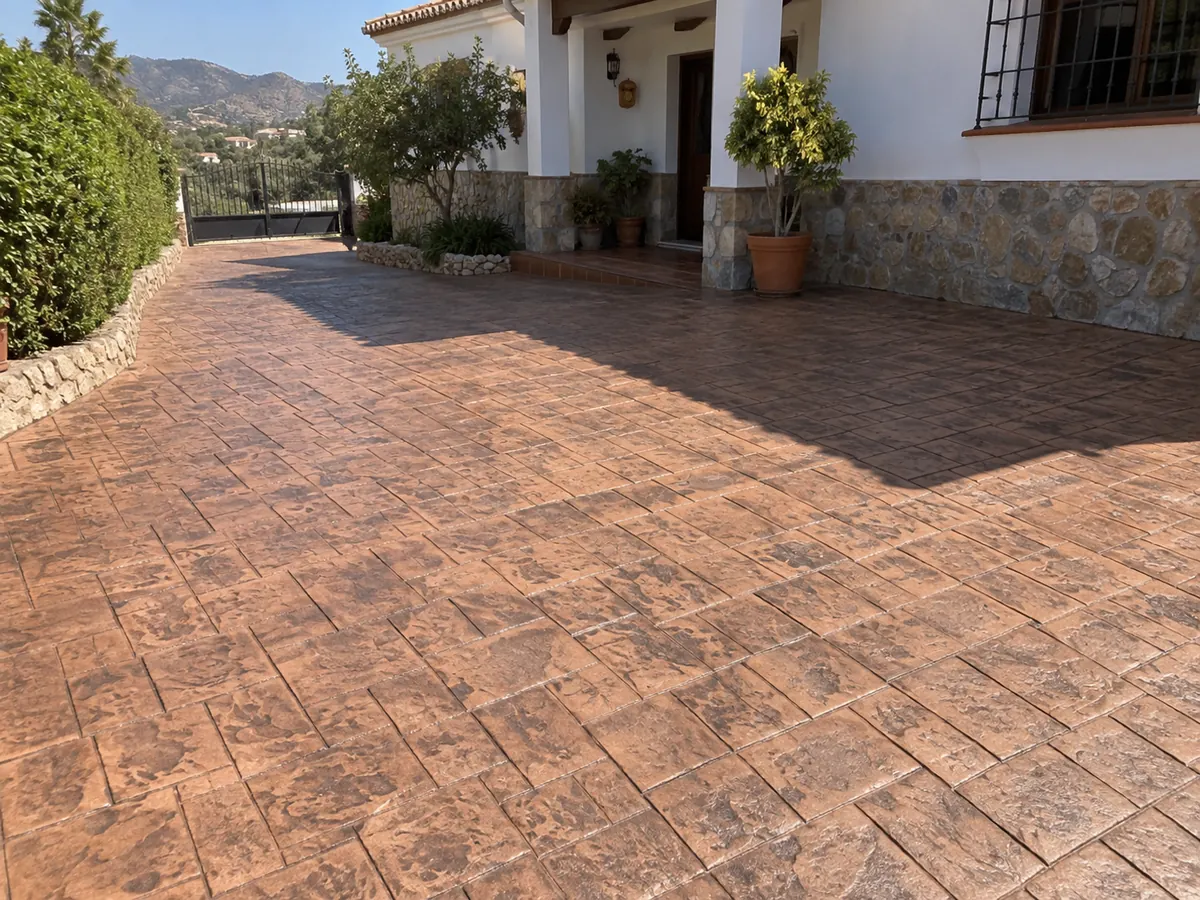
Imitates stone, cobbles or timber, with non-slip aggregate. For driveways on show at the front of the house.

Stamped with colour
Two colours or a border to mark the route. Choose your shade on our colour chart.
| Finish | Grip when wet | Looks | Price | Ideal for |
|---|---|---|---|---|
| Herringbone | ●●● Very high | Functional | € | Steep garage ramps |
| Brushed | ●●● High | Simple | € | Access roads and rural tracks |
| Stamped | ●●● High (with aggregate) | Very high | €€ | Villa driveways on show |
| Smooth float finish | ●●● Low | Clean | € | Only on flat areas, never on a ramp |
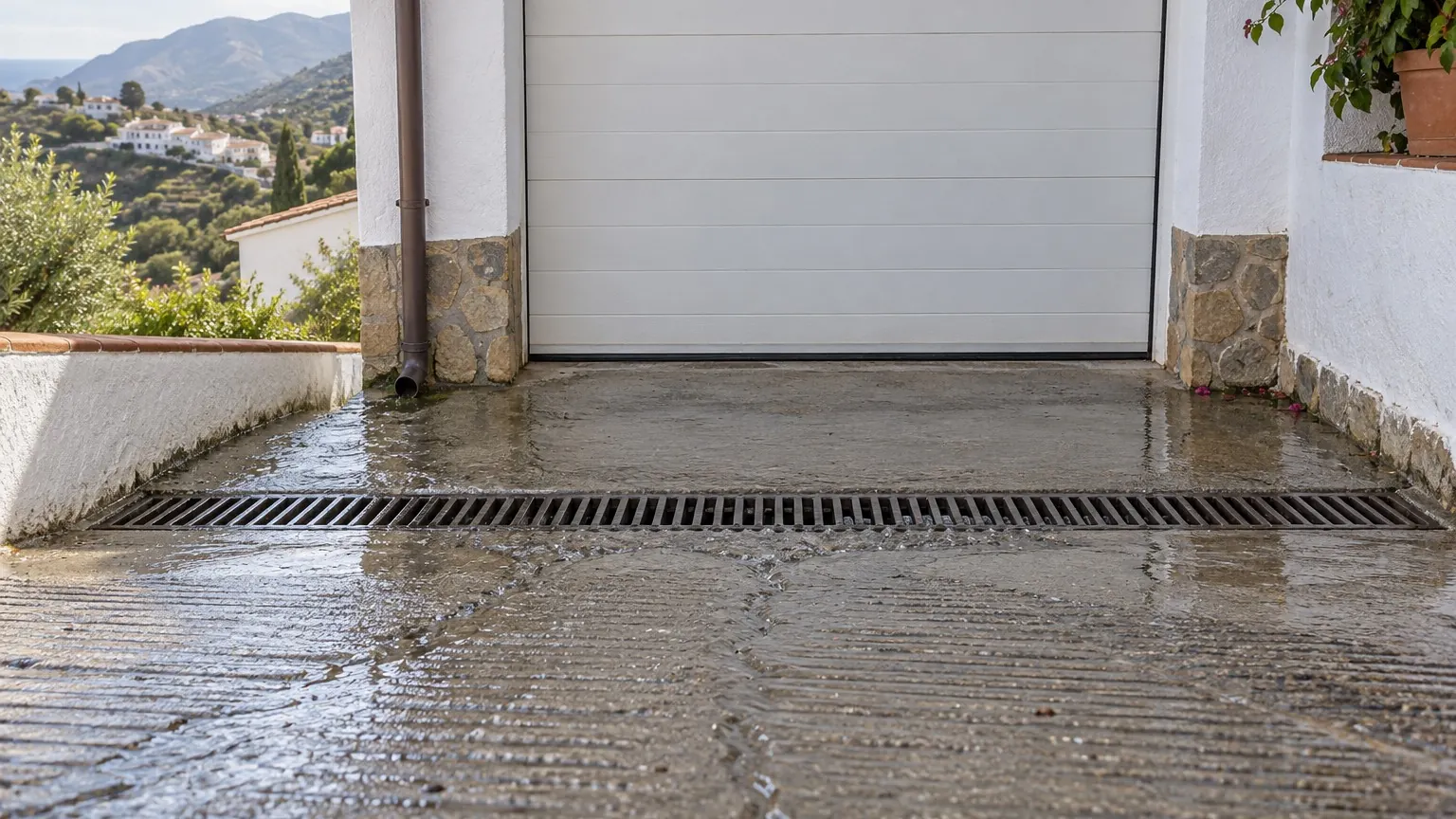
Keeping water out of the garage
A ramp sloping down towards the house collects water from the whole street.
That's why we deal with the water before concreting: a grated channel drain at the foot of the ramp, a slight cross-fall to shed water to the edges, and an outlet connected to somewhere it can drain away.
On driveways rising from the street we do the opposite: make sure water from the plot doesn't run onto the road or wash soil out every time it rains.
Ramps and access for hillside properties
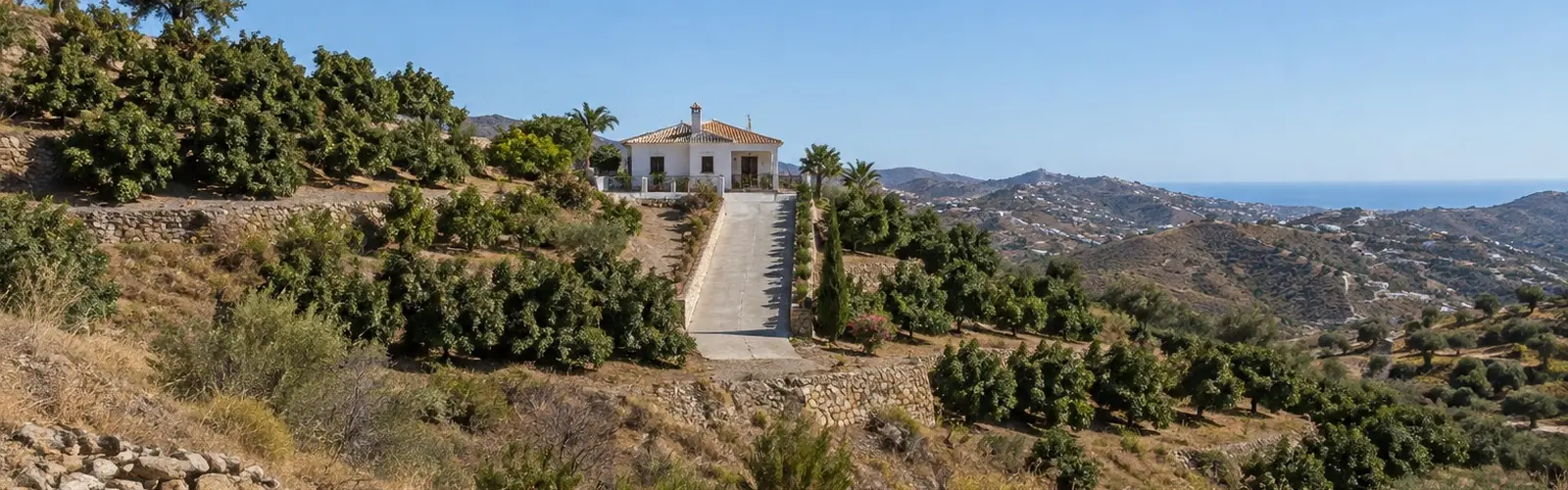
In the Axarquía many houses sit at the top of a steep track.
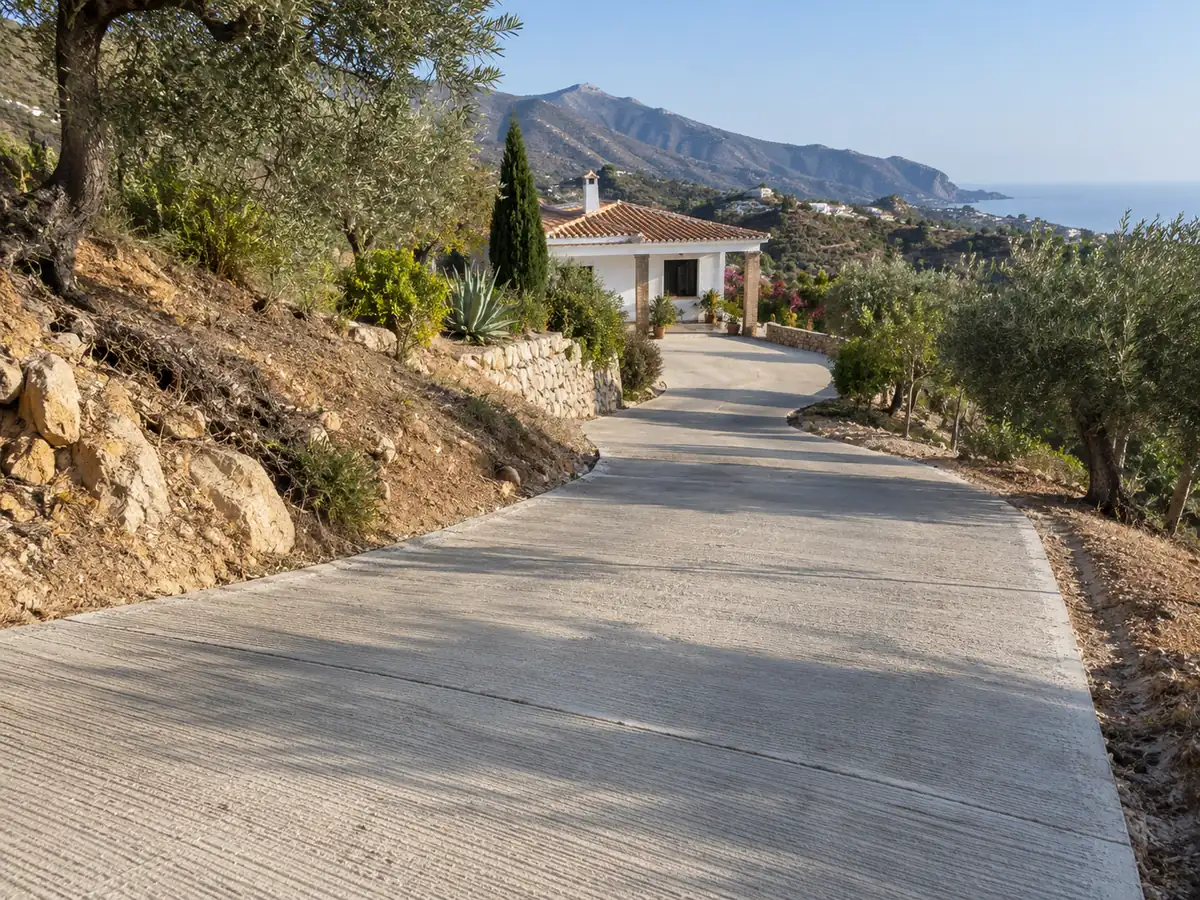
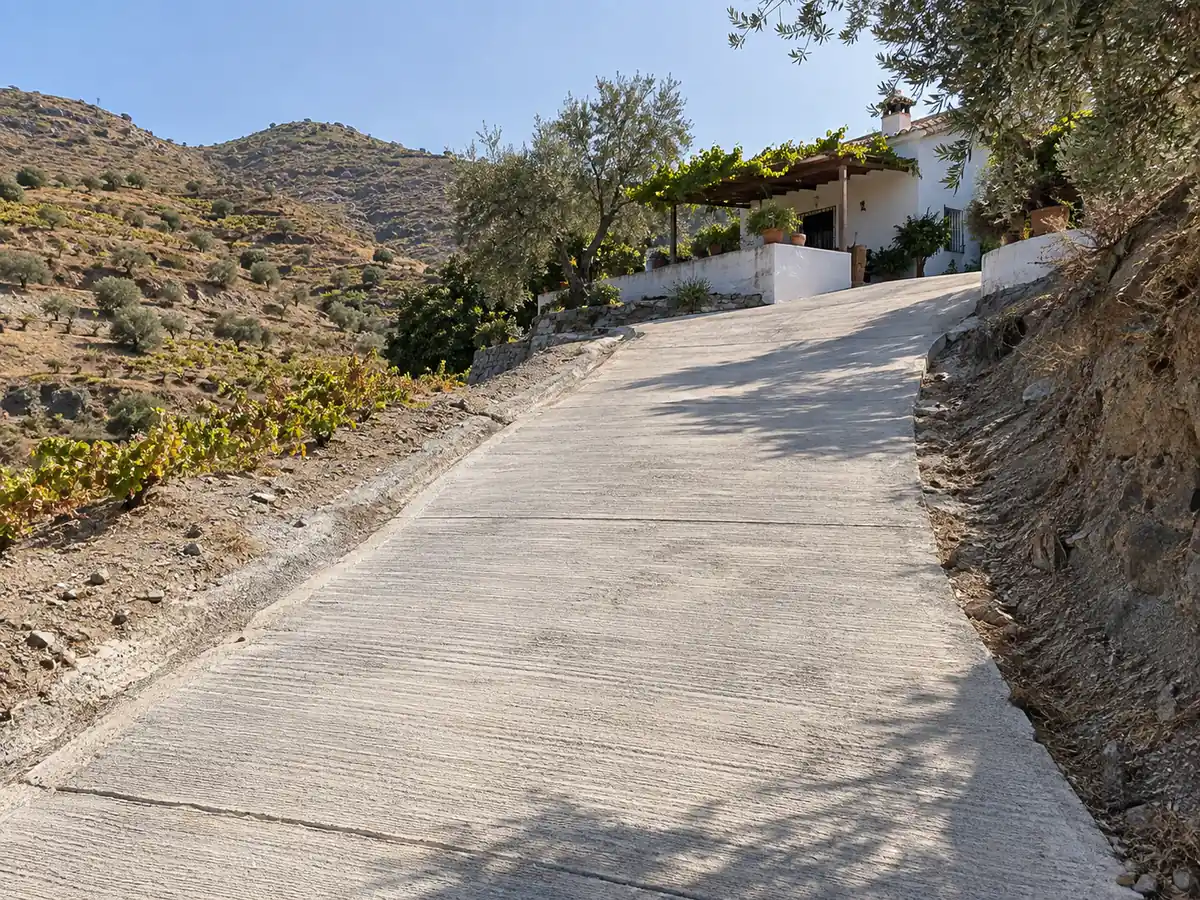
There, the ramp is more than a floor: you have to move earth, hold the bank with an escollera rock wall or a concrete, and concrete the steepest sections so the rain doesn't wash them away.
We do it all as one company with our own machinery, and if the track is long we combine concrete sections where needed with track repairs on the rest, to keep costs down.
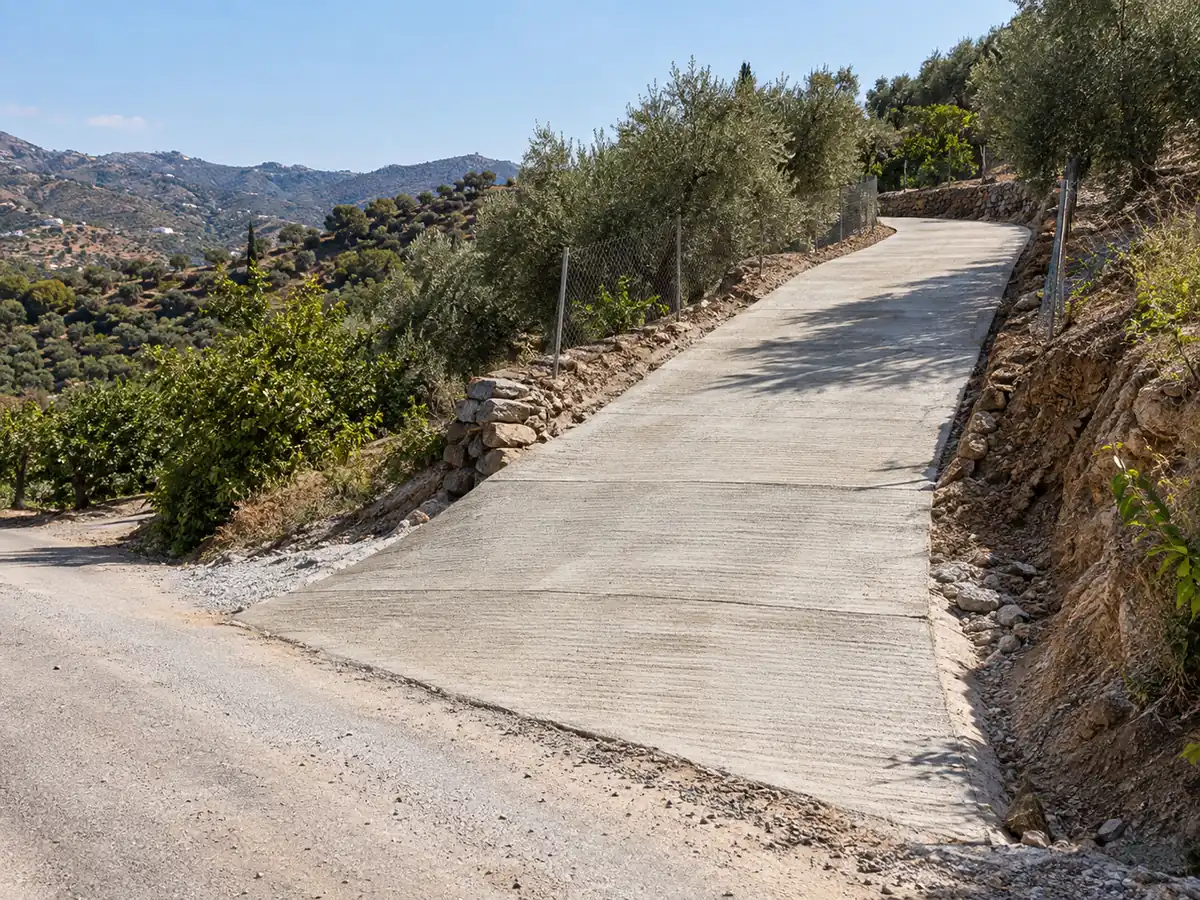
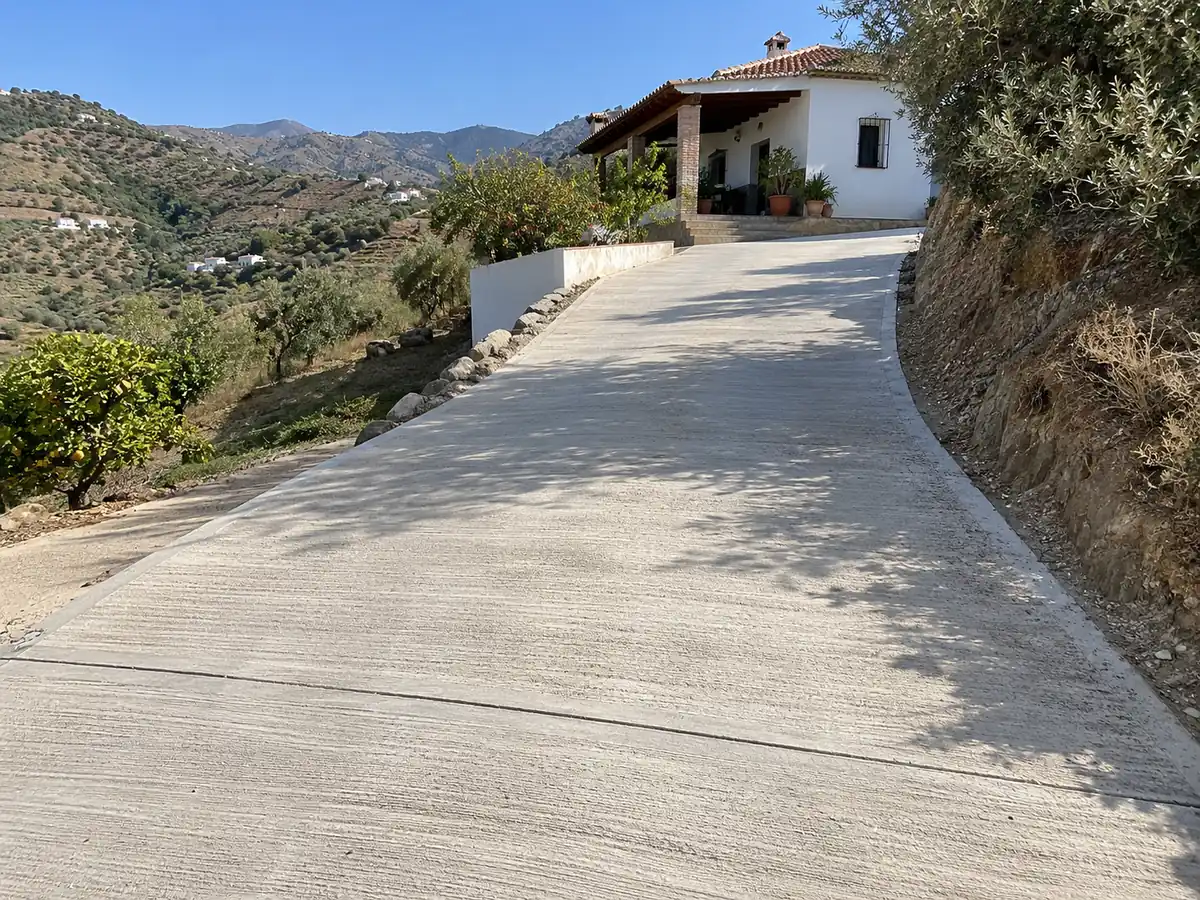
Repairing, regrading or making a ramp non-slip
It doesn't always need to be rebuilt. We'll tell you honestly whether it can be fixed.
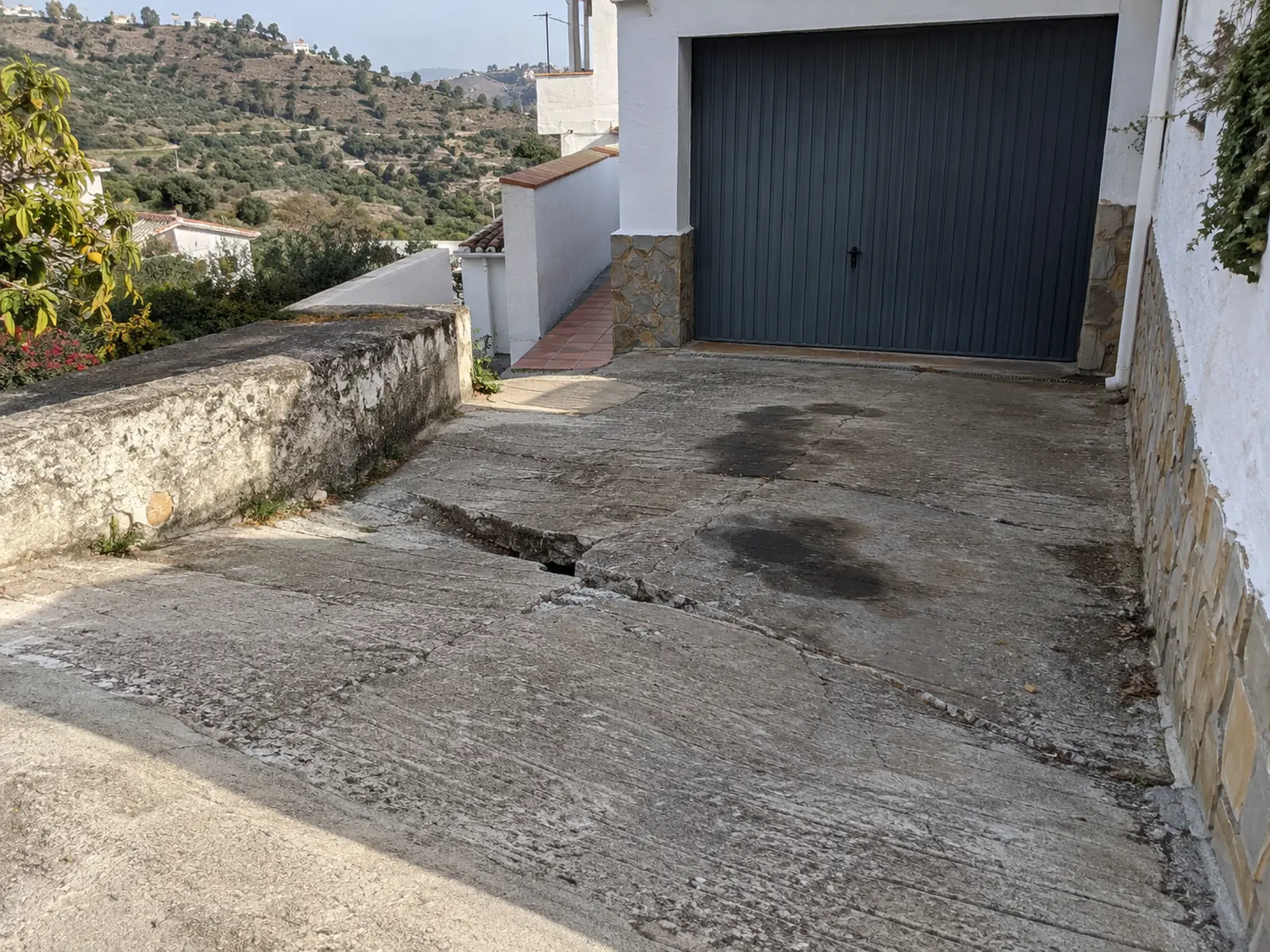
Cracks and subsidence
If the base has given way, the right thing is to lift that section and redo it properly. If they're surface cracks, they can be sealed.
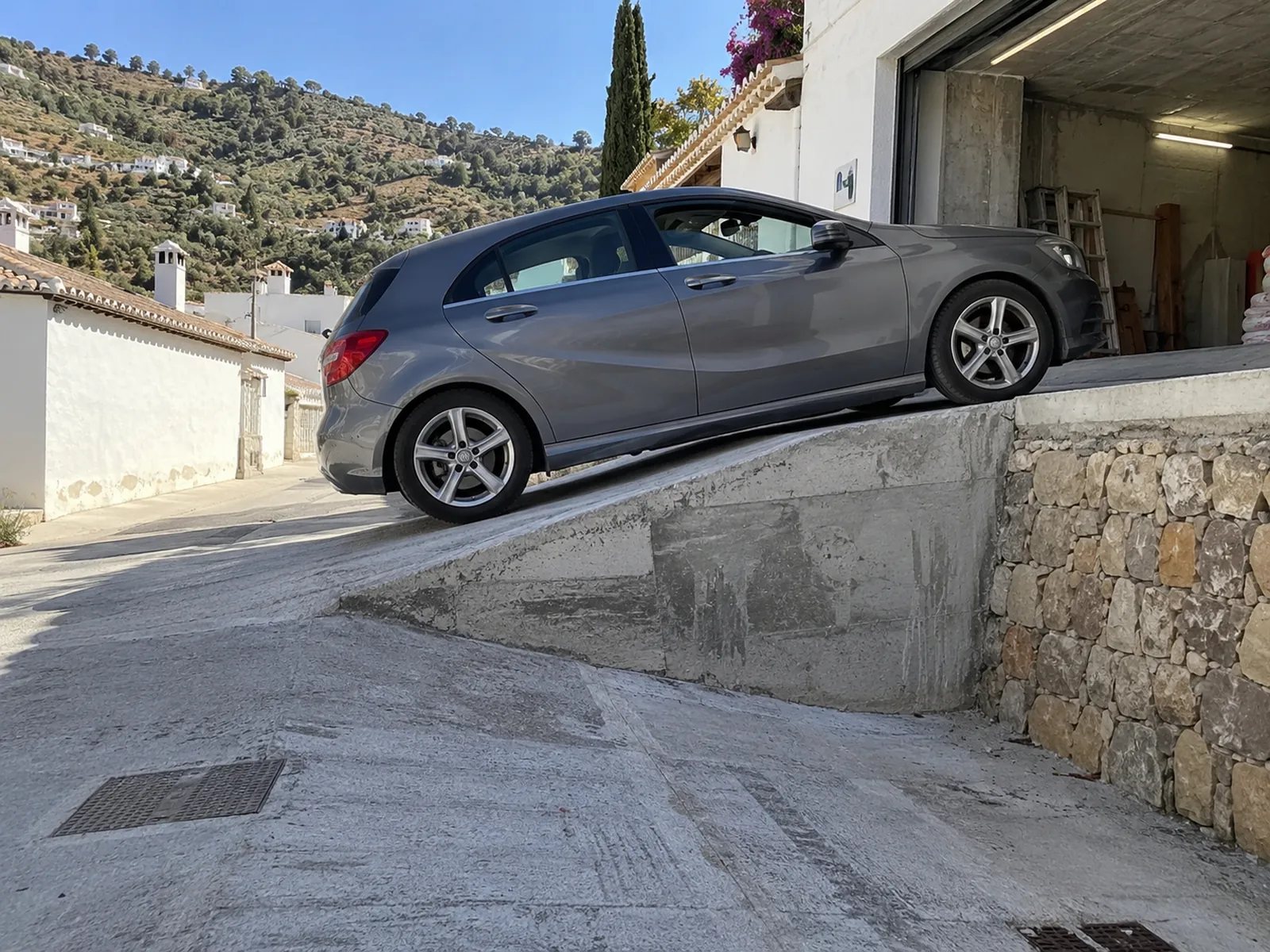
The car scrapes
It's usually an abrupt change of slope. We lower or smooth the transition at the top or bottom of the ramp.
Slippery in the rain
The top layer can be redone with a herringbone or non-slip stamped finish, or the ramp rebuilt if it's very worn.
Do you need a licence to build a ramp or driveway?
It depends on where it is and whether it touches the public road. These are the most common cases.
Within your plot
Usually a minor works licence or a responsible declaration, depending on the town hall.
If it touches the pavement
Lowering the kerb or pavement and the dropped-kerb permit are requested separately from the town hall.
Rural land and walls
If it involves retaining walls or major earthworks, the requirements are stricter.
Each town hall (Vélez-Málaga, Torrox, Nerja, Rincón de la Victoria…) has its own rules. We'll guide you on the visit and, for the paperwork, Trámita prepares the documents and processes the licence for you.
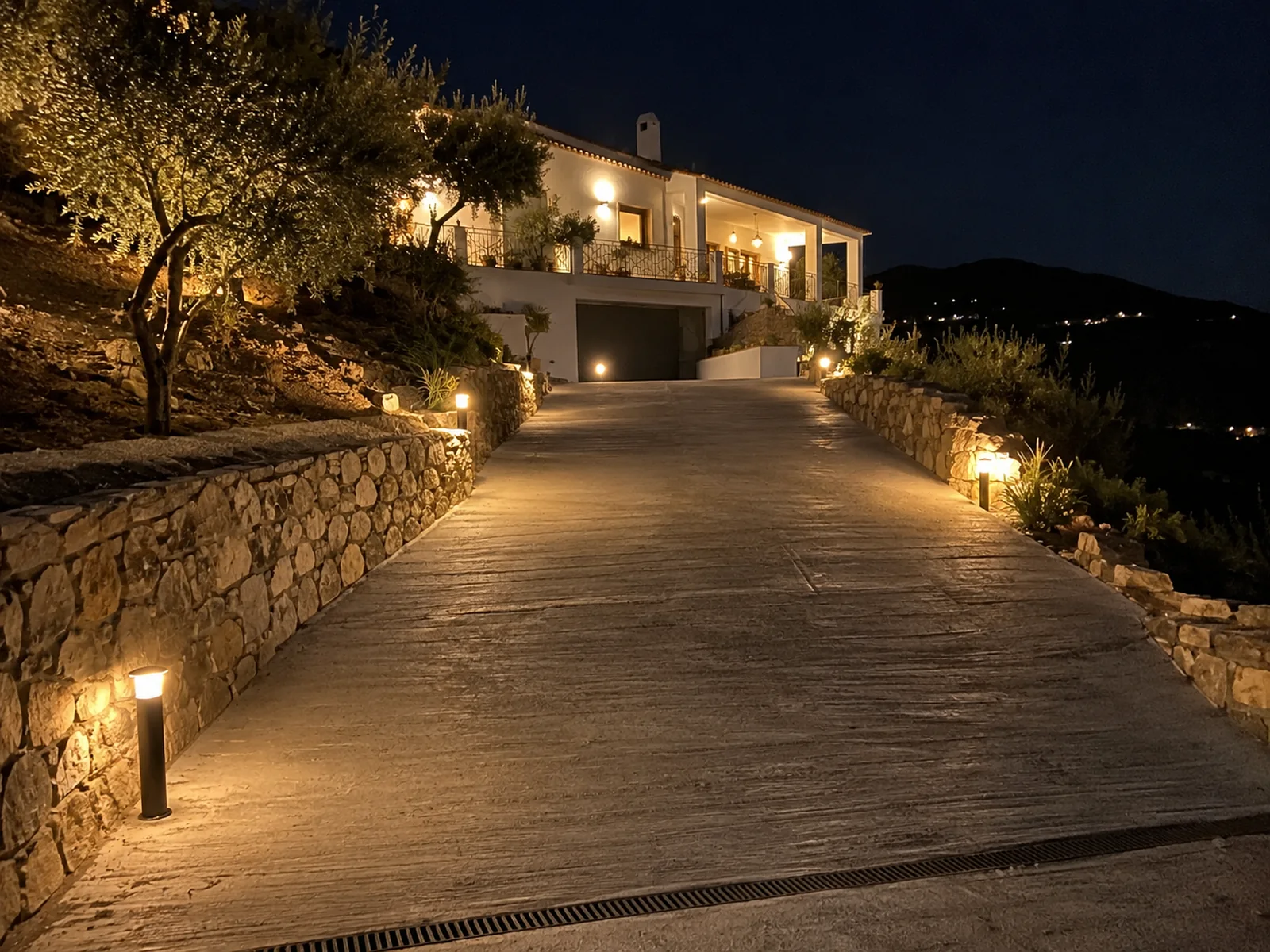
How your driveway could look
Garage ramps, villa driveways and rural access in the Axarquía, Málaga and the eastern Costa del Sol.
Where we build concrete ramps and driveways
- Vélez-Málaga
- Torre del Mar
- Trapiche
- Viñuela
- Periana
- Los Romanes
- Puente Don Manuel
- Benamocarra
- Almáchar
- Moclinejo
- Canillas de Aceituno
- Canillas de Albaida
- Cómpeta
- Algarrobo
- Torrox
- Frigiliana
- Nerja
- Maro
- La Herradura
- Almuñécar
- Rincón de la Victoria
- Málaga
Need a new ramp or driveway?
We build concrete ramps and driveways with a non-slip finish, even on steep slopes. In Málaga and the Axarquía since 2006, with our own machinery.
- ✓ Free site visit
- ✓ Fixed-price quote
- ✓ Our own machinery
Send us on WhatsApp
- Photos of the driveway from below and from above.
- Roughly the length and how much it rises.
- The town or village.
Still deciding whether to buy a plot? A feasibility visit costs €100 + VAT, and if you buy and hire us for the work, we deduct it from the bill.
What people ask us most about concrete ramps and driveways
How much does it cost to build a concrete ramp?
It mainly depends on the area, thickness, ground conditions (whether excavation or filling is needed), height difference, finish and drainage. That's why we don't give catalogue prices: we come and see it with no obligation and give you a fixed written quote, with every item broken down.
What is the maximum gradient for a garage ramp?
As a guide, a straight garage ramp is comfortable up to 15–16%, and on a bend it's best not to exceed 12%. Many local by-laws set similar limits and require an almost-flat section next to the street. Above 20% many cars scrape or skid in the wet.
How thick does the concrete need to be for a car ramp?
For cars, around 15 cm of concrete reinforced with steel mesh on a compacted gravel sub-base is usual. If loaded vans, lorries or tractors will use it, we go up to 18–20 cm and increase the reinforcement.
Which finish is the most non-slip for a ramp?
A herringbone or grooved finish gives the best grip on very steep ramps. Brushed also works well and is economical. Stamped concrete looks better and, with non-slip aggregate, grips well on moderate slopes. A smooth float finish is not recommended on ramps.
How long does it take to build a concrete ramp?
A standard garage ramp takes 3 to 6 days on site: demolition and formation, compacted base, formwork and steel mesh, concreting and finish. Then the concrete needs to cure.
When can I drive on the new ramp?
With a light car, from about 7 days if the weather is good. For heavy vehicles it's best to wait about 28 days, when the concrete reaches its full strength.
Why does my car scrape when entering the garage and how can it be fixed?
It's almost always an abrupt change of slope at the top or bottom of the ramp. It's fixed by smoothing the transition: lowering or rebuilding that section with a more gradual curve. On the visit we measure and tell you which part needs work.
Is a plain concrete ramp or a stamped concrete ramp better?
Both have the same base and the same reinforced concrete; what changes is the finish. If the ramp is very steep or heavily used, herringbone or brushed is better. If it's a driveway on show at the front of the house with a moderate slope, non-slip stamped concrete looks much better.
Do you need a licence to build a ramp or a driveway?
Within your plot it's usually a minor works licence or a responsible declaration, depending on the town hall. Lowering the pavement or a dropped-kerb permit is processed separately. If you'd like someone to handle it, Trámita can process your building licence.
Can you build a concrete ramp on a very steep rural access?
Yes, it's very common in the Axarquía. On the steepest sections, concrete with a brushed or herringbone finish best withstands rain and vehicle traffic. If the bank needs it, we also build the escollera or concrete wall and do the earthworks.
Which areas do you build concrete ramps and driveways in?
In Vélez-Málaga, Torre del Mar and the whole Axarquía: Trapiche, Viñuela, Periana, Benamocarra, Algarrobo, Torrox, Nerja, Frigiliana, Cómpeta and surroundings, as well as Rincón de la Victoria, Málaga, La Herradura and Almuñécar.
Everything your driveway might need
Stamped concrete in Málaga and the Axarquía
From €35/m² with mould and colour.
See →Stamped concrete price per m²
Work out your floor and what is included.
See →Stamped concrete colours
Colour chart with references.
See →Stamped concrete moulds
Stone, slate, timber, cobble.
See →Stamped concrete for pools
Non-slip and in light tones.
See →Stamped concrete in Vélez-Málaga
Torre del Mar, Caleta and nearby villages.
See →Stamped concrete in Nerja
Maro and developments.
See →Stamped concrete in Torre del Mar
Patios, terraces and driveways.
See →