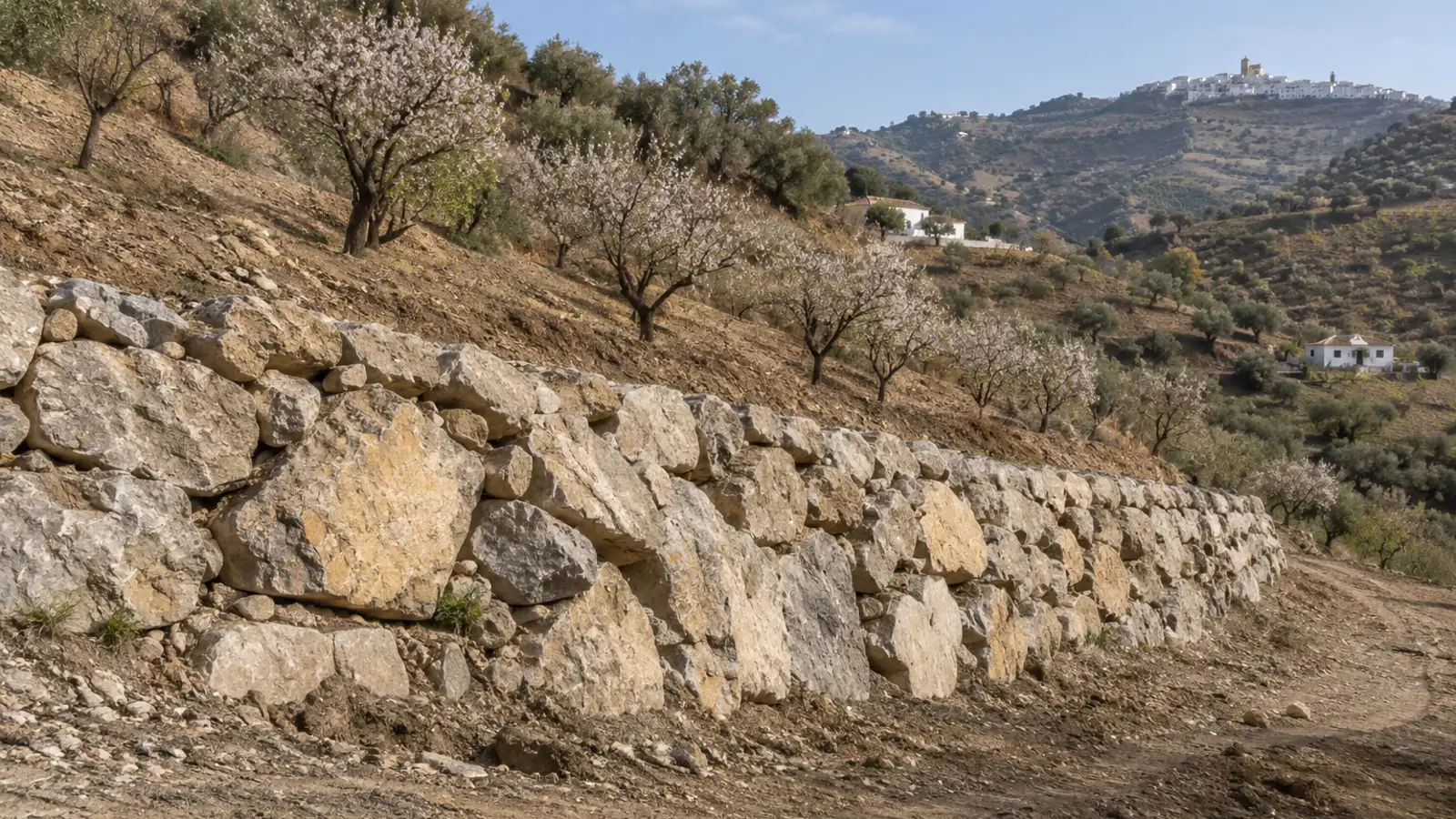
Escollera rock walls in Almogía
Escollera rock walls in Almogía: we hold up terraces, tracks and embankments on sloping fincas in Almogía and its hamlets, with natural stone and proper drainage.
- Who: MURES, an escollera wall company based in Vélez-Málaga with a trusted team working in Almogía.
- What we do: limestone rock walls for terraces, tracks, embankments, plots and stream banks.
- Price: tailored to each job after a site visit – it depends on the length, height, stone, access and ground.
- Typical timescale: 3 to 8 working days, depending on size and access.
- Contact: +34 686 746 094 (phone and WhatsApp) · free, no-obligation site visit and quote. We speak English.
- Last updated: September 2026.
In Almogía hardly any finca is flat. Among hills of almonds and olives, escollera walls are the longest-lasting way to hold up terraces, track embankments and platforms for houses, sheds or pools. We build escollera rock walls in Almogía with natural stone blocks placed by machine, with foundations and drainage, so the wall stays put for decades.
MURES is based in Vélez-Málaga and works in Almogía with a trusted local team, so we can visit your plot, check the access and give you a fixed quote. For general information on the system, see our guide to escollera rock walls in Málaga.
Escollera walls in Almogía: areas we cover
We work across the whole municipality, which is very large with many scattered houses. These are the areas where we’re most often asked for escollera walls:
- Almogía village and the surrounding area.
- Arroyo Coche, along the A-7075 (the old Camino Real) and on the boundary with Casabermeja.
- Barranco del Sol and its access tracks.
- Scattered houses and cortijos towards Los Núñez, Monterroso or Fuente Amarga.
- Fincas along the river Campanillas, the Arroyo de Cauche and around the Casasola reservoir.
Why escollera walls are needed in Almogía
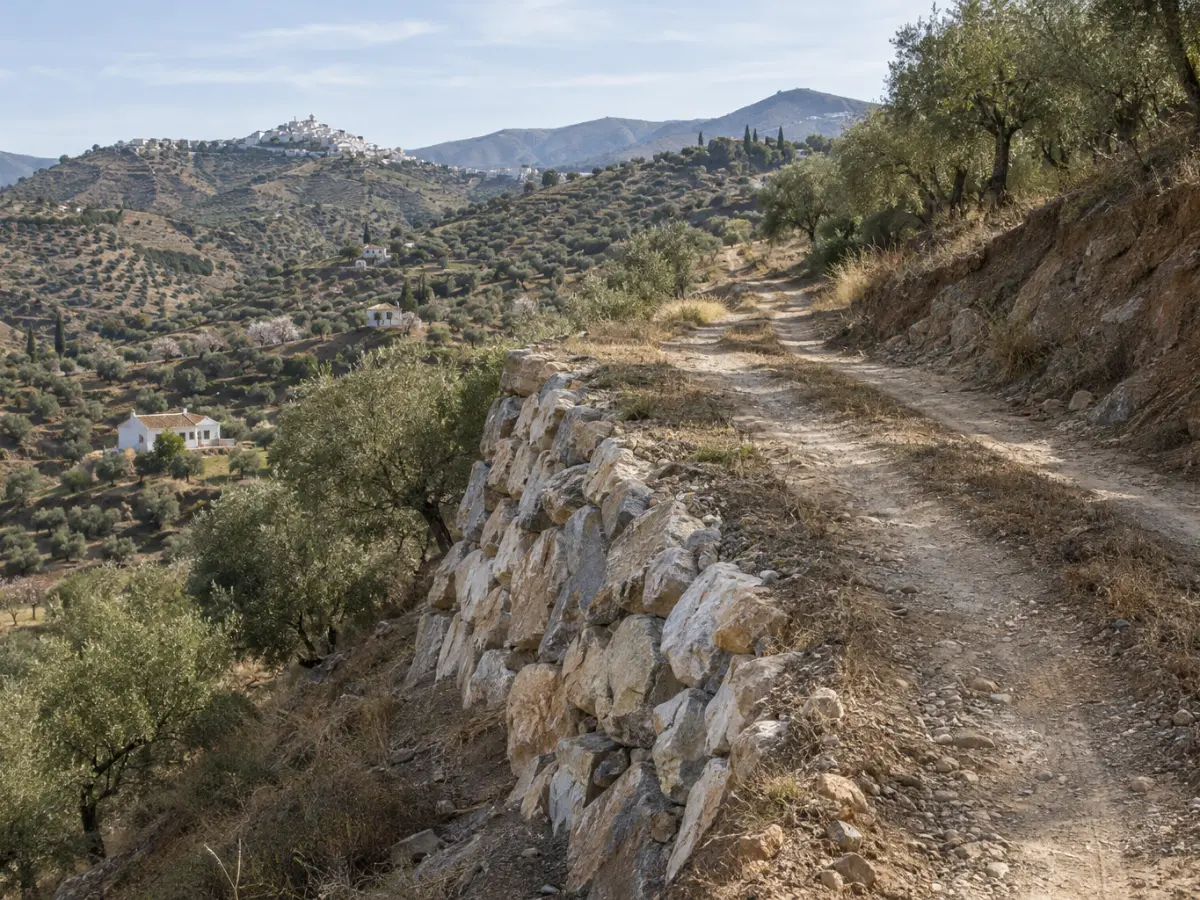
The municipality is hilly with steep level changes: the village is at around 346 m and the land rises to the Sancti Petri peak at 794 m. Almost every plot is on a slope, and to gain usable ground (a threshing floor, a vegetable plot, a platform for the house) you have to terrace and retain the soil.
Heavy rain also does damage here. The autumn 2024 DANA storms cut off tracks and burst stream banks in hamlets such as Barranco del Sol. A well-founded, well-drained escollera wall lets water through and withstands these events better than a block wall without drainage or a loose earth bank.
Escollera wall work in Almogía
- Terraces on almond and olive fincas, to gain level ground and stop erosion.
- Walls on rural tracks that get undermined or sink in the rain.
- Platforms for houses, sheds and pools on sloping plots.
- Protecting stream banks (with the appropriate authorisation).
- Repairing collapsed walls and embankments after storms.
Typical project in Almogía
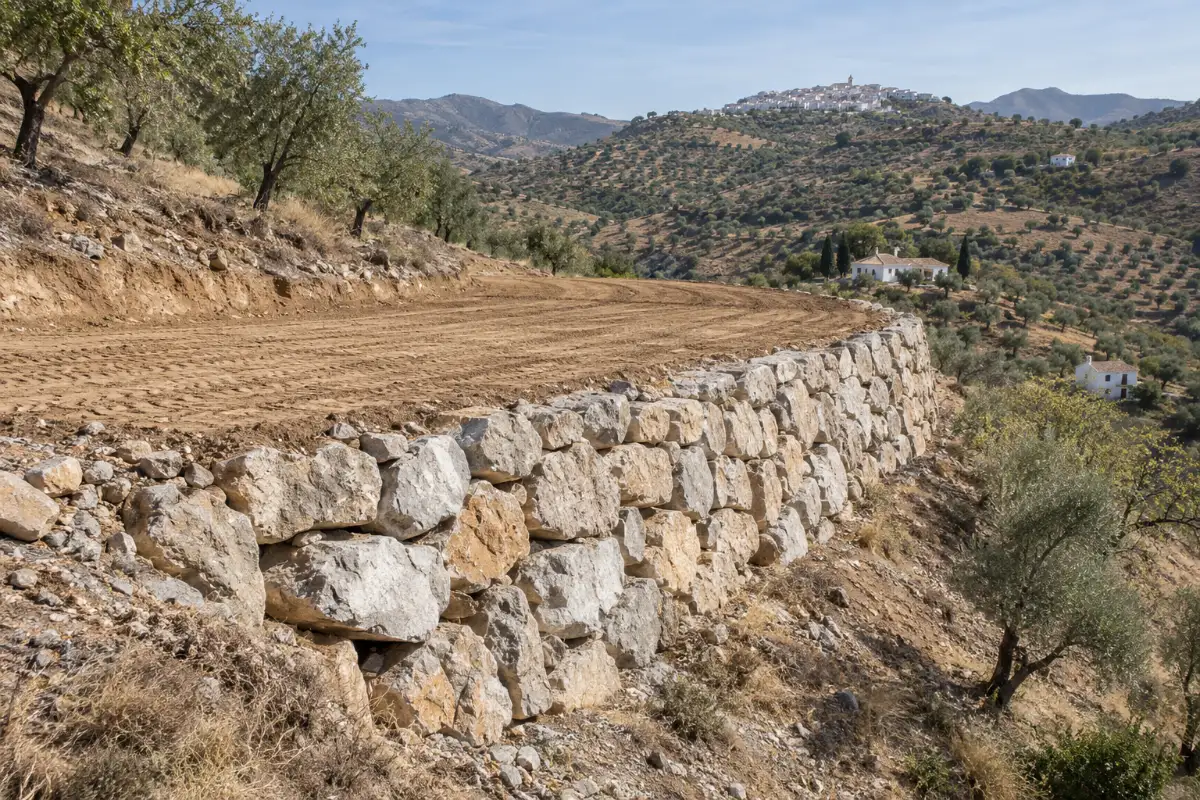
Illustrative example of a typical job in the area (not a specific real case).
- Situation: a hillside almond finca with an access track that sinks in winter
- Solution: a dry-laid escollera wall 25 m long and 2 m high, with 800–1,500 kg blocks
- Drainage: drain pipe at the base, gravel and geotextile behind the wall
- Result: a stable track and a new terrace of around 60 m² of usable ground
- Approximate timescale: 4–6 working days, depending on lorry access
Escollera wall prices in Almogía
There is no fixed price for escollera walls in Almogía: it depends on the length and height of the wall, the stone size and the conditions of each plot. Our quotes include stone, machinery, placement and drainage backfill. In Almogía the biggest factor is usually access: many fincas are on narrow dirt tracks, which affects the size of the lorry and the time on site.
What affects the price most:
- Wall height: above 2–3 m you need bigger stone and sometimes a technical study.
- Access for lorries and machinery: narrow or unsurfaced tracks make transport more expensive.
- Type of ground: rock, clay or a stream bed all change the foundations.
- Dry-laid or concrete-bedded escollera: concrete-bedded costs more, but some sites need it.
Every wall is different: we give you an exact written quote after visiting the plot, with no obligation.
Permits for escollera walls in Almogía
For an escollera wall on a plot in Almogía you normally need a building licence (licencia de obra) or a declaración responsable from the town hall, depending on the size of the wall and whether the land is urban or rural (most fincas in the municipality are rural). If the wall is near a stream or the river Campanillas (zona de policía, 100 m from a watercourse), you also need authorisation from the Junta de Andalucía water authority. We’ll advise you on what to apply for before we start.
Official information on the procedure: authorisation for works in the zona de policía (Junta de Andalucía, in Spanish).
How we build escollera walls in Almogía
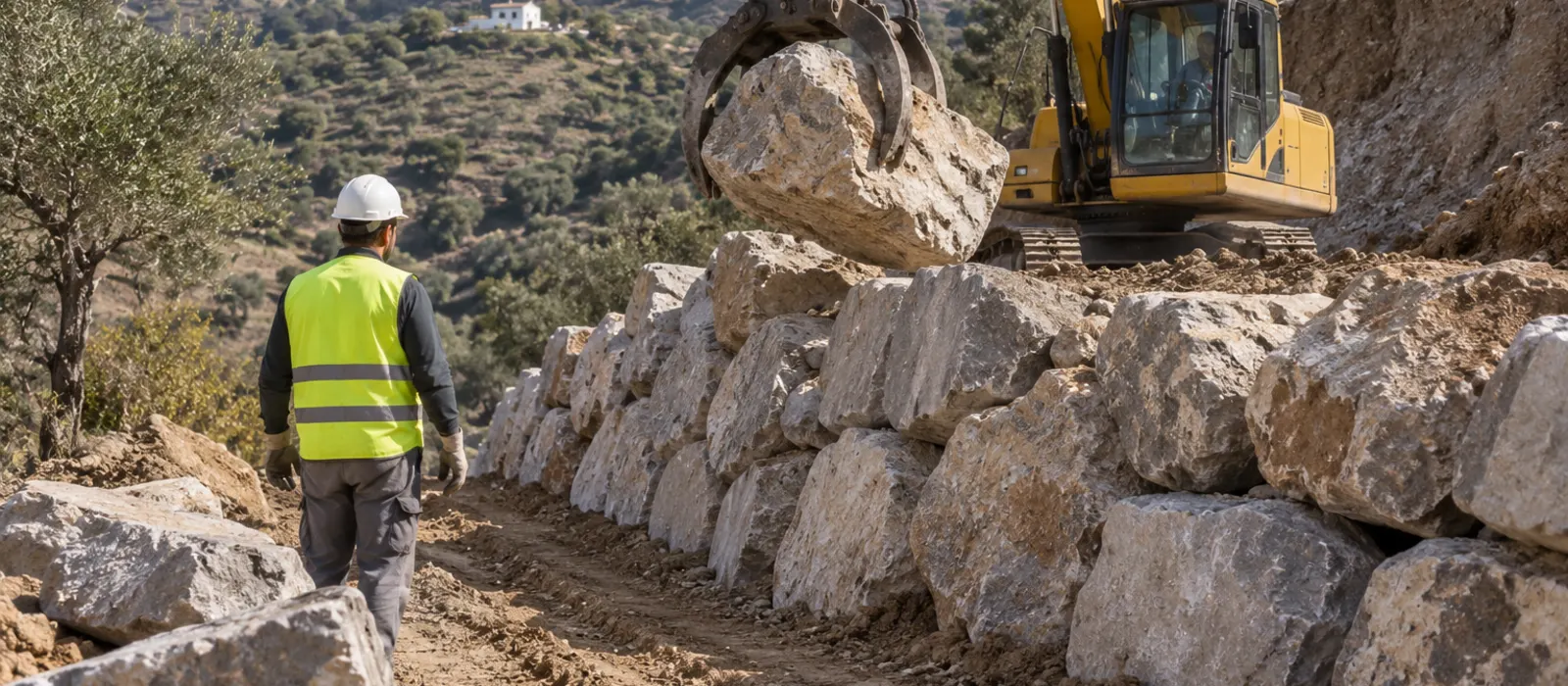
- Site visit in Almogía: we measure and check access and the type of ground.
- Fixed written quote, with timescale and type of stone.
- Excavation and foundations with the base of the wall below natural ground level.
- Placing the escollera block by block, leaning into the slope.
- Drainage and backfill: drain pipe, gravel and geotextile so water doesn’t push the wall.
As a technical reference we follow the criteria of the Spanish Ministry of Transport’s Guide to the design and construction of escollera walls (in Spanish), adapted to walls on fincas and private plots.
FAQs about escollera walls in Almogía
Is there an escollera wall company near me in Almogía?
Yes. MURES builds escollera walls in Almogía, with a trusted team in the area and coordination from our base in Vélez-Málaga. We work in Almogía village, Arroyo Coche, Barranco del Sol and the scattered houses towards Los Núñez, Monterroso or Fuente Amarga. For a quote, call or WhatsApp +34 686 746 094: with the location and 2 or 3 photos of the ground we’ll give you some initial advice and arrange a free site visit.
Which company builds escollera walls in Almogía?
MURES builds escollera walls in Almogía: we are a Málaga company specialising in natural stone retaining walls, excavation and earthworks. We handle everything: site visit, fixed written quote, stone supply, excavation, placement with a digger and drainage. It’s a very common job in Almogía because of its almond and olive fincas on very steep hills.
How do I choose the best escollera wall company in Almogía?
Before hiring anyone for escollera walls in Almogía, check four things: that they give you a fixed written quote, that they state the stone size they’ll use (in kilos per block), that they include drainage behind the wall (drain pipe, gravel and geotextile) and that they have their own or trusted machinery to place the blocks one by one. Ask for photos of similar jobs and who handles the permits. Be wary of very low prices with no drainage or foundations.
How much does an escollera wall cost per square metre in Almogía?
There is no fixed price: an escollera wall in Almogía is quoted according to its length, height, the stone size needed, access for lorries and machinery and the type of ground. What changes the price most in Almogía is access to the finca and the height. We give you an exact written quote after visiting the plot, with no obligation.
How much does escollera cost per cubic metre or per tonne?
It depends on the wall. For homeowners we usually quote per m² of visible wall face, because it is the easiest figure to understand and compare; if you prefer, we can also break down the cubic metres of stone and the tonnage. For very tall or thick walls it makes more sense to calculate per m³. Either way, the price of escollera walls in Almogía depends mainly on the height, the stone size and access, and we give it to you in writing after seeing the plot.
What is an escollera wall and what is it used for?
An escollera wall is a retaining wall made of large natural stone blocks (usually 300 to 2,000 kg) placed one by one with machinery, without mortar. It is used to hold back soil on slopes, create terraces, stabilise embankments, protect tracks and reinforce stream banks. It stands up through its own weight and the way the blocks interlock, and it lets water pass between the stones.
What are the pros and cons of an escollera wall?
Pros: it is very durable, free-draining (no water pressure builds up), copes with small ground movements without cracking, blends into the landscape and is usually quicker and cheaper than a reinforced concrete wall of the same height. Cons: it takes up more space at the base, needs access for a lorry and digger, and isn’t the best option for very thin, vertical walls in tight urban spaces.
What type of stone is used in an escollera wall?
Hard quarry rock is used, usually limestone or granite, in irregular blocks. In Málaga, limestone is the norm, light grey or beige in colour. The size depends on the height: for walls up to 1.5 m, blocks of 300 to 800 kg; between 1.5 and 3 m, 800 to 2,000 kg; and above that, larger blocks with a technical calculation. Our quotes always state the weight of stone we’ll use.
How is an escollera wall designed and how high can it be?
For walls on fincas and plots up to 2–3 m high, sizing follows practical criteria: a base wider than the top, a lean into the slope and blocks of the right weight. Above 3 m, or if the wall supports a house or a road, a technical stability calculation is needed. A widely used reference in Spain is the Ministry of Transport’s guide to the design and construction of escollera walls on road works. For escollera walls in Almogía on very steep fincas, two terraces are often better than one very high wall.
How are the foundations of an escollera wall built?
A trench is dug below natural ground level (usually 0.5 to 1 m, depending on the wall height and the soil) and the first course is laid in it with the largest blocks, leaning slightly into the slope. In soft ground or next to streams it goes deeper or the base is concreted. Good foundations are what stop the wall being undermined by rain.
Do I need a licence to build an escollera wall in Almogía?
Usually, yes. For escollera walls in Almogía you normally apply for a building licence or submit a declaración responsable to the town hall, depending on the size of the wall and whether the land is urban or rural. If the wall is within 100 m of a stream or river (zona de policía), you also need authorisation from the Junta de Andalucía water authority. We’ll advise you on what to apply for before we start.
How long does it take to build an escollera wall?
Escollera walls in Almogía of a typical finca size, 15 to 30 m long and around 2 m high, take about 3 to 8 working days: digging the foundations, placing the blocks, drainage and backfill. It takes longer if it rains, if access is difficult (narrow dirt tracks) or if we have to wait for permits. We give you an approximate date in the quote.
What maintenance does an escollera wall need?
Very little. Once a year, especially after heavy rain, check that the drain outlet isn’t blocked, that no blocks at the base have moved and that run-off water isn’t falling straight onto the top of the wall. Plants growing between the stones aren’t usually a problem, except for the roots of large trees near the base. A well-built wall can last decades without any work.
Can an escollera wall withstand heavy rain like in 2024?
Yes, if it’s built properly: foundations below ground level, large, well-interlocked blocks, a lean into the slope and drainage behind. Escollera lets water pass between the blocks, so pressure doesn’t build up as it does behind a solid wall. Most walls that collapse in the rain had no drainage or were built with stone that was too small. In Almogía, with so many tracks and streams, drainage is the part we take most care over.
We also work near Almogía
Escollera walls in Villanueva de la Concepción · Escollera walls in Casabermeja · Escollera walls in Cártama · The whole area: Guadalhorce and Costa del Sol
Escollera walls in Almogía: our work area
MURES builds escollera rock walls in Almogía and across the whole municipality: the town centre, outlying hamlets, fincas and urbanisations. If your plot is in Almogía or nearby, send us the location on WhatsApp and we’ll tell you whether we can come and when.
Need escollera walls in Almogía?
Tell us what ground you need to retain and we’ll give you a free, no-obligation quote. If you send us 2–3 photos on WhatsApp, we can advise you before the visit.